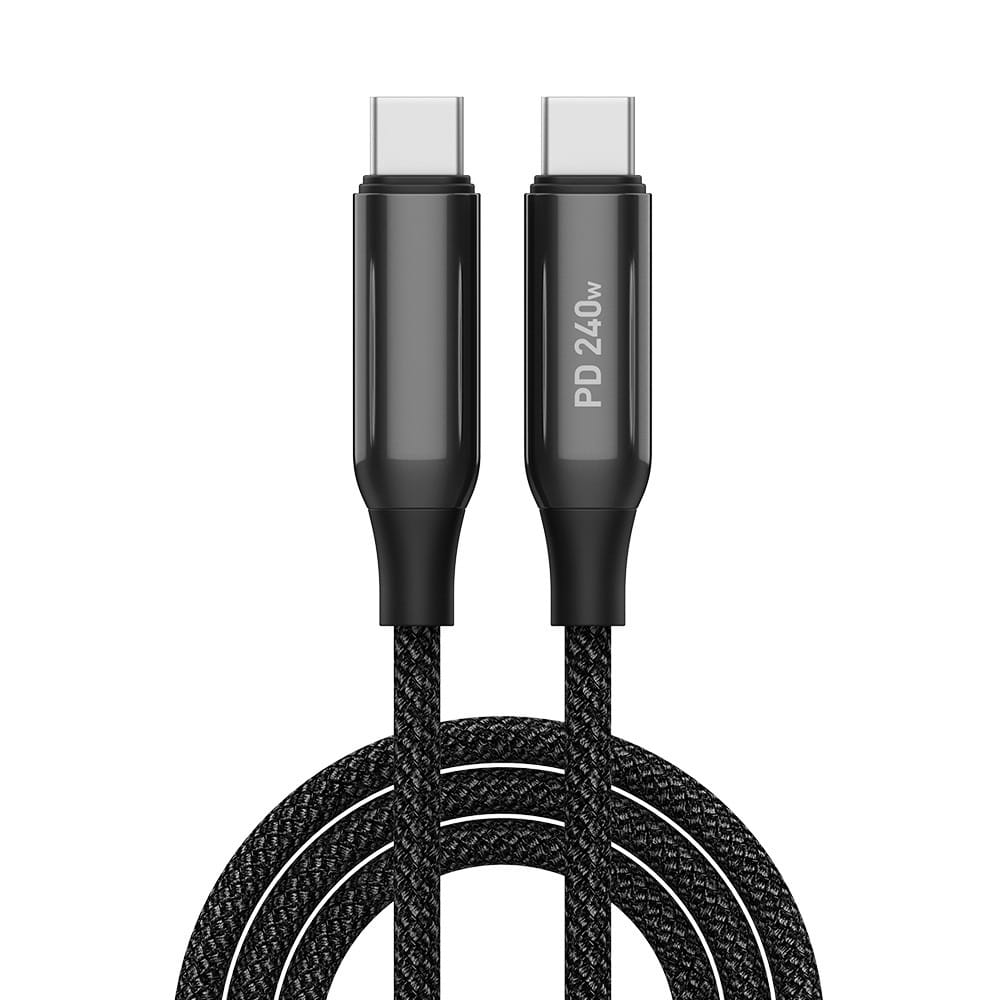
USB-C PD Charging Cable 240 W PD 3.1 EPR, Braided, 1 / 2 / 3 m
A usb-c pd charging cable built for the 240 W PD 3.1 extended power range: the marker chip in the plug reports the cable rating so the charger will offer the 48 V profile. Braided nylon jacket, 480 Mbps sync, 1 m, 2 m and 3 m.
Last updated: 13 September 2026
Overview
240 W is not a bigger version of 100 W — it is a different negotiation. A USB-C PD charging
cable built for the extended power range has to do more than carry current: it has to identify
itself to the charger, so the charger knows the cable is rated for the higher voltage before it applies
it. That identification is the job of the marker chip in the plug, and it is the reason a cable rated
for 60 W or 100 W will not pass 240 W even on a 240 W charger. This build is rated to the 48 V / 5 A
operating point of USB Power Delivery 3.1, with a braided jacket and molded strain relief.
Key Specifications
| Connector A | USB-C plug, reversible |
|---|---|
| Connector B | USB-C plug, reversible |
| Power rating | Up to 240 W at the 48 V / 5 A PD 3.1 EPR operating point |
| Specification | USB Power Delivery 3.1 with extended power range |
| Data rate | USB 2.0 up to 480 Mbps |
| Video | Not supported |
| Jacket | Braided nylon with molded strain relief |
| Lengths | 1 m / 2 m / 3 m |
| Accessory | Silicone cable tie |
The voltage ladder, and where 240 W sits
USB Power Delivery 3.1 keeps the current at 5 A, which is what the connector is built for, and raises
the voltage to gain power. The standard power range is the 5 V, 9 V, 15 V and 20 V set inherited from
PD 2.0 and 3.0, topping out at 100 W. The extended power range adds three fixed levels above it.
| Range | Voltage | Current | Power | Typical load |
|---|---|---|---|---|
| SPR | 5 V | Up to 5 A | Up to 25 W | Phones, small peripherals |
| SPR | 9 V | Up to 5 A | Up to 45 W | Phones, tablets |
| SPR | 15 V | Up to 5 A | Up to 75 W | Tablets, thin laptops |
| SPR | 20 V | Up to 5 A | Up to 100 W | Most laptops, docks |
| EPR | 28 V | Up to 5 A | Up to 140 W | 16-inch performance laptops |
| EPR | 36 V | Up to 5 A | Up to 180 W | High-end mobile workstations |
| EPR | 48 V | Up to 5 A | Up to 240 W | Top-tier workstations, docks, displays |
What the E-Marker actually does
A marker chip is a small device inside the plug that answers when the charger asks what the cable is.
It reports the current capability of the cable, its voltage rating, and whether it supports the extended
power range. Every cable rated above 3 A carries one. It is not a marketing extra — it is the mechanism
that stops a charger applying 48 V to a cable whose insulation was only ever rated for 20 V.
| What the chip reports | What the charger does with it |
|---|---|
| Current capability, 3 A or 5 A | Limits the current it will allow through the cable |
| Voltage rating of the cable assembly | Caps the profile it will offer — a 20 V cable never sees 48 V |
| EPR support, yes or no | Withholds the 28 V, 36 V and 48 V profiles if the answer is no |
| Cable identity and vendor | Used for logging and for fault finding on some hosts |
The three-way handshake
Extended power range only appears when three parties agree. The USB-C source advertises an EPR profile. The cable, through its marker
chip, confirms it can carry it. The sink explicitly requests entry into EPR mode — a charger never
forces the higher voltage onto a device that has not asked. If any one of the three is missing, the pair
settles at a lower operating point and charging still works, just more slowly. That graceful fallback is
by design, and it is why a mismatch presents as a slow charge rather than as a failure.
Once in EPR mode the sink has to keep sending a keep-alive signal, and if the source stops hearing
it the bus drops back to a safe level within a short window. That is the safety mechanism that makes 48 V
at 5 A acceptable on a connector designed for a laptop bag.
Why the cable matters more than the charger
A 240 W charger with a 100 W cable in the drawer delivers 100 W, and the charger is not faulty. This
is the most common cause of “the charger does not work” reports in fleet rollouts, and the fix is to
specify the cable as part of the SKU rather than leaving it to whoever is doing the install. Buy it with
the charger and keep the two bagged together, and print the rating on the jacket or the plug body so a
240 W cable is identifiable at a glance on a cart or a bench.
Data, and what this cable does not do
Data runs at USB 2.0 speeds, up to 480 Mbps, which covers charging, sync and file transfer. There is
no video output on this build — it will not drive a monitor. If your device needs high-speed data or
display output on the same lead, say so at the enquiry stage, because that is a different construction.
Build and strain relief
The jacket is braided nylon over the inner cores. It resists abrasion from being coiled into a bag or
dragged across a desk edge, and it does not hold a kink the way a smooth jacket does. The plug bodies
are molded with an extended strain relief, since the joint at the plug is where these cables actually
fail rather than the middle of the run. A silicone tie is supplied for storage.
- Braided nylon jacket in black, with other colors on request
- Molded strain relief at both plug bodies
- USB-C plug on both ends, reversible orientation
- 1 m, 2 m and 3 m lengths; silicone cable tie included
Choosing a length
One meter suits a desk charger or a power bank, two meters suits a sofa or a bedside run, and three
meters suits a socket that is not near the desk. Longer buys reach, not speed.
Typical applications for this USB-C PD charging cable
- Fleet and hot-desk charging where one cable type has to cover every laptop in the building
- Carts and docks running high-power workstations, alongside our USB-C power display cable for bench verification
- Kiosk and point-of-sale builds, with the POS USB-C PD cable for fixed terminal runs
- Field kits where a single charger and cable have to serve a laptop, a radio and a camera
- Panel and fixture builds using a dual port USB panel fed from this lead
Workmanship and testing
The line works to IPC/WHMA-A-620 Class 3 under ISO 9001, terminating 32 to 12 AWG. Every unit gets a continuity and pinout test before it is packed. Seal checking on the production batch is available when an ingress rating is in the specification.
Related USB-C assemblies
- 240 W Magnetic USB-C Charging Cable with Interchangeable Tips
- USB-C Power Display Cable 240 W PD 3.1 with Digital W/V/A Readout
- USB-C Gen2 Data Cable, 10 Gbps, with 100 W Power Delivery
- USB-C PD Trigger Cable to DC 5.5×2.1mm
- Dual Port USB Panel Mount with USB-C 100 W and USB 3.0 A
Full range: DC Plug Power Cable.
Frequently Asked Questions
Why does my 240 W charger only deliver 100 W?
Almost always the cable. Extended power range needs a cable whose marker chip reports EPR capability. A 100 W cable is not downrated by fault — it is doing exactly what it was built to do.
Is 240 W safe on a small device?
Yes. Power is requested by the device, not pushed by the charger. A phone connected to a 240 W charger draws what it asks for.
Does it carry video?
No. This build has no video output and will not drive a monitor.
Which length should I buy?
1 m for a desk or power bank, 2 m for a sofa or bedside run, 3 m where the socket is further away. Extra length buys reach, not speed.
What is the minimum order?
5 pcs minimum for prototypes, shipping in 3 working days. Production runs of 500 pcs and up ship 14 working days after approval.
| Connector A | USB-C plug, reversible |
|---|---|
| Connector B | USB-C plug, reversible |
| Power rating | Up to 240 W at the 48 V / 5 A PD 3.1 EPR operating point |
| Specification | USB Power Delivery 3.1 with extended power range |
| Data rate | USB 2.0 up to 480 Mbps |
| Video | Not supported |
| Jacket | Braided nylon with molded strain relief |
| Lengths | 1 m / 2 m / 3 m |
| Accessory | Silicone cable tie |