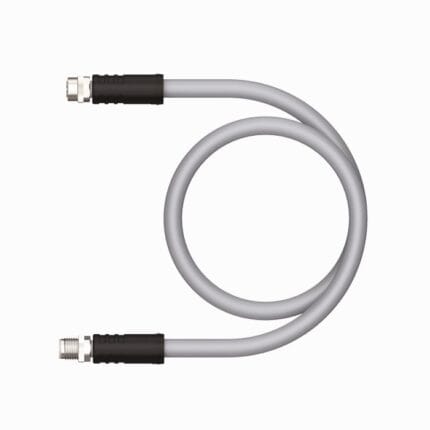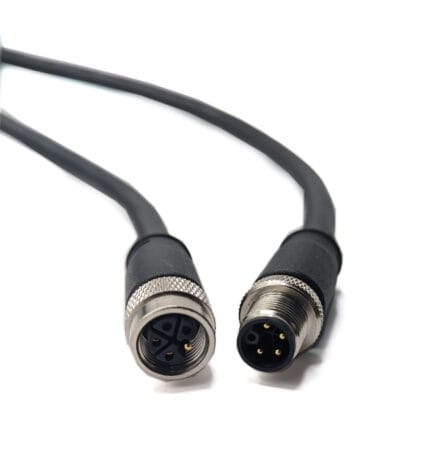
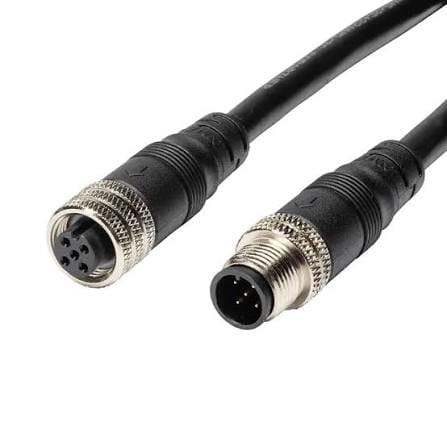
NMEA 2000 Drop Cable, Micro-C M12 5-Pin
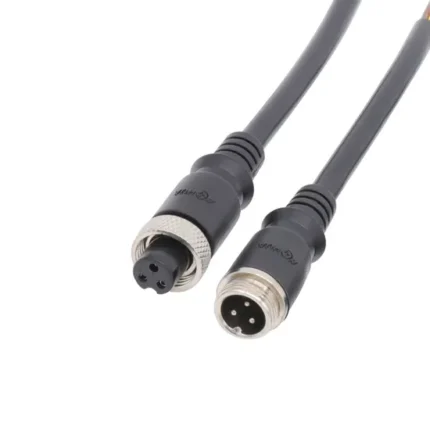
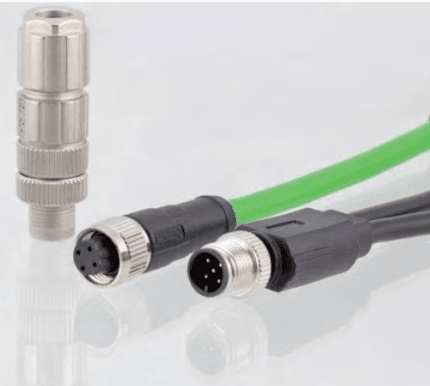
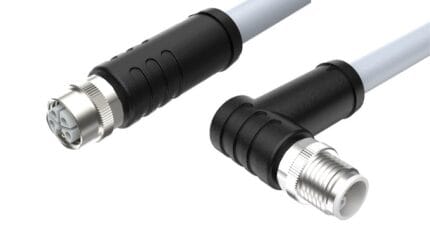
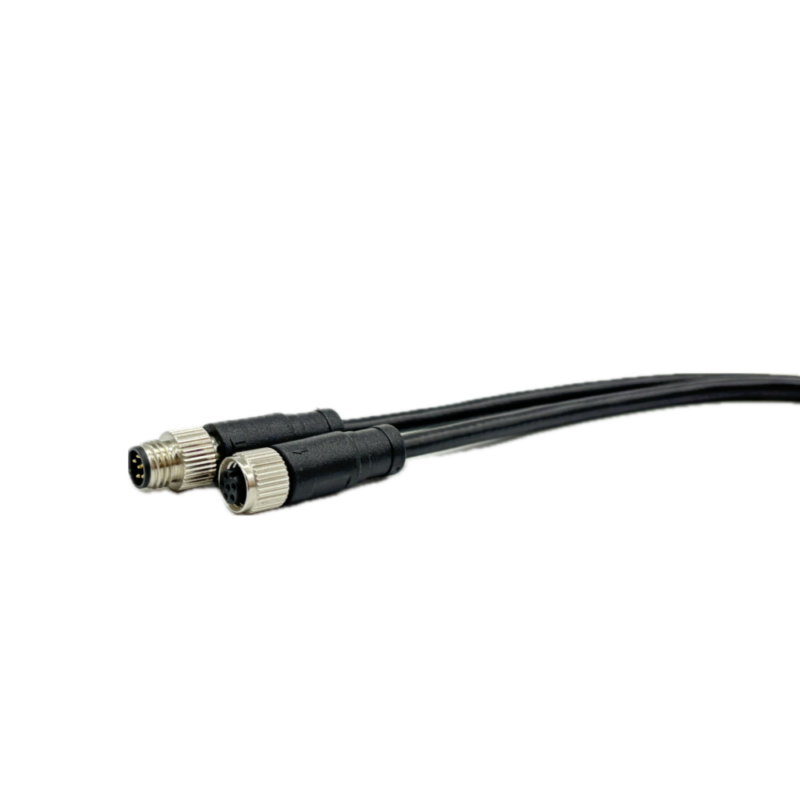
A NMEA 2000 drop cable links a device to the backbone tee, on tinned copper with a Micro-C M12 5-position interface. Built to the drop length your layout allows, because on this bus the stub length is the specification.
Last updated: 13 September 2026
Overview
A marine network lives or dies on its topology, and the NMEA 2000 drop cable is the part installers improvise. It is the short link from the backbone T-connector to a device — a display, a GPS, an engine gateway — and it is length-limited for a reason: every drop is an unterminated stub on a 250 kbit/s bus. Ours is built on the Micro-C M12 5-position interface with tinned conductors, because salt air finds untinned copper quickly.
Key Specifications
| Interface | NMEA 2000 Micro-C, M12 5-position |
|---|---|
| Coding | M12 A-coded, 5-position |
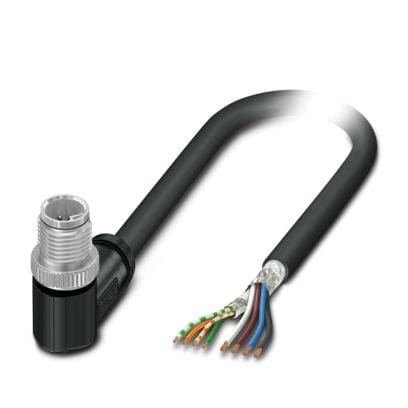
| Ends | Male-female drop, or male plus device lead, to order |
| Pinout | 1 shield, 2 NET-S, 3 NET-C, 4 NET-H, 5 NET-L, or to your drawing |
| Conductors | Tinned copper per NMEA 2000 cabling practice |
| Shield | Drain carried to pin 1 at both ends |
| Jacket | PVC standard; UV-stabilized for exposed runs |
| Length | OEM build to order |
| Network | Drop topologies per NMEA 2000 cabling layout |
Backbone, drop and terminator: where this cable sits
NMEA 2000 is a linear bus, not a star. The backbone runs bow to stern with a 120 ohm terminator at each end, and devices hang off it through tees on short drops. The figures below are the limits commonly applied to a Micro-C network and are quoted here as a design reference; the network you install should be checked against the layout rules from your electronics supplier, and the cable itself is built and verified to the values on your order. The standard itself is IEC 61162-3, and the protocol background sits with NMEA 2000.
| Element | What it is | Commonly applied limit | Note |
|---|---|---|---|
| Backbone | The trunk run between terminators | Micro-C cable in 100 m class per network design | Terminated at both ends with 120 ohm terminators |
| Drop | Device to T-connector | 6 m (20 ft) maximum per device | Where this cable is used |
| Cumulative drop length | All drop cables combined | 78 m (256 ft) maximum | Long drops are the usual cause of a marginal network |
| Device count | Nodes on one network | 50 devices maximum | Includes the power insertion point |
| Supply | Network power | 12 V nominal marine supply | One power insertion point, fused at the source |
Micro-C 5-position pinout
The Micro-C connector carries two power conductors, a differential data pair and a shield on five positions. The signal names below are the industry-standard convention for NMEA 2000 (IEC 61162-3). We build and test to the pinout on your drawing, so if your device vendor numbers the face differently, say so with the order.
| Pin | Conductor | Signal | Function |
|---|---|---|---|
| 1 | Bare or drain | Shield | Cable shield and drain |
| 2 | Red | NET-S | Power supply positive |
| 3 | Black | NET-C | Power supply common |
| 4 | White | NET-H | CAN High |
| 5 | Blue | NET-L | CAN Low |
DeviceNet or NMEA 2000: the same shell, a different network
This is the confusion that costs people a season. NMEA 2000 uses the M12 5-position Micro-C connector that came out of the DeviceNet world, and the two are mechanically intermateable. They are not the same network. A DeviceNet cable plugged into a marine backbone will physically fit, will carry the wrong supply expectation, and will not be built for salt air.
| NMEA 2000 | DeviceNet micro-style | |
|---|---|---|
| Connector | M12 A-coded 5-pin Micro-C | M12 A-coded 5-pin Micro-C |
| Keying | A-coded, same shell | A-coded, same shell — they will physically mate |
| Nominal supply | 12 V DC, 9 to 16 V range | 24 V DC nominal |
| Data rate | 250 kbit/s | 125, 250 or 500 kbit/s |
| Cable practice | Tinned conductors, shielded, marine jacket | Industrial jacket, often untinned |
| Typical environment | Bilge, mast, deck, salt air | Factory floor, cabinet, machine |
Practically: check the jacket and the conductors before you check the shell. Tinned copper and a marine-grade jacket are what you want on a boat. Industrial M12 CAN bus cable is the right product for the factory side of that line, and it is a different build from this one.
Why the 6 m drop limit matters in practice
A drop is an open stub on a bus that is terminated only at the two backbone ends. Reflections from a long stub arrive back at the transceiver inside the bit time and corrupt the edge the receiver is looking for, so the network gets shorter and noisier as the drops get longer. That is why the limit is on individual drop length and on the total drop length separately — a hundred short drops is fine, ten long ones are not. If a device genuinely sits further than 6 m from the backbone, the fix is to move the tee, not to buy a longer drop cable.
Typical applications for this NMEA 2000 drop cable
- Drop links from the backbone to multifunction displays, GPS and instruments
- Device leads supplied with marine electronics and sensors
- Backbone and spur repairs on existing installations
- Refits where the tee has to move and the old drop is too short
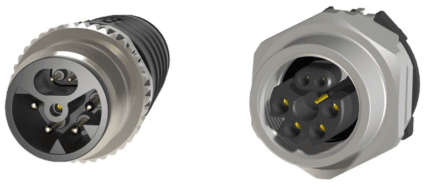
- Panel feedthroughs paired with our NMEA 2000 bulkhead connector
- Deck and mast runs that finish in an IP68 deck feedthrough
How to specify your build
- Ends — male to female drop, male to device lead, or a pigtail.
- Length, measured along the run, and whether 6 m is enough.
- Conductors — tinned copper is the marine default.
- Jacket — standard PVC or UV-stabilized for exposed runs.
- Pinout, if your device vendor deviates from the standard names.
- Environment — below decks, bilge, mast or deck, so we can match the jacket.
- Marking — your part number and length printed on the jacket or the overmold.
- Quantity, and whether this is a one-off refit or a production build.
Workmanship and testing
Every build is assembled and inspected to IPC/WHMA-A-620 Class 3 workmanship under our ISO 9001 system. We terminate conductors from 32 to 12 AWG. Each unit is checked for continuity and pinout before packing, and where the build carries an ingress rating we can add seal checking on the production run.
Custom builds and ordering
Prototype quantity starts at 5 pcs with a 3 working day turnaround, and production starts at MOQ 500 pcs shipping 14 working days after approval. Where a new tool is needed, allow about 10 working days. We ship OEM and ODM builds under your part number and labeling, and can provide material certificates and first-article reports.
Related marine and M12 assemblies
- NMEA 2000 bulkhead connector with Micro-C and OneNet options
- M12 CAN bus cable, 5-pin shielded pair for CANopen and DeviceNet
- M12 A-coded PVC and PUR straight or right-angle extension cable
- M8 and M12 5-pin right-angle PUR sensor cable
- M12 IP68 and IP69K stainless steel washdown cable
- M12 IO-Link cable, master to device drop
Full range: circular M8 and M12 cable assemblies.
Frequently Asked Questions
Can I use a longer drop than 6 m?
You should not. The drop is an unterminated stub on the bus, and longer stubs degrade the signal for every device on the network. If the device sits further away, move the tee along the backbone.
Is this the same as a DeviceNet M12 5-pin cable?
The connector is the same M12 A-coded 5-position shell and it will physically mate. The cable is not the same — different supply expectation, different conductor and jacket practice. Do not mix them on a marine network.
Why tinned conductors?
Salt air and bilge humidity attack bare copper. Tinned strand holds up far longer in that environment, which is why tinned copper is the standard practice for marine network cabling.
Do you build backbone cable as well?
Yes. Backbone runs, drops, power insertion leads and pigtails are all built on the same line to the lengths your layout calls for.
What is the minimum order?
5 pcs minimum for prototypes, shipping in 3 working days. Production runs of 500 pcs and up ship 14 working days after approval.
| Interface | NMEA 2000 Micro-C, M12 5-position |
|---|---|
| Ends | Male-female drop, or male plus device lead, to order |
| Conductors | Tinned copper per NMEA 2000 cabling practice |
| Jacket | PVC standard; UV-stabilized for exposed runs |
| Length | OEM build to order |
| Network | Drop topologies per NMEA 2000 cabling layout |
| Coding | M12 A-coded, 5-position |
| Pinout | 1 shield, 2 NET-S, 3 NET-C, 4 NET-H, 5 NET-L, or to your drawing |
| Shield | Drain carried to pin 1 at both ends |