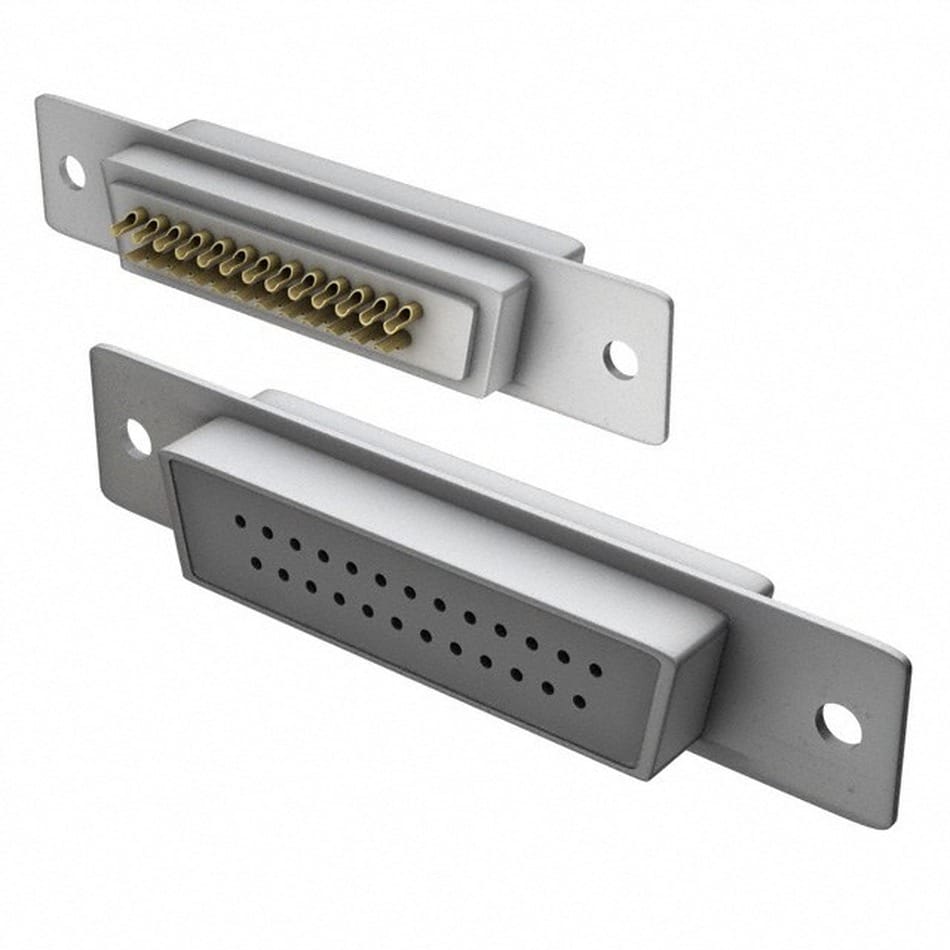
IP67 D-Sub Screw Cable, Sealed Cordset for Outdoor and Washdown Panels
An IP67 D-Sub screw cable is sealed in three places at once: the mating face, the panel joint and the cable exit. Gasket or sealing frame, gland or potted rear entry, and an overmolded cordset end. Send the shell size, pin count and washdown chemistry.
Last updated: 13 September 2026
Overview
An IP67 D-Sub screw cable is not a standard cordset with a gasket pushed under the flange and a bigger jackscrew. Doing the screws up harder does not make a D-Sub waterproof: the water does not come through the joint you are tightening, it comes through the two paths you cannot see from the front. A genuinely sealed assembly closes the mating face, the panel interface and the cable exit, and it closes them in a way that survives a washdown at the end of every shift rather than only on the day it is fitted. We build these to the shell size, contact count, gland size and jacket you specify.
A screwed-down D-Sub is not a sealed D-Sub
This is the mistake that costs the most money. The jackscrews on a D-Sub compress whatever sits between the two shell faces; they do nothing at all about the back of the connector, and nothing about a panel joint that was never designed to be a seal. A standard connector on a sealed cordset is still an unsealed system. There are three leak paths, and a build that closes two of them is a build that leaks.
| Leak path | How it is closed | What defeats it |
|---|---|---|
| Between the two shell faces | Face gasket or sealing frame compressed by the jackscrews | Uneven torque, a bent flange, a gasket specified for the wrong chemistry |
| Connector to panel | Panel gasket behind the flange, or a sealing frame on the receptacle | Painted or powder-coated panel, scratched surface, missing gasket on a retrofit |
| Where the cable leaves the hood | Compression gland sized to the cable OD, or potted rear entry | Gland bored for a different diameter, cable pulled after potting |
| Along the inside of the shell | Sealed insulator so moisture cannot track pin to pin or pin to shell | A standard insulator in a shell that is otherwise sealed |
How each sealing method works
There is no single right answer, and the choice is usually driven by what happens to the cable after it leaves the connector.
| Method | Where it sits | Suits | Trade-off |
|---|---|---|---|
| Face gasket | Compressed between plug and receptacle | Mated pairs that stay mated | Protects nothing once the plug is off |
| Sealing frame | Around the receptacle flange, against the panel | Panel feed-throughs, bulkhead positions | Needs a flat, clean panel surface |
| Compression gland | Rear of the backshell | Cable that may be replaced in the field | Must match the actual cable diameter |
| Potted rear entry | Compound filling the rear of the hood | Permanent builds, high vibration | Cannot be re-terminated afterwards |
| Overmolded cordset rear | Molded over the cable and shell as one part | One end of a cordset, service loops | Fixed length at that end |
On most of the cordsets we ship one end is overmolded, so the gland simply is not there to leak, and the other end carries a gland or a potted rear depending on whether you expect to re-terminate it. Tell us if the cable will be pulled during installation.
What IP67 covers, and what it does not
Ingress ratings are defined in IEC 60529 and the two digits mean two different things. The first is solid ingress: 6 is dust-tight. The second is liquid: 7 means no harmful ingress when the enclosure is immersed under the depth and duration conditions set out in the standard. It is a rating of an enclosure as tested, not a promise about a particular installation. Three practical consequences follow from that, and they are the ones that matter on a plant floor.
- A rating belongs to a mated pair. An IP67 plug on the end of a cable with nothing plugged into it is an open port. If the connector spends its life unmated, say so – some sealed ranges are rated mated only and others are rated both ways.
- The rating follows the weakest joint. A sealed plug mated into an ordinary IP20 receptacle is a sealed plug on one side of an unsealed joint.
- Installation is part of the rating. Correct gasket, a gland bored for the cable you are using, and jackscrews torqued down – none of which survive a rushed fit.
More detail on the digit definitions is in the IP code reference. Where a washdown uses high-pressure hot water, immersion ratings are the wrong target and IP69K to ISO 20653 is the one to ask for.
Key specifications
| Connector family | D-Sub per IEC 60807, sealed version |
|---|---|
| Shell sizes | Standard D-Sub shell sizes and contact counts |
| Sealing, panel face | Gasket or sealing frame compressed by the jackscrews |
| Sealing, cable exit | Gland or potted rear entry, or overmolded cordset rear |
| Ingress protection | Sealed design target for the mated pair; not a certified result |
| Contacts | Machined copper alloy, gold over nickel |
| Shell | Metal, nickel plated, conductive for screening |
| Jacket options | PVC or PUR, black |
| Length | Made to order |
| Testing | 100% continuity and pinout; seal checking on the batch quoted on request |
Typical applications for this IP67 D-Sub screw cable
- Outdoor telecom and traffic cabinets where the panel face sees rain and condensation
- Shipboard and offshore consoles exposed to salt fog and spray
- Railway trackside enclosures that are hosed rather than wiped
- Food and beverage plant panels washed down at the end of every shift
- Water treatment and pump station control panels
What to send us for a quote
- Shell size and contact count, and the gender at each end.
- Whether one end is a panel receptacle and how it is mounted.
- The sealing method you want at the cable exit – gland, potted or overmolded.
- Cable outer diameter, so the gland is bored to the cable you will actually use.
- Washdown chemistry, if there is one – it decides the gasket material.
- Length and quantity, and whether this is a prototype or production.
Workmanship and testing
Workmanship follows IPC/WHMA-A-620 Class 3 and the line runs under ISO 9001. Conductors from 32 to 12 AWG are in range. Continuity and pinout are verified on 100% of units before packing; if you specify an ingress rating, seal checking on the batch can be quoted.
Custom builds and ordering
Prototype quantity starts at 5 pcs with a 3 working day turnaround, and production starts at MOQ 500 pcs shipping 14 working days after approval. Where a new tool is needed, allow about 10 working days. We ship OEM and ODM builds under your part number and labeling, and can provide material certificates and first-article reports.
Related sealed and screw-lock assemblies
- D-Sub Screw Lock Cable, DB9 DB15 DB25 Serial and I/O Cordset for dry indoor panels
- IP67 RJ45 Screw-Lock Bulkhead Cable
- IP67 RJ45 Patch Cable, waterproof shielded Ethernet jumper
- IP68 Industrial Data Cable for serial, USB and Ethernet ports
- IP69K Screw Lock Cable for RJ45 and M12 gigabit vision links
- M12 IP69K washdown cable with stainless steel coupling nut
- IP67 Keystone Panel Frame for field-replaceable modules
Full ranges: Screw-Lock Molded Cable • Panel Mount Cable • Signal and Data Cables.
Frequently Asked Questions
Is a sealed plug waterproof on its own?
Usually not. An ingress rating applies to the mated pair and the panel interface. A sealed plug with nothing in it is an open port; a sealed plug mated into an unsealed receptacle is an unsealed joint.
Why does the gland need the cable diameter?
A compression gland seals by squeezing the jacket. Bored for a cable that is thinner than the one you fit, it cannot compress; bored for a thicker one, it will not close. Give us the actual outer diameter.
Can the rear be re-terminated if it is potted?
No. Potting is permanent, which is exactly why it is used on high-vibration builds. If you expect to change the cable in the field, specify a gland instead.
What do you need to know about the washdown?
The cleaning agent and its temperature. The gasket material has to suit the chemistry, and a gasket that swells or hardens will stop sealing long before the cable wears out.
What is the minimum order?
5 pcs minimum for prototypes, shipping in 3 working days. Production runs of 500 pcs and up ship 14 working days after approval.
| Category | Screw-Lock Molded Cable |
|---|---|
| Connector family | D-Sub per IEC 60807, sealed version |
| Shell sizes | Standard D-Sub shell sizes and contact counts |
| Sealing, panel face | Gasket or sealing frame compressed by the jackscrews |
| Sealing, cable exit | Gland or potted rear entry, or overmolded cordset rear |
| Ingress protection | Sealed design target for the mated pair; not a certified result |
| Contacts | Machined copper alloy, gold over nickel |
| Shell | Metal, nickel plated, conductive for screening |
| Jacket options | PVC or PUR, black |
| Length | Made to order |
| Testing | 100% continuity and pinout; seal checking on the batch quoted on request |