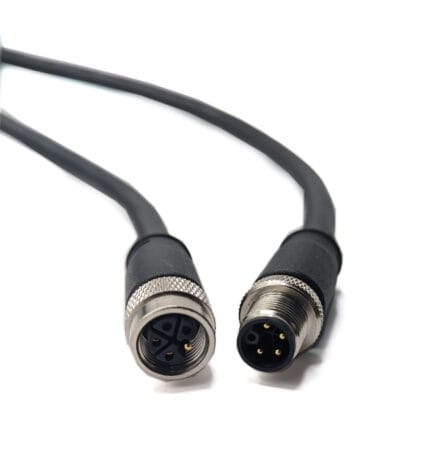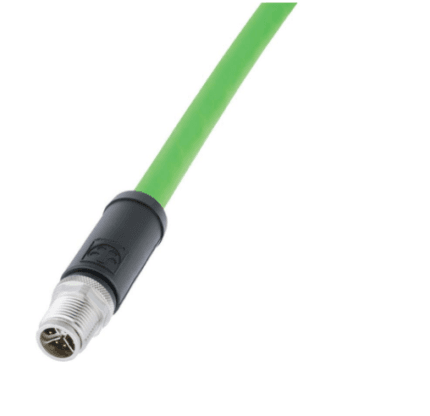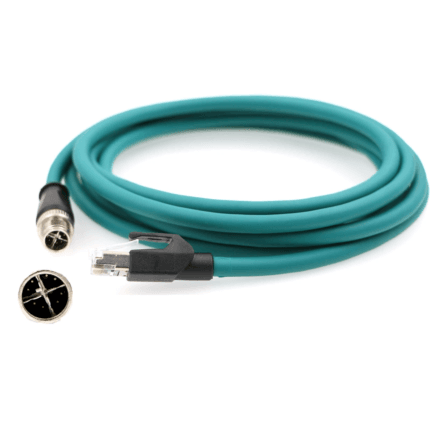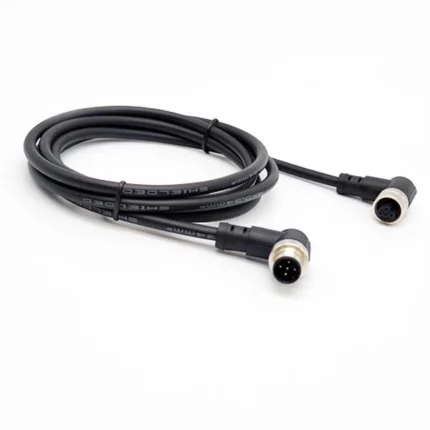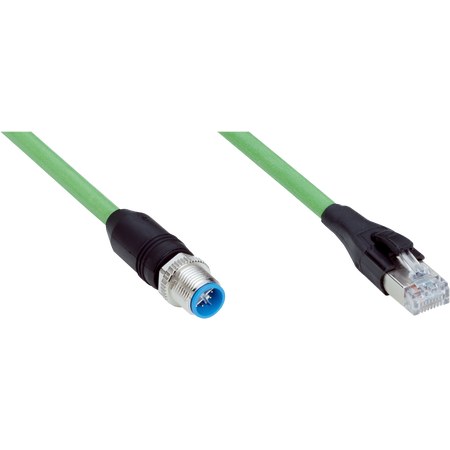
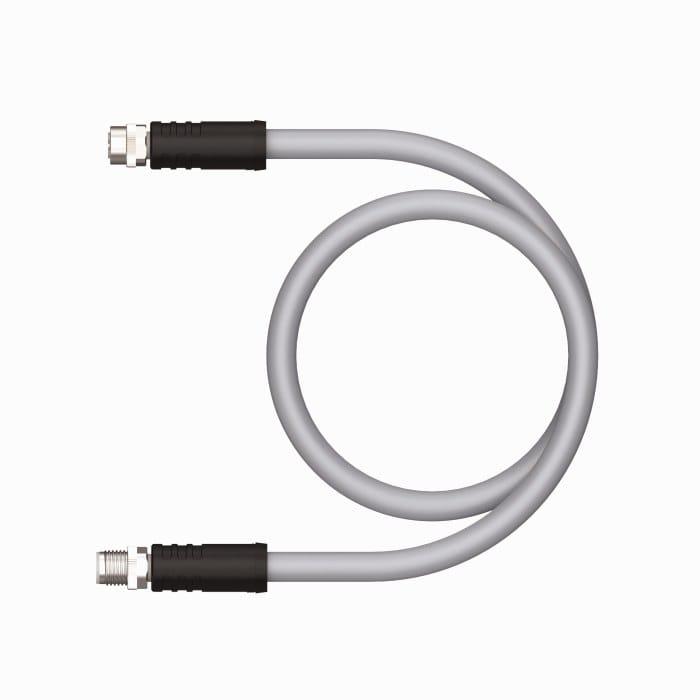
M12 IP69K Washdown Cable with Stainless Steel Coupling Nut
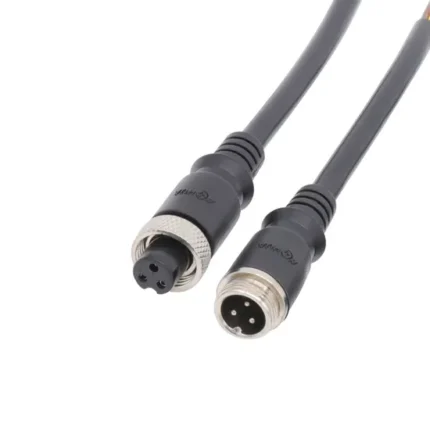
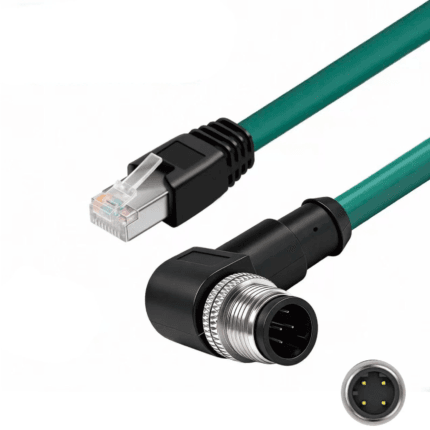
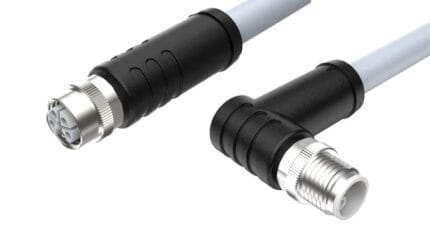
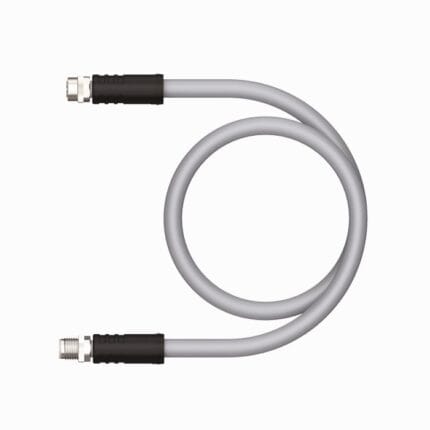
An M12 IP69K washdown cable with a stainless steel coupling nut survives high pressure hot water, caustic foam and daily thermal cycling. D-coded or X-coded, silicone-free halogen-free jacket, built to your length and pinout.
Last updated: 13 September 2026
Overview
A M12 IP69K washdown cable is for the places where an ordinary PUR Ethernet cordset dies – and it dies there for reasons that have nothing to do with build quality. A food plant cleans differently from a machine shop: high pressure hot water at close range, caustic foam, peracetic acid, and a thermal cycle from production temperature down to a cold rinse several times a day. This assembly is built around that cycle, with a stainless coupling nut and a jacket and seal set chosen against the cleaning chemistry.
Key Specifications
| Connector series | M12, D-coded 4 positions or X-coded 8 positions |
|---|---|
| Coupling nut | Stainless steel 316L / 1.4404 class (pending material certificate) |
| Overmould material | Polypropylene or food-contact grade compound (pending supplier confirmation) |
| Seal material | EPDM or FKM (pending supplier build sheet) |
| Jacket material | Silicone-free, halogen-free MPPE or PUR |
| Ingress rating | IP65 / IP67 / IP68 / IP69K quoted in competitor data, pending test reports |
| Temperature range | -25 to +105 C class (pending supplier datasheet) |
| Anti-vibration feature | Serrated coupling nut face where specified |
| Typical uses | Filling lines, dairy and meat plants, pharmaceutical suites, hygienic vision |
| Compliance files | Food contact and cleaning agent statements pending supplier documents |
Why the standard cordset fails
Three mechanisms do the damage. The first is chemistry: cleaning agents and sanitizers attack the plasticizer in a standard PUR jacket and the surface of a plated brass nut. The second is thermal cycling: a connector tightened at production temperature relaxes when it is hit with cold rinse water. The third is mechanical: a brass nut sprayed with a sugar solution and then dried will not undo by hand, so it gets changed with a tool, which damages the thread and the panel receptacle with it.
What the rating actually tests
Ingress ratings for enclosures come from IEC 60529, and the 9K step used on road vehicles and cleaning equipment comes from ISO 20653. They are not a scale where a higher number automatically includes the lower ones – a connector can pass an immersion test and still fail a high pressure spray.
| Rating | What the test is | What it does not tell you |
|---|---|---|
| IP65 | Low pressure water jet from a nozzle | Nothing about hot water or chemicals |
| IP67 | 30 minutes under 1 m of water | Nothing about jet pressure or temperature |
| IP68 | Continuous immersion at an agreed depth | Depth is agreed with the maker, not fixed |
| IP69K | High pressure, high temperature spray from close range | Nothing about immersion in a tank |
The IP code is only meaningful with the test report behind it. Ask for the report before the rating goes into a hygienic specification.
What is different in the construction
The coupling nut is the visible change: a 316L stainless nut, material 1.4404, which resists the cleaning chemistry and does not gall against a stainless receptacle thread. Behind it, seals are EPDM or FKM rather than the usual NBR, chosen against the temperature range and the sanitizer in use, and the overmold is polypropylene or a food-contact grade compound. A serrated nut face is sometimes specified so the joint does not back off under vibration.
Pinout for the washdown build
These assemblies are normally D-coded for 100 Mbit/s device drops or X-coded where the run carries gigabit or 10 gigabit traffic to a vision station.
| Pin | D-coded 4-pin | X-coded 8-pin | Note |
|---|---|---|---|
| 1 | TD+ (yellow) | Pair 1 white/orange | Data pair, twist held to the termination |
| 2 | RD+ (white) | Pair 1 orange | Data pair |
| 3 | TD- (orange) | Pair 2 white/green | Data pair |
| 4 | RD- (blue) | Pair 2 green | Data pair |
| 5 | – | Pair 3 white/blue | Only on the 8-position face |
| 6 | – | Pair 3 blue | Only on the 8-position face |
| 7 | – | Pair 4 white/brown | Only on the 8-position face |
| 8 | – | Pair 4 brown | Only on the 8-position face |
The coding family, read for a washdown plant
A food plant ends up with several codings on the same line. The useful question is not which code is best but which code belongs on which drop.
| Code | Contacts | What travels | Where it shows up in a plant |
|---|---|---|---|
| A | 3 to 12 | Sensor and actuator signals | Proximity switches on fillers and cappers |
| D | 4 | 100 Mbit/s Ethernet | Machine PLC and device drops |
| X | 8 | Gigabit and 10 gigabit Ethernet | Hygienic vision stations |
| B | 4 to 5 | PROFIBUS-DP | Older fieldbus on legacy lines |
| C | 3 to 6 | AC power | AC actuators being replaced |
| S | 2+PE / 3+PE | Single-phase AC | Heater and pump supplies |
| K | 4+PE | Three-phase AC | Conveyor and mixer motors |
| L | 4+FE | DC power at 63 V | IO-Link power and 24 V field islands |
| T | 2 to 4 | DC power | DC drives and distribution |
| M | 5 to 6 | Servo power with brake | Servo axes on packaging machines |
| P | 4 | EtherCAT P | One-cable drops on modular machines |
| Y | 8 (4+4) | Power plus Fast Ethernet | Robot and AMR loads with one connector |
Where it goes
- Filling and packaging lines that are foamed and rinsed every shift
- Dairy, meat and ready-meal plants with caustic and peracetic cleaning cycles
- Hygienic machine vision stations that keep the Ethernet run inside the washdown zone
Food contact and cleaning agent claims
Competitor literature for this category references FDA 21 CFR 177.2600 for the elastomeric parts and Ecolab testing of cleaning agent resistance. We are not repeating either as our own claim. If you need a documented food contact position, ask for it before ordering and we will supply the supplier document or say that we cannot.
Ratings still to be evidenced
The ingress ratings quoted for comparable products run to IP65, IP67, IP68 and IP69K, and the temperature range to -25 to +105 C. Those are plausible for this construction and they are not yet ours. Ask for the test documentation before this goes into a hygienic specification.
Typical applications for this M12 IP69K washdown cable
- Filling, capping and labeling machines rinsed at every shift change
- Dairy and meat processing lines with caustic and peracetic cycles
- Pharmaceutical suites where the cleaning agent is the aggressive part
- Vision and inspection stations mounted inside the washdown envelope
How to specify your build
- Coding and pin count – D-coded 4-pin or X-coded 8-pin.
- Cleaning chemistry – caustic, peracetic, chlorine, or a named agent.
- Water temperature and pressure at the nozzle.
- Coupling nut – stainless, and whether you want the serrated face.
- Jacket – silicone-free, halogen-free MPPE or PUR.
- Length and body style.
Workmanship and testing
Each assembly is built and inspected to IPC/WHMA-A-620 Class 3 criteria within an ISO 9001 quality system, covering 32 to 12 AWG. Continuity and pinout are tested on every unit before packing. Where the specification calls for an ingress rating, seal checking on the batch can be quoted.
Custom builds and ordering
Small runs start at 5 pcs and leave in 3 working days. At production volume the minimum is 500 pcs and lead time is 14 working days after approval. New tooling is about 10 working days on top. OEM and ODM orders ship under your part number, with material certificates and first-article reports available.
Related M12 and M8 assemblies
- M12 IP68 / IP69K Food-Grade Stainless Steel Washdown Cable
- Cat6A IP69K Washdown Patch Cord, M12 X-Code to RJ45, PUR
- M12 D-Code 4-Pin PROFINET Industrial Ethernet Cable
- M12 X-Coded Cat6A Cable to RJ45 for Machine Vision
- M12 A-Coded PVC/PUR Straight or Right-Angle Extension Cable
- M12 Bulkhead Panel Connector with Pigtail, A, D and X Coding
Full range: circular M8 and M12 cable assemblies.
Frequently Asked Questions
Is IP67 enough for a washdown area?
Usually not. IP67 covers immersion, not high pressure hot water. Plants that wash down normally specify IP69K to ISO 20653 with a stainless coupling nut.
Why stainless instead of brass?
Brass corrodes under cleaning agents and a corroded nut will not undo by hand, which is how panel receptacles get damaged. Stainless also avoids galling against a stainless receptacle.
Can you document food contact?
We will supply the supplier document for the compound actually used, or tell you plainly that we do not have one. We do not make the claim ahead of the document.
| Connector series | M12, D-coded 4 positions or X-coded 8 positions |
|---|---|
| Coupling nut | Stainless steel 316L / 1.4404 class |
| Seal material | EPDM or FKM |
| Jacket material | Silicone-free, halogen-free MPPE or PUR |
| Ingress rating | IP65 / IP67 / IP68 / IP69K class |
| Temperature range | -25 to +105 C class |
| Anti-vibration feature | Serrated coupling nut face where specified |
| Typical uses | Filling lines, dairy and meat plants, pharmaceutical suites, hygienic vision |
| Compliance files | Food contact and cleaning agent |
| Overmold material | Polypropylene or food-contact grade compound |