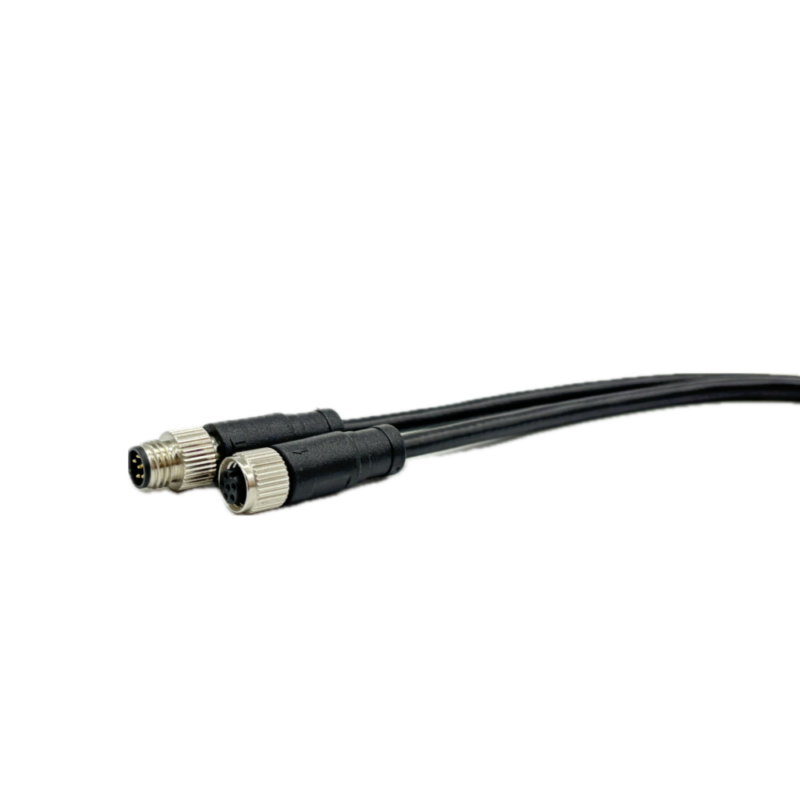
Cat6a Fiber Hybrid Cable for Machine to Cabinet High-Speed Links
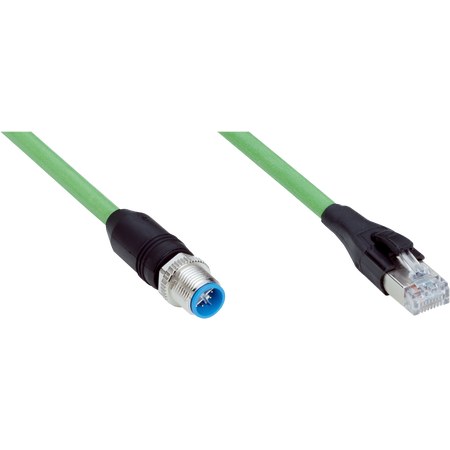
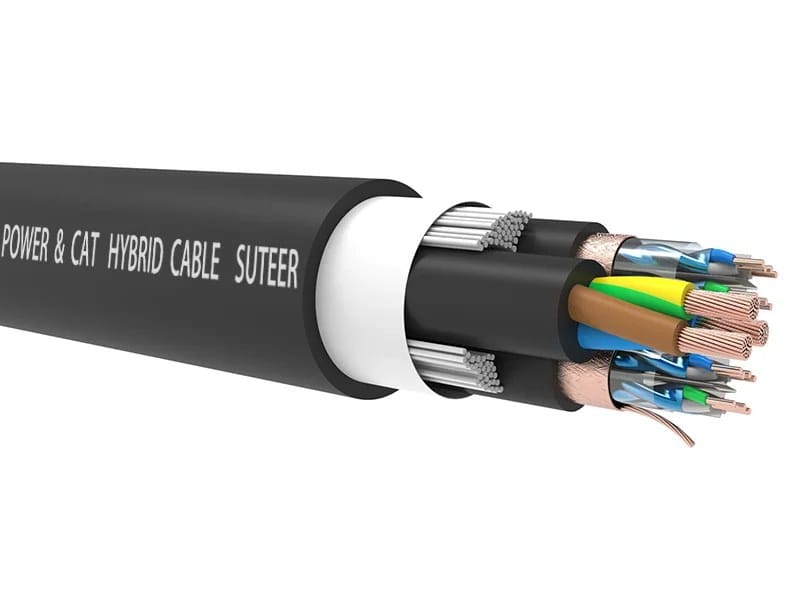
A Cat6a fiber hybrid cable that puts S/FTP copper pairs and optical elements under one PUR sheath, so a vision cell runs one cable instead of two. RJ45 or M12 X-coded on the copper, LC or SC on the fiber, 1 m to 30 m. Decide the signal split before ordering.
Last updated: 13 September 2026
Overview
A vision workstation rarely needs one link type. It needs copper for the camera and, increasingly, a fiber path back to the server rack or to an edge box sitting outside the cell. Running two cables through one drag chain costs space and adds a second failure point, which is why this Cat6a fiber hybrid cable puts S/FTP copper pairs and optical elements under the same PUR sheath.
Key Specifications
| Product type | Cat6A and fiber hybrid cable assembly |
|---|---|
| Copper element | Cat6A S/FTP, individually screened pairs with overall braid |
| Optical element | Optional fiber cores, single-mode or multi-mode per order |
| Jacket material | PUR, oil and coolant resistant |
| Termination | RJ45 or M12 X-coded on copper, LC or SC on the fiber |
| Length range | 1 m to 30 m, made to order |
| Duty | Drag-chain rated construction – rating to be confirmed |
| Bend radius | Set by the fiber element – stated per build |
| Gland planning | One gland size at the cabinet wall instead of two |
Why the run fails, and what a hybrid fixes
Before specifying a hybrid, it is worth being clear about which problem you are solving. It is not a universal answer, and the table below is the honest split:
| Failure in service | Root cause | Does a hybrid help? |
|---|---|---|
| Ground loop between two separately powered cabinets | Copper link carrying a potential difference as well as the signal | Yes – the fiber element removes the copper path entirely |
| Chain overfilled, second cable will not fit | Two jackets, two bend radii, two clamp sets | Yes – one part number and one bend radius to respect |
| Intermittent frames on the copper camera link | Usually termination quality or a coil of surplus cable | No – fix the termination and the routing first |
| Link shorter than the run | Copper reach limit, not a cable defect | Yes, if the long leg is the fiber element |
Which signal goes on which element
Decide this before ordering, because the mix is fixed once the sheath is extruded. The usual split:
- Camera and field device traffic – on the copper pairs, where the device expects an RJ45 or M12 X-coded interface and the run is inside the cell.
- Backhaul to the rack or edge box – on the fiber, especially where the two ends are separately powered.
- Anything crossing a cabinet boundary – on the fiber, to remove the ground loop problem that copper-only links in that position reliably create.
Fiber type and connector polish are specified per order because single-mode and multi-mode runs need different transceivers at each end, and the wrong pairing will not link at all. Confirm the transceiver on both ends at the same time as the cable.
Channel performance and what we can claim
Cat6A is defined in the ISO/IEC 11801 and TIA-568 channel specifications as a 500 MHz class channel supporting 10GBASE-T to 100 m. That is the industry definition of the class and it is the reason the copper element is built with individually screened pairs. In practice, channel performance on a finished assembly depends on the termination at least as much as on the cable, so the published lengths and the drag-chain rating in the table are design targets pending channel testing on production builds. The values your assembly is built and verified to are the ones stated on your drawing.
Planning the run
- Fix the signal split – copper for the device, fiber for the backhaul.
- Check bend radius – the fiber element sets it, and it is usually larger than the copper alone needs.
- Check chain fill – one cable instead of two, but not necessarily the same diameter as either.
- Size the gland at the cabinet wall once, for the combined sheath.
- Confirm the transceivers at both ends of the fiber, in the same order as the cable.
Typical applications for this Cat6a fiber hybrid cable
- Vision cells where the camera runs on copper and the backhaul to the rack runs on fiber
- Machine to cabinet links across a cell boundary, alongside our hybrid servo cable for the axis wiring
- Gantry and robot mounted heads using a Cat6A high-flex drag chain patch cord construction
- Cabinet to cabinet runs where a copper-only link has already caused a ground loop
- Test rigs and inspection stations built up with a 38999 high speed harness at the panel
The copper element is Cat6A class; the channel performance your assembly is verified to is measured on the finished build, not quoted from the cable class alone.
Workmanship and testing
Each assembly is built and inspected to IPC/WHMA-A-620 Class 3 criteria within an ISO 9001 quality system, covering 32 to 12 AWG. Continuity and pinout are tested on every unit before packing. Where the specification calls for an ingress rating, seal checking on the batch can be quoted.
Custom builds and ordering
Five pieces is where a prototype starts and it ships in 3 working days. Production requires 500 pcs minimum and takes 14 working days after approval. Non-stock tooling adds around 10 working days. Private-label builds ship under your part number and labeling; material certificates and first-article reports are available on request.
Related assemblies
- Cat6A High-Flex Drag Chain Patch Cord, S/FTP PUR
- Cat6A PUR High-Flex Patch Cord, S/FTP 26AWG
- Cat6A M12 X-Coded Patch Cord, 8-Pin M12 to RJ45
- Hybrid Servo Cable for One-Cable Solution Servo Drives
- CoaXPress Machine Vision Cable Assembly for CXP-12 Links
- M12 X-Coded Cat6A Cable to RJ45 for Machine Vision
Full range: Ethernet cable patch cords.
Frequently Asked Questions
Can the copper-to-fiber mix be changed later?
No. The hybrid is built to order and the mix is fixed once the sheath is extruded. Decide the split before the length is cut.
Single-mode or multi-mode?
Both are available and they are not interchangeable – each needs its matching transceiver. Confirm the transceiver type on both ends at the same time as the cable.
Will this solve my dropped frames?
Only if the cause is a ground loop or a reach limit. If it is termination quality or a coil of surplus cable beside a drive cabinet, fix that first; a hybrid will not help.
What is the minimum order?
For prototypes the floor is 5 pcs and lead time is 3 working days. Production orders begin at 500 pcs and ship 14 working days after sample sign-off.
| Product type | Cat6A and fiber hybrid cable assembly |
|---|---|
| Copper element | Cat6A S/FTP, individually screened pairs with overall braid |
| Optical element | Optional fiber cores, single-mode or multi-mode per order |
| Jacket material | PUR, oil and coolant resistant |
| Termination | RJ45 or M12 X-coded on copper, LC or SC on the fiber |
| Length range | 1 m to 30 m, made to order |
| Duty | Drag-chain rated construction – rating to be confirmed |
| Bend radius | Set by the fiber element – stated per build |
| Gland planning | One gland size at the cabinet wall instead of two |