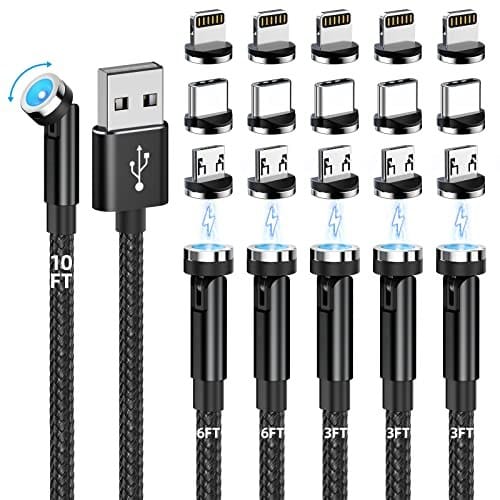
240 W Magnetic USB-C Charging Cable 16-Pin Rotating Head, Interchangeable Tips
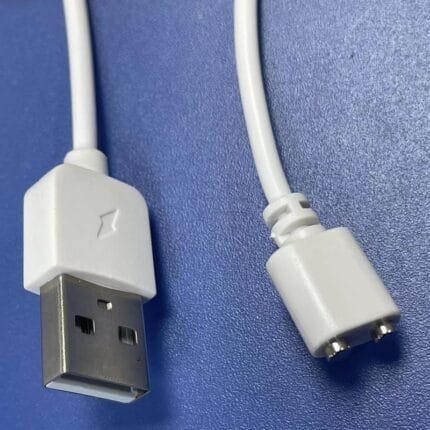
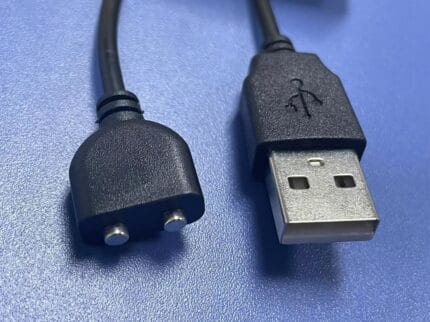
A magnetic usb-c charging cable with a 16-pin self-aligning head that connects one handed and breaks away when pulled. Rated to the 240 W PD 3.1 EPR operating point, USB 2.0 at 480 Mbps, with interchangeable tips and a rotating head.
Last updated: 13 September 2026
Overview
A magnetic USB-C charging cable buys you a connection that finds its own way home
and lets go when something catches it, and it pays for that with contact area. Sixteen spring-loaded
pins have to do the work that a one-piece plug does with a solid shell, so the engineering question on
this build is not whether it is magnetic — it is how much current you can push across those pins before
the joint becomes the hottest part of the chain. We build the head, the pin set and the cable as one
assembly, and the rating your build is verified to is the one stated on your drawing.
Key Specifications
| Interface | 16-pin magnetic connector, self-aligning |
|---|---|
| Connector B | Interchangeable USB-C and Micro-USB tips |
| Rotation | Full rotation plus a wide swivel arc |
| Power rating | Up to 240 W at the 48 V / 5 A PD 3.1 EPR operating point |
| Data rate | USB 2.0 up to 480 Mbps |
| Indicator | LED locator light on the head |
| Accessory | Storage dock for head and spare tips |
| Applications | Fleet carts, in-vehicle charging, accessibility use |
What the sixteen pins are doing
A magnetic head does not have the mechanical preload of a plug seated in a socket, so the pin count
is spent on carrying current in parallel rather than on signal variety. Splitting the power path across
several pins lowers the resistance of the joint and spreads the heat; the remaining pins carry the
USB 2.0 pair, the channel configuration line and the identification used by the tip.
| Pin group | Role | Why it is split this way |
|---|---|---|
| VBUS pins | Parallel power path | Sharing current lowers joint resistance and spreads heating |
| Ground pins | Parallel return | Return path has to match the power path or it becomes the limit |
| D+ / D- | USB 2.0 data | 480 Mbps sync and file transfer alongside charging |
| CC / identity | Orientation and tip detection | Lets the same head serve USB-C and Micro-USB tips |
The trade you are making: breakaway against contact resistance
This is the part most listings skip. A magnetic joint releases under a pull, and the force required
to release it is the same force holding the pins against their pads. Set it high and the cable stops
breaking away, which is the whole point of buying it. Set it low and the pins lift under vibration,
the contact resistance rises, and the joint warms up. So the useful specification is not the magnet
strength — it is the pull force your application needs, stated per your drawing, plus the contact
resistance the assembly has to hold after mating cycles.
- Handheld, in-vehicle, bedside — lower release force is right, because the cable is meant to let go.
- Carts, kiosks, fixed mounts — higher retention is right, because nobody is pulling the cable and vibration is the real risk.
- High current — keep the mating faces clean. Finger oils and dust on the pads raise resistance and heat the joint.
- Dirty or oily environments — ask about a covered head. Debris across the pads is the failure mode that ends these cables.
What 240 W actually requires from the rest of the chain
240 W is the top of the extended power range introduced with USB Power Delivery 3.1: 48 V at 5 A.
It only appears when three things agree. The charger has to advertise the 48 V EPR power data object.
The cable has to report, through the marker chip in the plug, that it is an EPR cable rated for that
voltage and current. And the device has to ask for it. If any one is missing the pair settles at a
lower operating point and charging simply gets slower — that graceful fallback is by design, and it is
why a mismatch shows up as a slow charge rather than a failure. The USB-C connector itself stays at 5 A; the extra power comes from
raising the voltage, not from pushing more current.
Rotation geometry
The head rotates a full turn and also swivels through a wide arc, so the cable leaves the plug in
whatever direction the layout needs instead of fighting the user. That matters when a device sits flat
on a surface and the cable has to exit sideways, or when a handheld is used while charging. Rotation is
mechanical, and the contact design is what keeps the connection stable through it: the power pins run
on concentric rings so they stay in contact at any angle, while the data pins are routed to keep the
pair short.
Tip options and fleet use
The head accepts interchangeable tips, so one cable covers a mixed device population. USB-C and
Micro-USB tips are available now; further tip types are quoted on request. A storage dock keeps the
head and spare tips together, which is what makes this workable on a cart rather than in a drawer.
- Fleet and classroom charging carts, where one cable type covers several device generations
- In-vehicle and bedside use where the cable is pulled often
- Accessibility setups — the connection takes no precision and no force, which is a genuine help to users with limited hand mobility
- Shared test benches where a port gets mated hundreds of times a week
Typical applications for this magnetic USB-C charging cable
- Charging carts in schools, warehouses and hospitals, with our USB-C PD charging cable as the non-magnetic alternative on the same cart
- In-vehicle and forklift mounts where the operator leaves the vehicle with the device in hand
- Bedside and wheelchair mounts, where a breakaway is a safety feature rather than a convenience
- Retail and kiosk demo units, paired with a dual port USB panel on the fixture
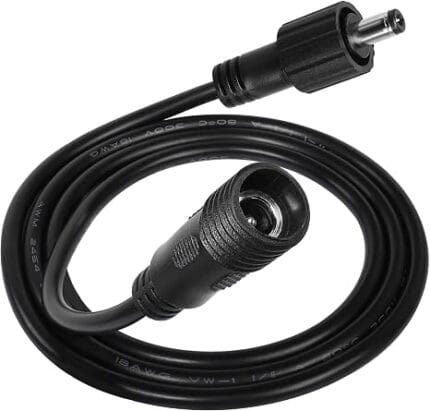
- DC-side magnetic builds using our DC 5.5 x 2.1 mm magnetic charging cable
How to specify your build
- Release force — how hard a pull should separate the head, in your application.
- Current and voltage — what the device draws, and whether EPR is actually needed.
- Tip set — which tips, and how many per cable.
- Cable length and jacket — braided or smooth, and what it will be dragged across.
- Mating cycles — the number the head has to survive, if you have a figure in mind.
- Marking and packaging — your part number, your label.
Workmanship and testing
Assembly and inspection follow IPC/WHMA-A-620 Class 3 workmanship criteria under our ISO 9001 quality management system, and every unit passes 100% continuity and pinout testing before it is packed. Conductor range is 32 to 12 AWG. Where an ingress rating is specified we can quote seal checking on the production batch.
Related charging assemblies
- USB-C PD Charging Cable 240 W PD 3.1 EPR, Braided
- USB-C Power Display Cable 240 W PD 3.1 with Digital W/V/A Readout
- USB Type-C Magnetic Charging Cable
- DC 5.5 x 2.1 mm Magnetic Charging Cable
- Magnetic Pogo Pin Cable USB-C for Medical and Wearable Devices
Full range: DC Plug Power Cable.
Frequently Asked Questions
Does the magnetic joint reduce charging speed?
Any additional contact adds some resistance. The design answer is to split power across several pins so the joint stays cool. If your device is sensitive to drop, tell us the current and we will quote the pin configuration and the resistance target.
Will it reach 240 W on any charger?
No. 240 W needs a charger that offers the 48 V EPR profile, a cable that reports EPR capability through its marker chip, and a device that asks for it. With any one missing the pair falls back to a lower level and charges more slowly.
Can the head pick up metal debris?
Yes, and that is the main wear mechanism in a workshop. Keep the head on the dock when it is not in use, and ask about a covered version for dirty environments.
Are extra tips available separately?
Yes. Tips are a stocked spare and we pack them to your quantity, bagged separately or with each cable.
Is this suitable for data transfer?
Yes, at USB 2.0 speeds up to 480 Mbps, which covers sync and file transfer. It is not a high-speed video or 10 Gbps data cable.
| Interface | 16-pin magnetic connector, self-aligning |
|---|---|
| Connector B | Interchangeable USB-C and Micro-USB tips |
| Rotation | Full rotation plus a wide swivel arc |
| Power rating | Up to 240 W at the 48 V / 5 A PD 3.1 EPR operating point |
| Data rate | USB 2.0 up to 480 Mbps |
| Indicator | LED locator light on the head |
| Accessory | Storage dock for head and spare tips |
| Applications | Fleet carts, in-vehicle charging, accessibility use |