Heart-Shape 2-Pin Magnetic Charging Cable
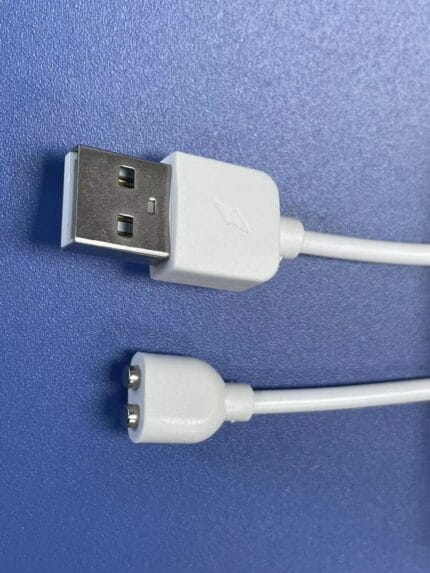
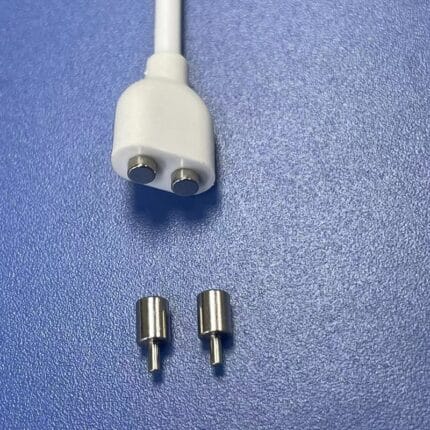
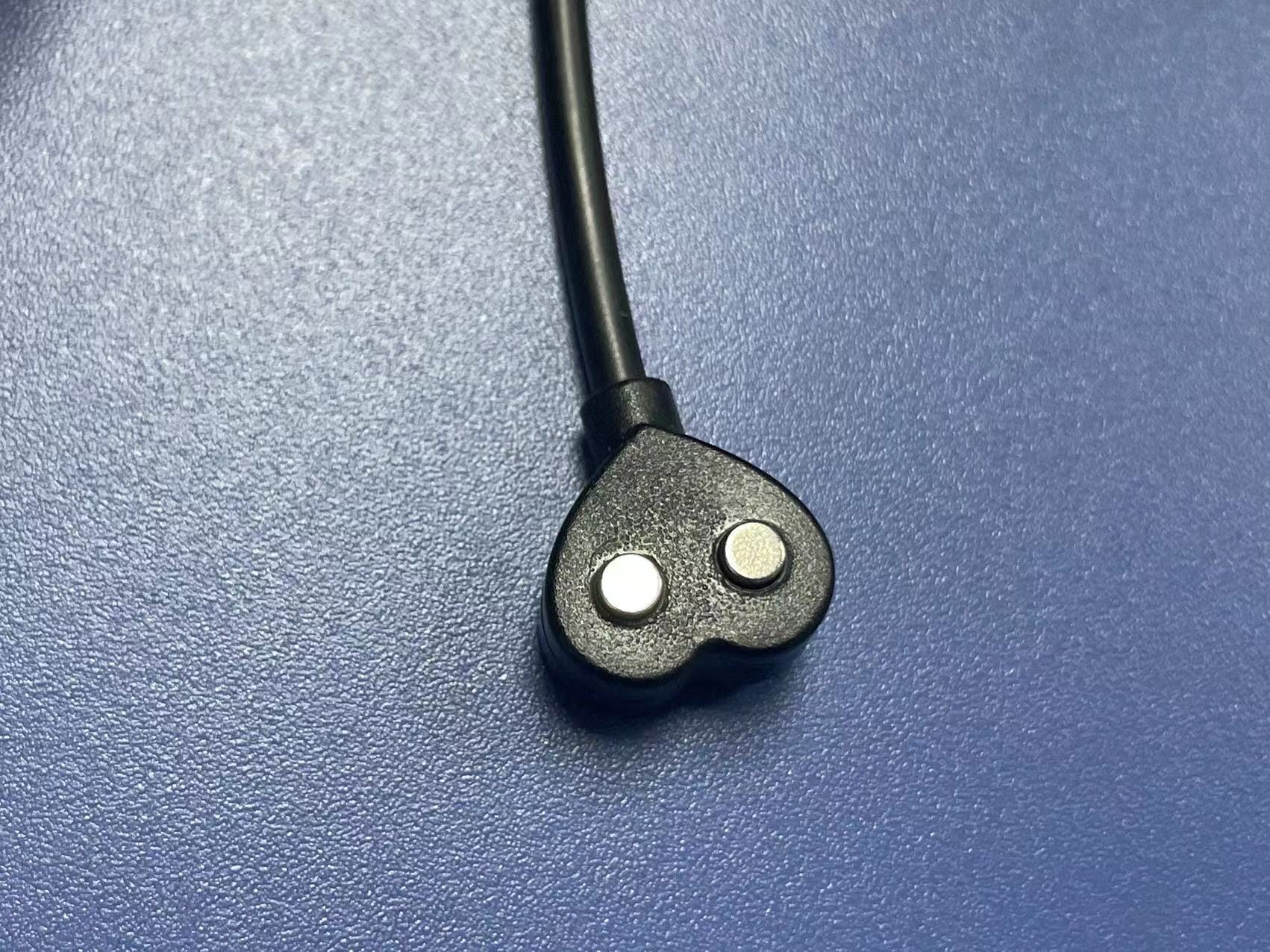
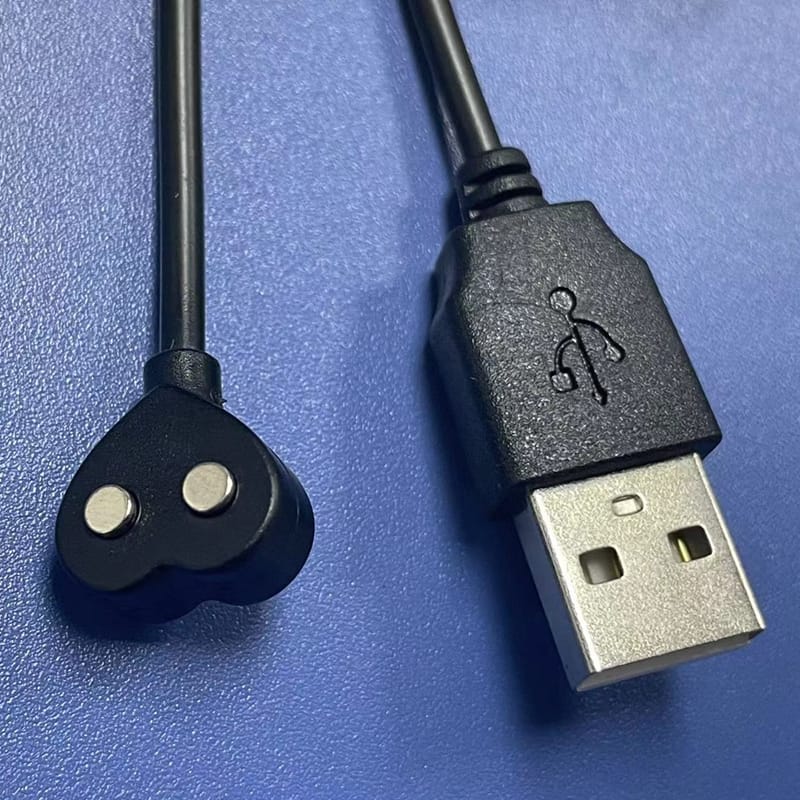
A magnetic 2pin heart cable is a power-only charging lead with a heart-shape pogo-pin head. The asymmetric outline makes polarity obvious in the dark, so earbuds and wearables dock the right way round.
Overview
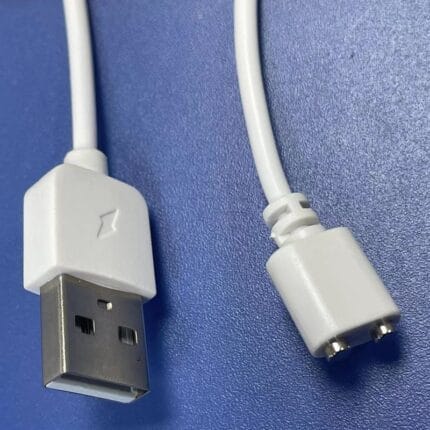
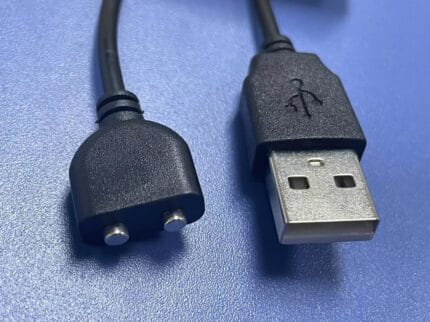
A magnetic 2pin heart cable solves a small problem that costs manufacturers real money: two-pin magnetic charging has no mechanical key, so a user docking a device in the dark has a fifty percent chance of getting the polarity wrong. The heart-shape housing is the key. Its outline is asymmetric, so there is exactly one way the head will seat, and the shape itself tells the user which way round to bring it in. Underneath it is a conventional two-pin pogo build: two gold-plated spring pins, or pogo pins as they are known in the trade, in an injection-molded ABS / PC housing, 2 x 24 AWG tinned copper conductors under an aluminum foil shield, and a USB-A plug at the host end with a ferrite bead to keep conducted noise off the line. This lead carries power only, not data.
Key Specifications
| Connector A | USB-A male, gold-plated contacts |
|---|---|
| Connector B | 2-pin pogo-pin magnetic head, heart-shape housing |
| Pin Configuration | 2-pin (V+ / GND) |
| Contact Resistance | <= 50 mOhm per pin at rated load |
| Mating Cycles | 10,000 connect / disconnect minimum |
| Cable Jacket | PVC, black or white, 3.0 mm OD typical |
| Length | 1 m standard; OEM on request |
| Conductor | 2 x 24 AWG tinned copper |
| Shielding | Aluminum foil with drain wire |
| Polarity | Set at build time; housing shape cues the operator |
Why two pins, and when that is not enough
Pin count is the first decision on any magnetic build, and it follows the function. Two pins is the right answer for a device that only ever charges. Adding pins costs money at both ends – the head and the device-side tip – and buys capability the product may never use.
| Pin count | Carries | Right for | Wrong for |
|---|---|---|---|
| 2 pin | V+ and GND only | Earbud cases, fitness bands, small lights, anything that only charges | Any device that syncs data or needs a sense line |
| 4 pin | Power plus two data or sense lines | Wearables that sync over the dock, devices with a thermistor | Full USB 2.0 data, which needs the fifth conductor |
| 5 pin | Full USB 2.0 – VBUS, D+, D-, GND and CC | Devices that charge and sync through the magnetic joint | Simple chargers, where the extra pins are pure cost |
If your device needs to enumerate on a host, two pins will not do it. Say so at the quoting stage, because the tip tooling is different and the cable core changes from two conductors to five. The same applies to a thermistor or a sense line: it is a pin, and a pin has to be in the tool from the start.
What the shape actually buys you
Beyond the obvious anti-reversal function, an asymmetric outline does three useful things in production. It gives the operator a tactile cue, so docking does not require looking at the port. It gives the product a recognizable silhouette, which matters for accessories that are branded rather than generic. And it gives the assembly line a visual check: a head that is rotated cannot be seated, so a mis-wired tip is caught at dock rather than at the customer.
That last point is not trivial. With a plain round head, a tip wired with V+ and GND swapped will mate perfectly and then destroy the device or the charger. A keyed shape makes the error physically impossible, which is why we recommend it wherever the product is docked blind.
Specifying the head: the four numbers that matter
Every custom magnetic head comes down to four values, and they interact. Pin spacing sets how close the contacts can be before tracking becomes a risk. Pin diameter sets the current the joint carries before it heats. Pull force sets how easily the joint separates. Contact resistance sets how much voltage the device actually sees. Pushing any one of them changes the others.
- Current before pin diameter, so the pins can be sized for it.
- Pull force in the direction the user will actually pull, not straight off the face.
- Pin polarity, confirmed against your device tip drawing before tooling is cut.
- Mating cycles expected in service, which drives plating thickness on the pins.
New head shapes and new device-side tip molds carry a tooling charge and add roughly ten working days. If you are still at the industrial design stage, it is worth having us quote the head before the enclosure is frozen, because the tip footprint has to fit it.
Where a magnetic 2pin heart cable gets used
- True-wireless earbud cases and charging docks
- Fitness bands and wearables where the wearer docks without looking
- Handheld LED lights, scanners and small appliances with a magnetic dock
- Demo and showroom units, where the shape doubles as a brand cue
- Left and right handed device pairs, where the outline cues which side is which
- Medical and care equipment where a breakaway joint is a safety requirement, alongside our Magnetic Pogo Pin Cable range
Workmanship and testing
Heart-Shape 2-Pin Magnetic Charging builds are assembled and inspected to IPC/WHMA-A-620 Class 3 criteria, with ISO 9001 as the quality system over 32 to 12 AWG work. Every Heart-Shape unit is checked for continuity and pinout before packing, and seal checking is quoted whenever an ingress rating is on the drawing.
RoHS and REACH declarations are provided per project together with the agreed test reports; the documentation scope is listed under certifications and compliance. If your drawing specifies a UL style, we build to that drawing and supply the UL reference with the shipment instead of substituting an equivalent. Injection parameters for this part are developed against the jacket material using the approach documented under overmolding and injection molding. The wider context is covered under cable assemblies for marine and outdoor equipment. Any tooling we cut for this part stays yours, maintained in our own tool room under your part reference.
Custom builds and ordering
Heart-Shape 2-Pin Magnetic Charging prototype builds start from 1 to 50 pcs and are out in 3 working days; production is quoted from 500 pcs at 14 working days after sample approval. Tooling not already held adds around 10 working days. Your part number and labeling go on OEM and ODM Heart-Shape shipments, and material certificates with first-article reports are available.
What is listed here for Heart-Shape 2-Pin Magnetic Charging builds is the industry-standard definition, not a measurement we took on a finished part. What your assembly is built and verified to is what your drawing states, confirmed against the supplier datasheet before a quote goes out.
Related magnetic charging builds
- Square-Shape 2-Pin Magnetic Charging Cable
- Magnetic Pogo Pin Cable USB-C for Medical and Wearables
- Smart Watch Magnetic Charging Cable with PCBA
- 240 W Magnetic USB-C Charging Cable, 16-Pin
- DC 5.5 x 2.1 mm Magnetic Charging Cable
- USB A to DC 5521 Male Power Cable
Full ranges: DC plug power cable and custom wire harnesses.
Frequently Asked Questions
Can the heart shape be changed to our own outline?
Yes. The head is an injection-molded part we tool ourselves, so a custom outline is a tooling charge plus about ten working days. It is the most common customization on this class of cable.
Is this a data cable?
No. Two pins carry V+ and GND only. If the device needs to sync or enumerate, ask for the four-pin or five-pin build instead.
What is the pull force?
Set at build time to your requirement. Tell us how the cable will be pulled in service and we will propose a value, then confirm it on the first article.
Can we buy spare device-side tips?
Yes, and we recommend it. The tip is the part that stays in the product and the part users lose; order them with the cable batch so the plating and magnet grade match.
| Connector A | USB-A male, gold-plated contacts |
|---|---|
| Connector B | 2-pin pogo-pin magnetic head, heart-shape housing |
| Pin Configuration | 2-pin (V+ / GND) |
| Contact Resistance | <= 50 mOhm per pin at rated load |
| Mating Cycles | 10,000 connect / disconnect minimum |
| Cable Jacket | PVC, black or white, 3.0 mm OD typical |
| Length | 1 m standard; OEM on request |
| Conductor | 2 x 24 AWG tinned copper |
| Shielding | Aluminum foil with drain wire |
| Polarity | Set at build time; housing shape cues the operator |