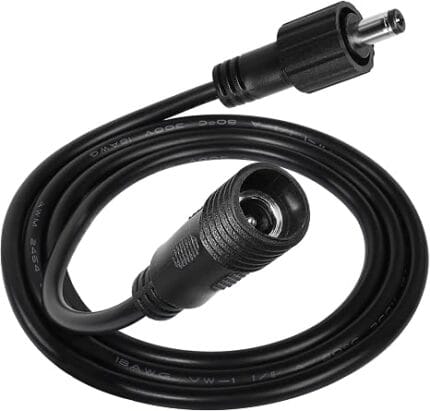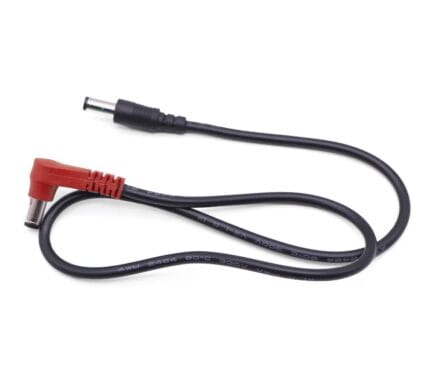
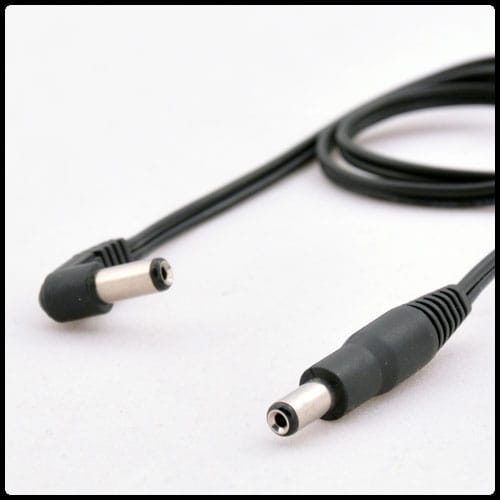
DC 5521 Right Angle to Straight Adapter Cable
A dc 5521 straight adapter cable puts a right-angle 5.5 x 2.1 mm plug on one end and a straight female socket on the other, so power leads can run flush against panels instead of kinking.
Overview
A dc 5521 straight adapter cable is the smallest part that fixes one of the most common installation problems: a device whose barrel jack sits close to a wall, a rack rail or another cable, where a straight plug will not fit without a sharp bend. One end is an L-shaped 5.5 x 2.1 mm male plug that goes into the device, the other is a straight female socket that accepts the existing power lead. The right-angle head routes the cable sideways along the chassis, so the bend the installer would otherwise force into the cord happens inside a molded plug instead. Contacts are nickel-plated brass for repeated mating, and polarity is center positive as standard.
Key Specifications
| Connector A | DC 5.5 x 2.1 mm male (right angle / L-shaped) |
|---|---|
| Connector B | DC 5.5 x 2.1 mm female (straight) |
| Jacket | Black PVC |
| Color | Black |
| Polarity | Center positive (standard) |
| Contact | Nickel-plated brass sleeve and center pin |
| Conductor | Stranded copper, size stated per your drawing |
| Length | Custom, short runs typical |
| Application | CCTV, LED strip, router, 12 V DC device |
Right-angle plug, straight socket, or the other way round?
Adapters in this family come in four combinations and picking the wrong one is easy, because both ends look like a barrel connector. What matters is which side is tight. The right-angle end goes where the clearance is; the straight end goes where there is room.
| Combination | Use it when | Typical install |
|---|---|---|
| Right-angle plug to straight socket | The device jack is against a wall or a rail and the supply lead has room | Camera or mini-PC mounted close to a surface |
| Straight plug to right-angle socket | The supply side is cramped and the device side is open | Leads exiting a crowded distribution box |
| Both ends right-angle | Both faces are close to a surface | Shallow enclosures with a lid that has to close |
| Both ends straight, short | You only need to extend or change gender | Joining two existing leads |
Decide by measuring the gap at the tight end. If the space behind the device is less than the plug body plus a sensible bend radius, that end needs to be the right-angle one.
Why barrel adapters fail, and how to avoid it
Every adapter adds two contact interfaces and one extra place for the cable to be pulled. Three failure modes account for most of the trouble.
- Size mismatch. A 5.5 x 2.5 mm plug pushed into a 2.1 mm socket, or the reverse, gives a joint that looks seated and makes intermittent contact. The coaxial power connector family has no single governing standard, so measure with calipers rather than trusting a listing.
- Contact heating. A loose or worn socket has higher resistance, which heats, which loosens it further. If a joint runs warm, replace it rather than pushing it back in.
- Leverage. An adapter sticking out of a jack is a lever, and anything that catches the cable loads both the adapter and the device receptacle. Support the cable within a short distance of the joint.
The practical rule is to use an adapter where it solves a clearance problem and to replace the whole lead where it is only bridging a size difference. A single molded cable has two contact interfaces; an adapter chain has four or six, and every one of them is a place for resistance to grow and for the joint to run warm.
One more check that costs nothing: flex the cable gently at the plug while the device is running. Intermittent contact shows up immediately as a reset or a flicker, and it is far easier to find on the bench than after the installation is closed up.
Polarity and current: two checks before you fit it
Center positive is the standard and is what this build ships with. A device that is center negative will either not run or will be damaged, and the adapter does not protect you from that, because it is a straight-through lead. Check the symbol on the device label: a dot with a plus and a ring around it means center positive.
Current matters just as much. The adapter carries the full load current through two barrel contacts, and the smallest contact in the chain sets the ceiling. Add up what the device draws, including anything that only switches on at night, and confirm it against the rating you are working to. Conductor size on this build is stated per your drawing.
Where a dc 5521 straight adapter cable earns its place
- CCTV cameras and NVRs mounted against a soffit or inside a shallow housing
- LED strip drivers and controllers in a channel with no depth behind them
- Mini-PCs, 3D printer controllers and small gateways at the back of a rack
- Retrofit jobs where the original lead was cut short and the jack is inaccessible
- Consumer routers and switches where the barrel jack faces the wall
- Vending, ticketing and display hardware built into a shallow housing
- Service vans and field kits, where a short adapter saves carrying a second lead
- Mixed-size installations, alongside our DC Barrel Adapter Kit when the two ends are not the same callout
Workmanship and testing
DC 5521 Right Angle builds are made to IPC/WHMA-A-620 Class 3 workmanship inside an ISO 9001 system, over a 32 to 12 AWG range. Each DC unit passes a 100% continuity and pinout check before it ships, and seal checking is quoted whenever an ingress rating is on the drawing.
RoHS and REACH declarations are provided per project together with the agreed test reports; the documentation scope is listed under certifications and compliance. If your drawing specifies a UL style, we build to that drawing and supply the UL reference with the shipment instead of substituting an equivalent. Exit direction is a tooling decision, not a field bend see right-angle exit tooling options for the forms we mold and when each one makes sense. The wider context is covered under cable assemblies for marine and outdoor equipment. Any tooling we cut for this part stays yours, maintained in our own tool room under your part reference.
Custom builds and ordering
For DC 5521 Right Angle builds, prototypes run from 1 to 50 pcs with a 3 working day turnaround. Volume orders begin at 500 pcs and ship 14 working days after approval. Tooling not already held adds around 10 working days. OEM and ODM DC work ships under your part number and labeling, and material certificates and first-article reports are on offer.
Related DC barrel and adapter builds
- DC 4017 Straight to Right Angle Combo Cable
- DC 5525 Female to Male Adapter Cable
- DC 5525 Male to Bare Wire Power Cable
- 14 AWG DC Barrel Pigtail Cable 5.5×2.1mm to Bare Wire
- Reverse Polarity DC 5521 Power Cable
- Threaded Locking DC Pigtail 5.5×2.1mm
Full range: DC plug power cable.
Frequently Asked Questions
Which end is the right-angle one?
The male plug that goes into the device is the L-shaped end as standard. If you need the socket right-angled instead, say so and we will mold it that way.
Will this fit a 5.5 x 2.5 mm jack?
A 2.1 mm pin will enter a 2.5 mm bore but the fit is loose and the joint will heat. Use the adapter kit for mixed sizes rather than relying on the slack.
Does it change the polarity?
No. It is a straight-through lead, center positive. A center negative device needs a reversed build, not an adapter.
Can it be made longer?
Yes, but remember the adapter is meant to solve a clearance problem close to the device. For a long run, put the right-angle plug at the device end of a single longer cable instead.
| Connector A | DC 5.5 x 2.1 mm male (right angle / L-shaped) |
|---|---|
| Connector B | DC 5.5 x 2.1 mm female (straight) |
| Jacket | Black PVC |
| Color | Black |
| Polarity | Center positive (standard) |
| Application | CCTV, LED strip, router, 12 V DC device |
| Contact | Nickel-plated brass sleeve and center pin |
| Conductor | Stranded copper, size stated per your drawing |
| Length | Custom, short runs typical |
Related products
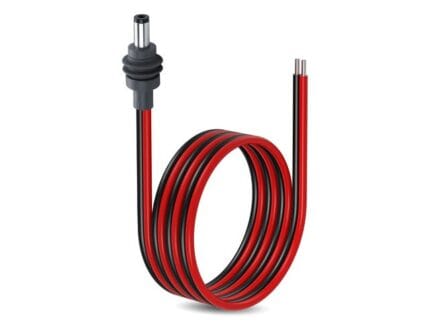
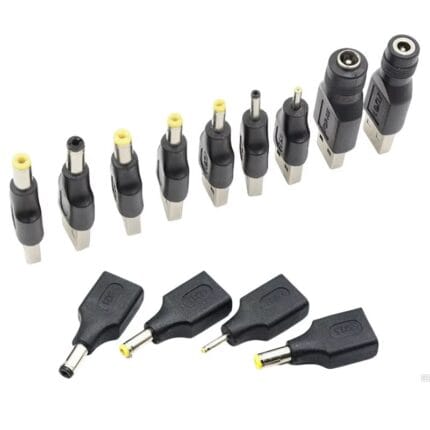
DC Barrel Adapter Kit – 5521 / 5525 / 4017 / 3513 / 1.35mm / 2.5mm, 6-Piece
A dc barrel adapter kit covering 5.5x2.1, 5.5x2.5, 4.0x1.7, 3.5x1.35 and 2.5 mm in six molded female-to-male adapters, so one supply covers a mixed estate. Center positive throughout, with nickel-plated brass contacts. Measure the socket pin with a caliper before ordering: the outer shell is identical across three of these five sizes. Bagged with a size card, or boxed with a printed insert.