14 AWG DC Barrel Pigtail Cable 5.5×2.1mm to Bare Wire or Ring Terminals
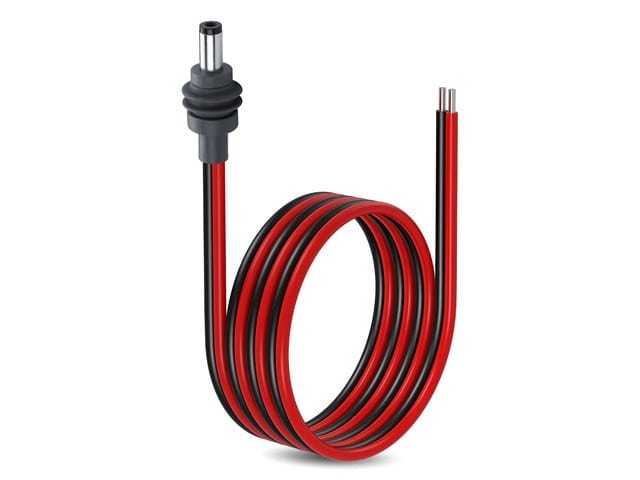
A dc barrel pigtail cable for permanent low-voltage installs: molded 5.5×2.1mm center-positive plug to 14 AWG stranded tinned copper tails, in 1 m or 3 m, with optional M6 or M8 ring terminals, bootlace ferrules or an inline fuse holder fitted near the supply end.
Overview
Where a device never moves, a pigtail is tidier than a wall adapter and a coiled lead, and more
reliable than a barrel plug knocked into a socket in the back of a cabinet. One end of this
DC barrel pigtail cable is a molded 5.5×2.1mm plug; the other end is stripped tinned
copper, ready for a fused distribution panel, a battery post or a screw terminal block. The DC path
stays DC from battery to device, which is how RV, marine and off-grid cabinets are normally wired. The
decision that matters on this build is what happens at the free end, so that is where most of this page
sits.
Key Specifications
| Connector A | DC barrel plug 5.5×2.1mm, center positive, sealed overmold |
|---|---|
| Connector B | Stripped and tinned bare wire, red / black |
| Conductor | 14 AWG stranded tinned copper |
| Lengths | 1 m / 3 m |
| Jacket | Flexible PVC, -50 to +80 ℃ |
| Termination options | M6 / M8 ring terminals, inline fuse holder |
| Polarity | Center positive; red = positive |
| Fitment | Compact terminals and other 5.5×2.1mm center-positive inputs |
Choosing the termination at the free end
Four options cover almost every install, and the right one depends on what the cable is landing on
and who will be servicing it.
| Termination | Lands on | Pick it when | Watch out for |
|---|---|---|---|
| Stripped and tinned | Screw terminal blocks, spring cages, lever connectors | The panel is already there and the installer will dress it | Bare tails need a strain relief within 100 mm or the strands work-harden and break |
| Bootlace ferrule | Spring and screw cages | Production builds that want a repeatable, inspector-friendly finish | Ferrule size has to match the conductor, not the terminal |
| M6 / M8 ring terminal | Battery posts, busbars, studded distribution points | Vehicle, marine and solar work where the connection is a stud | Stud size and ring orientation; a ring on a vibrating post needs a lock washer |
| Inline fuse holder | Anything fed from a battery | The run leaves the distribution panel, which is nearly always | Fit it close to the supply end, not next to the load |
The tinned conductor is not a detail. Stranded tinned copper crimps cleanly and does not wick
corrosion under the insulation, which is the failure mode in a humid bilge, a coastal cabinet or an
outdoor enclosure where a plain copper tail goes black within a season.
Sizing the conductor: gauge against length
On a 12 V system the limiting factor is nearly always voltage drop rather than the current rating of
the wire. The figures below are nominal resistance values for stranded copper at 20 ℃, for
estimating only; conductor sizes follow the American wire gauge scale, where a smaller number is a thicker
conductor. Both conductors count, so a 3 m cable is 6 m of copper in series.
| Conductor | Nominal resistance per meter | Round-trip at 1 m | Round-trip at 3 m |
|---|---|---|---|
| 14 AWG | About 8.3 mΩ | About 17 mΩ | About 50 mΩ |
| 16 AWG | About 13 mΩ | About 26 mΩ | About 78 mΩ |
| 18 AWG | About 21 mΩ | About 42 mΩ | About 126 mΩ |
Multiply the round-trip figure by your load current to get the drop in volts, then compare it with
the input range on the device label. The current rating and the temperature rise your assembly is built
and verified to are the values stated on your drawing — send us the load current and the one-way
distance and we will size the conductor before you commit to a build.
Polarity and identification
The barrel is center positive and the tails are red for positive, black for return, which is the
convention across most of this gear. Reversing it on a barrel supply damages unprotected equipment, so
check the symbol on the device before applying power and confirm with a meter on the first unit of a
run. Where a build is going into a fleet, we can print the polarity and your part number on the jacket
so the next person to open the cabinet does not have to guess.
Where installers use this DC barrel pigtail cable
- RV and camper builds feeding a router, terminal or monitor from the house battery
- Boats and cabins where the supply comes from a fused switch panel
- Off-grid solar boxes with a 12 V or 24 V battery bus
- Test benches and racks that need a repeatable DC lead rather than an adapter
- LED and signage cabs fed from a driver in a separate enclosure, next to our COB LED power injection cable
Installation notes
- Fit the fuse as close to the supply end as the layout allows. A fuse next to the load protects nothing except the load.
- Support the cable within 100 mm of the termination. The free end is where a pigtail fails, not the middle of the run.
- Where the run passes through a panel, use a grommet and leave a drip loop below the joint.
- Do not cut the molded end to shorten the cable — a cut end loses the overmold and the strain relief with it.
- Torque ring terminals to the panel maker’s figure. A loose ring on a battery post is a heater.
How to specify your build
- Length — 1 m or 3 m stock, or a custom length.
- Conductor — 14 AWG stock; heavier for long runs at high current.
- Termination — stripped and tinned, ferrule, M6 or M8 ring, or a combination.
- Fusing — inline holder fitted, and at which end.
- Barrel style — straight or right-angle, and the sealing collar if it is outdoors.
- Jacket color and print, and your part number on the bag.
Workmanship and testing
Build standard for 14 AWG DC Barrel builds is IPC/WHMA-A-620 Class 3 under ISO 9001, with terminations from 32 to 12 AWG. continuity and pinout are checked on every 14 unit before packing, and seal checking is quoted whenever an ingress rating is on the drawing.
Every production run can ship with RoHS and REACH declarations and the electrical report agreed at quotation; see certifications and material declarations. UL styles and other named approvals are built to drawing: we source to the style you specify and document it, rather than asserting a listing we do not hold. Termination, molding and verification happen in-house see the assembly lines behind this build so the process that made your sample is the process that runs the order. More background: cable assemblies for marine and outdoor equipment. Tooling is quoted separately, cut in-house rather than brokered out, and owned by you.
Related DC power leads
- DC 5525 Male to Bare Wire Power Cable
- COB LED Power Injection Cable DC 5.5×2.1mm Male to Tinned Bare Wire
- Threaded Locking DC Pigtail 5.5×2.1mm, Shielded Right-Angle Plug
- Fused 12V Distribution Harness, Anderson Powerpole to 4x DC 5.5×2.1mm
- IP67 DC to USB-C Cable, 5.5×2.1mm Barrel Power Lead
Full range: DC Plug Power Cable.
Frequently Asked Questions
Which termination should I order?
Stripped and tinned if your installer is dressing into a terminal block. Ring terminals if it lands on a stud or a busbar. An inline fuse holder if the run leaves a battery — which it usually does.
Is 14 AWG enough for my run?
For the stock 1 m and 3 m lengths at typical compact-terminal loads, yes. For a long cabin run at high current, send us the distance and the load current and we will size it properly.
Can I get one end bare and one end ringed?
Yes, mixed terminations are common. State which conductor gets which on the drawing.
Why tinned copper?
It resists corrosion wicking under the insulation, which is what kills plain copper tails in humid, coastal and marine installs.
What is the minimum order?
On 14 AWG DC Barrel builds, prototype lots run from 1 to 50 pcs and leave in 3 working days; production runs of 500 pcs and up ship 14 working days after approval.
| Connector A | DC barrel plug 5.5×2.1mm, center positive, sealed overmold |
|---|---|
| Connector B | Stripped and tinned bare wire, red / black |
| Conductor | 14 AWG stranded tinned copper |
| Lengths | 1 m / 3 m |
| Jacket | Flexible PVC, -50 to +80 C rated |
| Termination options | M6 / M8 ring terminals, inline fuse holder |
| Polarity | Center positive; red = positive |
| Fitment | Compact terminals and other 5.5×2.1mm center-positive inputs |
Related products
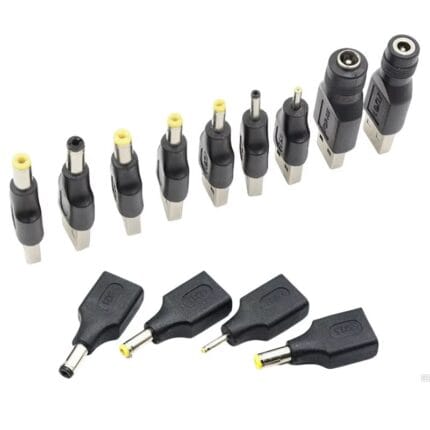
DC Barrel Adapter Kit – 5521 / 5525 / 4017 / 3513 / 1.35mm / 2.5mm, 6-Piece
A dc barrel adapter kit covering 5.5x2.1, 5.5x2.5, 4.0x1.7, 3.5x1.35 and 2.5 mm in six molded female-to-male adapters, so one supply covers a mixed estate. Center positive throughout, with nickel-plated brass contacts. Measure the socket pin with a caliper before ordering: the outer shell is identical across three of these five sizes. Bagged with a size card, or boxed with a printed insert.