KUKA Robot Encoder Cable Compatible with 00-174-775
This kuka encoder 174775 cable is wired to the KUKA pin assignment for part 00-174-775, running encoder power and the data pair from the robot axis back to the controller. Six cores plus one pair under foil and braid, in a matte black PUR drag-chain jacket. A compatible replacement, not an OEM part.
Overview
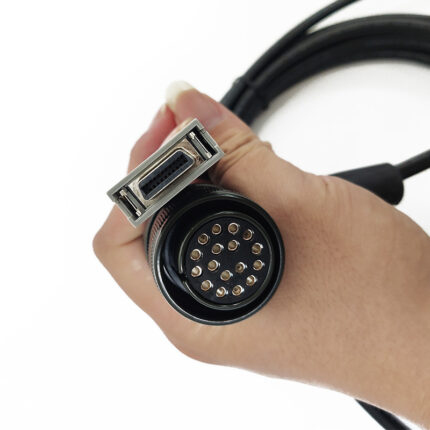
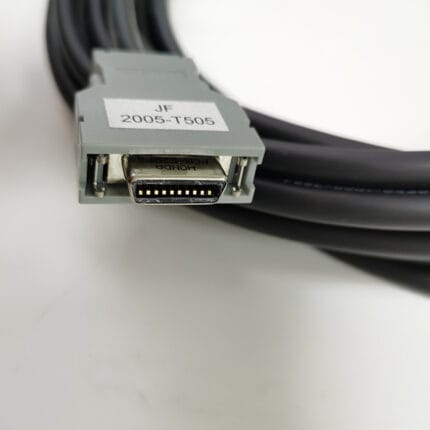
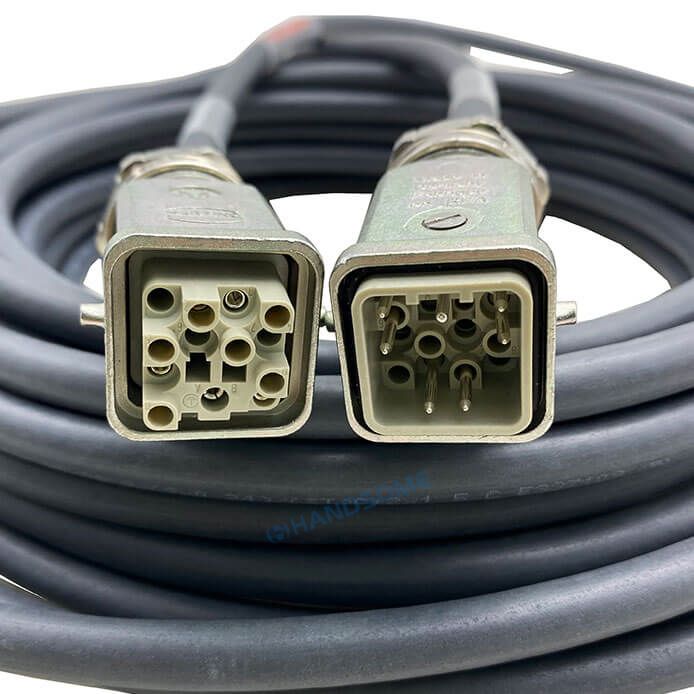
A kuka encoder 174775 cable is the feedback lead between the encoder on the rear of a KUKA robot axis and the controller. This one is wired to the KUKA pin assignment for part number 00-174-775: six 24 AWG signal conductors plus one twisted pair for the encoder data lines, all under an overall foil plus braid shield with a drain wire, in a halogen-free PUR jacket rated for drag-chain use with a matte black finish. Both heads use a KUKA-compatible 8-pin industrial rectangular shell with a thumb-latch lock. It is a compatible replacement, not an OEM KUKA product.
Key Specifications
| Connector A | KUKA encoder side, 8-pin industrial rectangular, locking |
|---|---|
| Connector B | Controller side, KUKA controller receptacle or open lead |
| Cable | 6-core + 1-pair, 24 AWG stranded tinned copper |
| Shielding | Overall foil + braid, drain wire |
| Jacket | PUR, black, drag-chain rated, oil-resistant |
| Bend Radius | 10 x OD static, 7.5 x OD dynamic (drag-chain) |
| Length | 5 m to 30 m standard; OEM on request |
| Cross-reference | OEM part 00-174-775 – compatible replacement |
How to confirm this kuka encoder 174775 cable matches your axis
The part number is a starting point, not a guarantee. Encoder feedback wiring changed across controller generations and across axis types, and a lead that is mechanically correct can still be electrically wrong. Three checks settle it before you spend money on a first article. First, the encoder head on the motor: count the pins and note the keyway position. Second, the controller end: is it a receptacle on the cabinet, or an open lead into a terminal strip. Third, whether the axis is a standard rotary axis or a linear or external axis, because those use a different length and sometimes a different pinout.
| Check | How to capture it | What it rules out |
|---|---|---|
| Pin count and keyway at the encoder | Photo of the motor-side connector face, straight on | Wrong shell size or a mirrored key |
| Controller end termination | Receptacle on the cabinet, or open lead | A plug you cannot land |
| Axis type and generation | Controller model and axis number from the teach pendant | A pinout that changed between generations |
| Routed length | Full stroke plus bend radius at each end | A lead that pulls taut at the travel limit |
| Fixed or in a carrier | Whether the run moves with the axis | Fixed-installation stranding on a moving run |
Why encoder leads fail before the encoder does
The encoder is a sealed device bolted to the back of a servo motor. The cable is a flexing assembly strapped to a moving arm. On a six-axis robot the wrist end of the run sees both bending and torsion at the same time, and that combination is what destroys ordinary cable: the lay of the conductors is pulled open, the screen loses coverage, and the differential pair stops behaving like a pair. The symptom is usually speed-dependent position error – clean at low speed, noisy at full rapid – which sends people looking at the drive when the problem is the lead. If your cell runs continuous drag-chain duty, say so up front and we will build with high-flex stranding and a jacket matched to the coolant.
What the pair and the screen are doing
The twisted pair carries the encoder data as a differential signal, which means noise rejection depends on the twist staying intact all the way to the contact and on the screen being a real screen. A foil plus braid construction gives coverage at both low and high frequency – foil for the high-frequency end, braid for the low-frequency end and for the mechanical job of carrying fault current. The drain wire is there so you can terminate the foil properly instead of twisting it into a pigtail. We keep the twist to within about 25 mm of the contact and bond the screen at the connector, because that is where the pair usually gets destroyed in the field.
Torsion or bending: which one is your axis doing
Bending is a cable going around a radius in one plane, and almost every flexible cable is built for it. Torsion is the cable twisting about its own axis, which is what a six-axis arm does at the wrist on nearly every move. The two load the construction in completely different ways: under torsion an ordinary stranded bundle unlays, the screen loses coverage, and the conductors migrate until the shortest one carries the load and breaks. If your run includes a rotating joint, tell us the rotation angle and we will build on a torsion-rated construction with the shield applied so it cannot unwind. It is not a more expensive cable so much as a different one, and specifying it after the first failure is the usual – and avoidable – sequence.
Typical applications for this kuka encoder 174775 cable
- KUKA robot axis encoder feedback cable replacement
- Drop-in lead for the 00-174-775 cable set on KR and VK series
- General 6-core plus pair encoder feedback on industrial machinery
- High-flex production cells using drag-chain cable tracks
- Refurbishment and spare-part programs for older KUKA cells
How to specify your build
- Controller and axis, so the pinout can be confirmed.
- Connector heads – both ends, straight or right-angle.
- Length, including stroke and bend radius margin.
- Fixed or moving – this decides stranding and jacket.
- Back-shell style, and whether you want a label printed.
- Quantity, and whether this is a sample or a production order.
Workmanship and testing
ISO 9001 covers the system and IPC/WHMA-A-620 Class 3 covers the work on KUKA Robot Encoder Cable builds, across 32 to 12 AWG. No KUKA unit is packed until continuity and pinout check out, and seal checking is quoted whenever an ingress rating is on the drawing.
Every production run can ship with RoHS and REACH declarations and the electrical report agreed at quotation; see certifications and material declarations. UL styles and other named approvals are built to drawing: we source to the style you specify and document it, rather than asserting a listing we do not hold. For continuous motion the stranding, lay length and jacket are built to the flex method described under continuous-flex construction and flex-life testing, with the cycle count defined in the test scope. Related reading: our test and measurement work. Tooling is quoted separately, cut in-house rather than brokered out, and owned by you.
Custom builds and ordering
KUKA Robot Encoder Cable lots run from 1 to 50 pcs, out in 3 working days; volume starts at MOQ 500 pcs shipping 14 working days after approval. Tooling not already held adds around 10 working days. KUKA orders go out under your part number and labeling, OEM or ODM, and material certificates and first-article reports come with them on request.
Related robot and feedback assemblies
- KUKA Robot Power Cable Compatible with MOT X20
- Encoder Feedback Cable with PUR Jacket for Digital Drives
- OEM Servo Encoder Cable Cross-Reference Builds
- Custom Servo Motor Cable Assembly
- Hybrid Servo Cable for One-Cable Solution Servo Drops
- Robot Torsion Resistant Cable for Six-Axis Arms
Full range: signal and data cable assemblies.
Frequently Asked Questions
Is this an original KUKA cable?
No. The 00-174-775 reference is for identification only; this is a compatible replacement built to your drawing and pinout.
Can you build with an open lead on the controller end?
Yes. Numbered ferrules are standard on an open end so it can be landed without a second connector.
What if my cell has a different pinout?
Then we build to the pinout you send instead. The pinout on your drawing is the one we verify against.
How is the cable tested?
ISO 9001 covers the system and IPC/WHMA-A-620 Class 3 covers the work on KUKA Robot Encoder Cable builds, across 32 to 12 AWG. No KUKA unit is packed until continuity and pinout check out, and seal checking is quoted whenever an ingress rating is on the drawing.
| Connector A | KUKA encoder side, 8-pin industrial rectangular, locking |
|---|---|
| Connector B | Controller side, KUKA controller receptacle or open lead |
| Cable | 6-core + 1-pair, 24 AWG stranded tinned copper |
| Shielding | Overall foil + braid, drain wire |
| Jacket | PUR, black, drag-chain rated, oil-resistant |
| Bend Radius | 10 x OD static, 7.5 x OD dynamic (drag-chain) |
| Length | 5 m to 30 m standard; OEM on request |