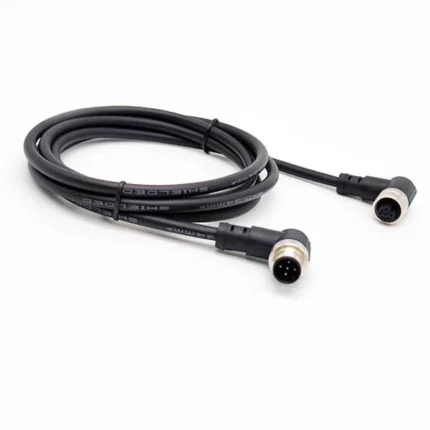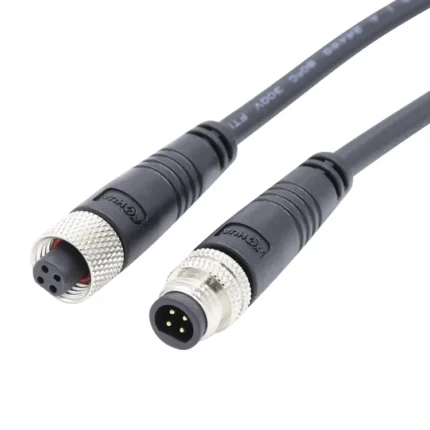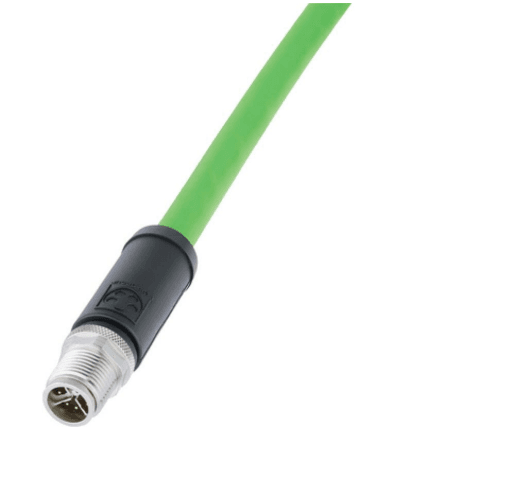
M12 Push-Pull X-Code Cat6A Industrial Ethernet Cable
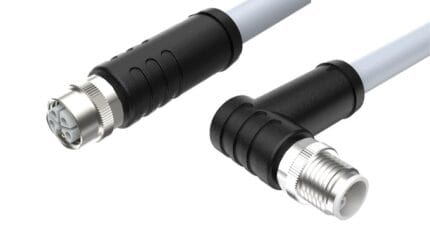
This M12 push pull cat6a cable replaces the threaded coupling with a single-motion latch per IEC 61076-2-010 while keeping X-coded Cat6A performance. IP67, S/FTP 26 AWG, halogen-free PUR. Plugs also seat in existing threaded X-coded sockets.
Overview
An M12 push pull Cat6A cable keeps everything the X-coded family delivers and removes the part that slows commissioning down. Instead of a threaded coupling nut that needs two hands and several turns, the push-pull variant defined by IEC 61076-2-010 uses a latch that engages in one motion and releases by pulling the sleeve. On a dense panel or on equipment that is disconnected daily, that difference is measured in minutes per device rather than in specification lines. The X-coding still governs what travels: four shielded pairs at Cat6A class, 10 Gbit/s capable.
Key Specifications
| Standard | IEC 61076-2-010 push-pull locking plus IEC 61076-2-109 X-coding |
|---|---|
| Connector A | M12 push-pull X-coded 8-pin male, IP67 |
| Connector B | M12 push-pull X-coded 8-pin male, IP67 |
| Cable | Cat6A S/FTP, 26 AWG stranded, 4 twisted pairs |
| Speed class | 10 Gbit/s class, 10GBASE-T capable |
| Rated | 0.5 A per contact / 60 V DC |
| Jacket | PUR halogen-free, drag chain capable |
| Backward mating | Push-pull plug seats in a classic threaded X-coded socket |
| Length | OEM build to required length |
What changes mechanically
The locking sleeve is built into the connector housing rather than added around it, so the outside diameter stays close to a conventional X-coded M12. Internally nothing changes: the same eight contacts, the same cross-shaped pair shield, the same keyway. What you gain is mating speed, repeatability of torque, and, on a rack full of ports, the ability to get one hand into a space where two will not fit.
| Attribute | Threaded X-coded | Push-pull X-coded |
|---|---|---|
| Locking method | Rotating coupling nut to hand torque | Axial latch, engages in one motion |
| Mating time | Several turns per connection | Single push, audible and tactile engagement |
| Hands needed | Usually two in tight layouts | One, which decides most dense panels |
| Vibration retention | Good when torqued correctly | Good, and independent of installer torque |
| Service life consideration | Thread wear if overtightened or cross-threaded | Latch mechanism wear if repeatedly abused |
| Outer diameter | Reference size | Close to reference, despite the added function |
The intermateability asymmetry everyone trips over
This is the single most useful thing to know before you standardize. A push-pull plug will seat in a classic threaded X-coded socket. A classic threaded plug will not seat in a push-pull socket. That asymmetry is intentional: it keeps the two locking types distinguishable in the field while letting a new cable drop into a socket already mounted on equipment.
| Plug | Socket | Result | Why |
|---|---|---|---|
| Push-pull | Threaded X-coded | Mates | Deliberate backward compatibility during migration |
| Push-pull | Push-pull | Mates | The intended pairing |
| Threaded | Push-pull | Does not mate | Locking geometries differ on purpose |
| Any other coding | Either type | Does not mate | X-coding keyway excludes A, B, D and power codings |
If you are rolling push-pull into an installed base of threaded sockets, this means you can change the cable side first and the equipment side later, one machine at a time.
When push-pull pays for itself
Do the arithmetic per connection. Ten fewer thread turns on sixty ports is real time, and on an asset that is reconfigured weekly it compounds quickly. In a fixed installation mated once every two years, the threaded version is cheaper and completely adequate, and we will tell you that.
| Situation | Push-pull worth it | Threaded fine |
|---|---|---|
| Dense cabinet with many ports per rack | Yes | No |
| Equipment teardown each product changeover | Yes | No |
| AGV or AMR battery swap connections | Yes | No |
| Permanent machine drop, mated once | Probably not | Yes |
| Retrofit into a threaded installed base | Yes, cable side first | Already there |
X-coding still governs the signals
Changing the lock does not change the electrical story. Pair one through pair four are individually screened inside the cross shield, the impedance is 100 ohm nominal, and the performance class comes from the cabling standard rather than from the latch. Keep your Gigabit Ethernet expectations tied to the channel, not to the connector: the plugs consume part of the available margin, so short machine-mounted runs are the comfortable case.
Changing the locking mechanism leaves the coding untouched, so the keying rules still apply. The download center carries a two-page reference listing every M12 letter from A to Y with its pole counts and usual application.
Typical applications for this M12 push pull Cat6A cable
- Dense switch and gateway cabinets where screw threads dominate commissioning time
- AGV and AMR connections broken daily for battery swap or module change
- Rolling stock and process cabinets needing single-hand mating in confined panels
- Machine vision clusters feeding 10 gigabit cameras through a drag chain
- Rapidly reconfigured test rigs, skids and rental equipment
How to specify your build
- Locking type at each end, and what the equipment side already has.
- Length, and whether the run flexes.
- Jacket – halogen-free PUR standard, other options on request.
- Route and what it passes near: power conductors, drives, weld controls.
- Screen concept at both ends, matching your EMC plan.
- Quantity, prototype or production.
Workmanship and testing
For M12 Push-Pull X-Code Cat6A builds the line runs to IPC/WHMA-A-620 Class 3 under ISO 9001, terminating 32 to 12 AWG. continuity and pinout are tested on each M12 unit before it is packed, and seal checking is quoted whenever an ingress rating is on the drawing.
RoHS and REACH declarations are provided per project together with the agreed test reports; the documentation scope is listed under certifications and compliance. If your drawing specifies a UL style, we build to that drawing and supply the UL reference with the shipment instead of substituting an equivalent. Flex life is a construction decision made before tooling, following the conductor and jacket approach set out under continuous-flex design and testing. The wider context is covered under what automation programs ask for. Any tooling we cut for this part stays yours, maintained in our own tool room under your part reference.
Custom builds and ordering
M12 Push-Pull X-Code Cat6A prototype lots start from 1 to 50 pcs and ship in 3 working days. Production requires 500 pcs and runs 14 working days after sample approval. Your part number and labeling go on OEM and ODM M12 shipments, and material certificates and first-article reports come with them on request. We hold 100 sets of mold tooling in house, so a standard body needs no tooling time and a new one adds about 10 working days.
Related M8 and M12 assemblies
- M12 X-Coded Cat6A Cable to RJ45 for Machine Vision
- M12 X-Code Cat6A to RJ45 Shielded Industrial Ethernet Cable
- M12 Rail Ethernet Cable for Rolling Stock Networks
- Cat6 S/FTP IP67 Waterproof RJ45 Patch Cord
- M12 Drag Chain Cable, Continuous Flex Cordset
- Custom Shielded Ethernet Data Cable
Full ranges: circular M8 and M12 cable assemblies and Ethernet patch cords.
Frequently Asked Questions
Will a push-pull plug fit my existing threaded socket?
Yes. That direction is deliberately compatible so you can migrate the cable side first.
Will a threaded plug fit a push-pull socket?
No. The locking geometries are intentionally different so the two types stay distinguishable on site.
Does the latch hold under vibration?
Yes, and it does not depend on the installer applying the right torque, which is often the real advantage in the field.
Is it still IP67?
Yes, the rated sealing applies in the mated state for this locking type.
Is it worth the extra cost on a fixed installation?
Usually not. If a port is mated once and left alone for years, the threaded version is cheaper and entirely adequate.
| Standard | IEC 61076-2-010 (push-pull locking) + IEC 61076-2-109 (X-coding) |
|---|---|
| Connector A | M12 push-pull X-coded 8-pin male, IP67 |
| Connector B | M12 push-pull X-coded 8-pin male, IP67 |
| Cable | Cat6A S/FTP, 26 AWG stranded, 4 twisted pairs |
| Speed | 10 Gbps / 500 MHz (10GBASE-T capable) |
| Rated | 0.5 A per contact / 60 V DC |
| Jacket | PUR halogen-free, drag-chain rated |
| Backward | Push-pull plug mates with classic threaded M12 X-coded socket |
| Length | OEM build to required length |