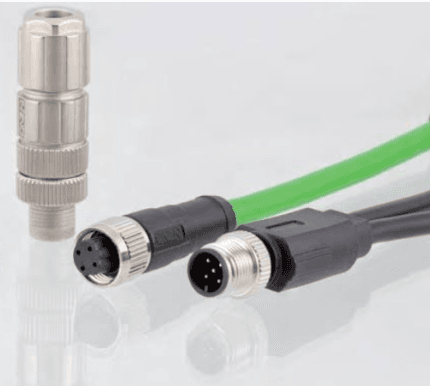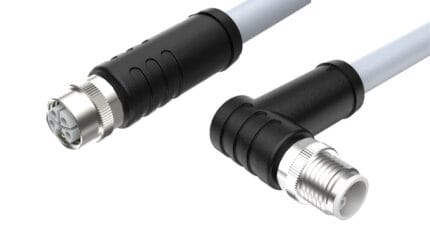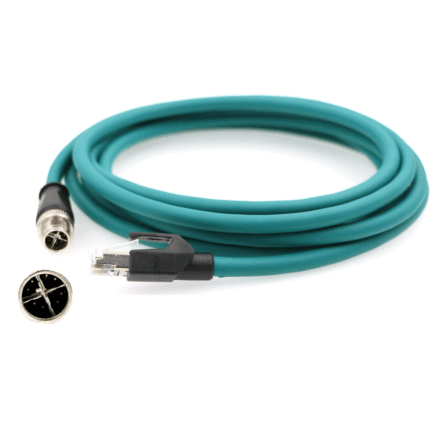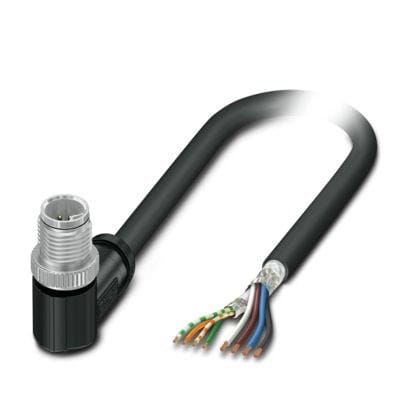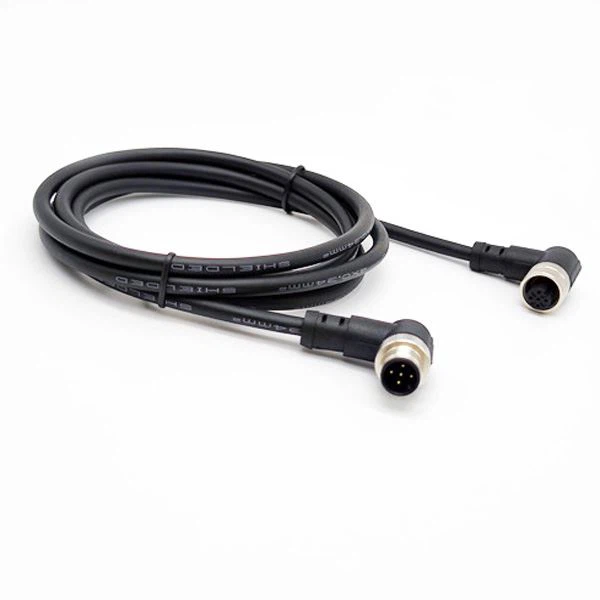
M8 / M12 5-Pin Right-Angle PUR Sensor Cable (Gray)
An m8 m12 5 pin cable with a right-angle body in oil-resistant gray PUR, IP67, 60 V and 4 A per pin, 5 x 26 AWG. Built to IEC 61076-2-104 or 2-101 for factory sensor runs that see oil and coolant.
Overview
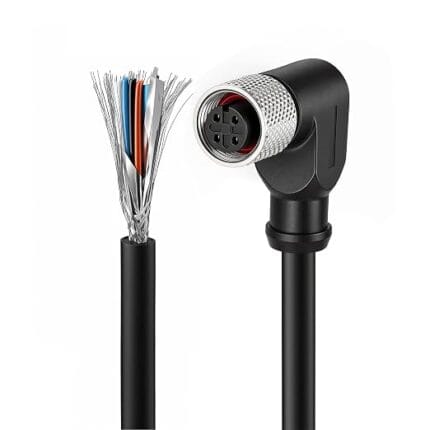
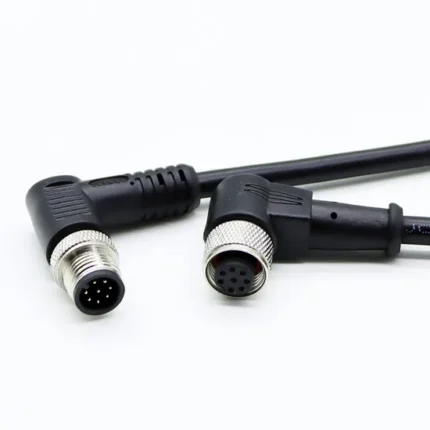
An m8 m12 5 pin cable covers both thread sizes of the same five-pin, A-coded sensor family, with a right-angle body and an oil-resistant gray PUR jacket. It is built to the M8 family of IEC 61076-2-104 or the M12 family of IEC 61076-2-101 depending on which thread you specify, rated IP67 mated, 60 V and 4 A per pin, with five 26 AWG conductors. The gray PUR jacket is the point of this part: on a machine where cutting fluid, hydraulic oil and coolant mist are part of the environment, PVC hardens and cracks and PUR does not. Right-angle because on a sensor mounted flat to a machine frame there is no room for a straight body.
Key Specifications
| Connector | M8 or M12 5-Pin A-Coded, right-angle male/female |
|---|---|
| Standards | IEC 61076-2-104 (M8) / IEC 61076-2-101 (M12) |
| IP rating | IP67 |
| Rated voltage | 60 V AC/DC |
| Rated current | 4 A per pin |
| Conductor | 5 x 26 AWG |
| Jacket | PUR, oil and UV resistant, gray |
| Operating temperature | -25 to +85 C |
| Mating cycles | More than 100 |
| Orientation | Right-angle |
M8 or M12: the decision is mechanical, and it is permanent
Both threads carry the same five-pin A-coded insert and both will do the job electrically. The difference is the thread size, the body diameter and the space they need, and once a panel is drilled or a sensor is specified, you are committed. M8 is the compact choice for small sensors and tight heads; M12 is the general-purpose industrial standard, it is more robust mechanically, and it is what most field hardware is already drilled for.
| M8 | M12 | |
|---|---|---|
| Thread | 8 mm | 12 mm |
| Body diameter | Smaller – fits compact sensor heads | Larger – the general industrial standard |
| Standard | IEC 61076-2-104 | IEC 61076-2-101 |
| Typical pin counts | 3, 4, 5, 6 | 3, 4, 5, 8, 12, and coded variants |
| Best for | Compact sensors, tight mounting, tooling | General factory automation, field I/O |
| Mechanical robustness | Adequate, easier to over-tighten | More forgiving; more thread engagement |
| Interchangeable | No – different thread | No – different thread |
Five pins, A-coded: what the fifth conductor is for
The move from four pins to five is almost always one of two things: a second switched output, usually the complement of the first, or a spare conductor used for a configuration or teach-in line. That is why a 5-pin lead will physically plug into a 5-pin receptacle and still not do what you expected if the device assigns pin 5 differently. Get the pinout off the device datasheet and build to it rather than to a generic chart.
| Pin (typical) | Assignment | Note |
|---|---|---|
| 1 | Supply positive | Often brown in the standard sensor color code |
| 2 | Second output or a second signal | The reason for a 5-pin part over a 4-pin |
| 3 | Supply negative | Often blue |
| 4 | Signal output | Often black – the primary switched output |
| 5 | Second output, complement, or configuration | Often gray or white; device dependent |
Where the fifth conductor sits is decided by the pinout; whether the plug will go in at all is decided by the keyway. The M12 coding reference in the download center covers both, mapping A through Y to the pole counts and jobs they are normally specified for.
Why PUR in a machine shop
Jacket material decides service life in a wet, oily cell far more than any electrical specification. PUR resists cutting oil, coolant and hydraulic fluid, it survives UV well enough for outdoor use, and it stays flexible at low temperature. PVC is cheaper and perfectly adequate in a dry cabinet, but in a machining cell it stiffens, it cracks at the point where it leaves the connector, and once the jacket is split the fluid wicks along the conductors and corrodes the contacts from the inside. The IEC publishes the connector standards these families are built to; the jacket choice is yours and it should follow the environment.
| Environment | Jacket | Why |
|---|---|---|
| Dry cabinet, indoor panel | PVC | Cheaper and entirely adequate |
| Machining cell, coolant and cutting oil | PUR | Resists the fluids that make PVC crack |
| Washdown, food and beverage | PUR, with a rated stainless option | Caustic cleaners and high-pressure water |
| Outdoor, UV exposure | PUR | Holds up where PVC hardens |
| Continuous flex, drag chain | PUR, flex-rated construction | Abrasion and cyclic bending |
Where an m8 m12 5 pin cable earns its keep
- Proximity, photoelectric and limit switches on machining and packaging lines
- Encoders and dual-output sensors that need the fifth conductor
- Factory automation cells and robotic workcells exposed to coolant mist, see our M12 Drag Chain Cable
- AGV and AMR power and signal links on the shop floor
- Washdown and food-grade areas, where the right part is the M12 IP69K Washdown Cable
- Installs that want a shielded 4-pin instead, compare the M12 4-Pin A-Coded Right-Angle Shielded Sensor Cable
- Compact sensor heads where the 8 mm thread is the only thing that fits, see the M8 3-Pin A-Coded Sensor Cable
- Panels that need a bulkhead rather than an inline extension, see the M12 Bulkhead Panel Connector
Failure modes on five-pin sensor runs
Fluid ingress through a cracked jacket at the connector exit is the expensive one, and it is prevented by choosing the right jacket in the first place. After that: a coupling nut left loose, which lets the connector back off under vibration until the seal is no longer compressed; and a right-angle body taking a sideways pull because the cable was never clamped close to the connector. Clamp the cable, hand tighten the nut, and route the exit the way the connector points.
What we treat as a target rather than a claim
What is listed here for M8 / M12 5-Pin builds is the industry-standard definition, not a measurement we took on a finished part. What your assembly is built and verified to is what your drawing states, confirmed against the supplier datasheet before a quote goes out.
How to specify your build
- Thread – M8 or M12; confirm what the device and the panel are drilled for.
- Pin count and coding – 5-pin A-coded as standard.
- Orientation – right-angle as standard, or straight.
- Length – state the route length; custom lengths are quoted.
- Jacket – gray PUR as standard; PVC on request for dry installs.
- Pinout – send the device datasheet.
- Quantity and whether this is a prototype or a production order.
Workmanship and testing
For M8 / M12 5-Pin builds the line runs to IPC/WHMA-A-620 Class 3 under ISO 9001, terminating 32 to 12 AWG. continuity and pinout are tested on each M8 unit before it is packed, and seal checking is quoted whenever an ingress rating is on the drawing.
Every production run can ship with RoHS and REACH declarations and the electrical report agreed at quotation; see certifications and material declarations. UL styles and other named approvals are built to drawing: we source to the style you specify and document it, rather than asserting a listing we do not hold. The 90-degree exit is formed in the tool itself; the exit options and their clearances are set out under right-angle overmold tooling options. The wider context is covered under cable assemblies for industrial automation and robotics. Tooling is quoted separately, cut in-house rather than brokered out, and owned by you.
Custom builds and ordering
M8 / M12 5-Pin prototype lots start from 1 to 50 pcs and ship in 3 working days. Production requires 500 pcs and runs 14 working days after sample approval. Your part number and labeling go on OEM and ODM M8 shipments, and material certificates with first-article reports are available. We hold 100 sets of mold tooling in house, so a standard body needs no tooling time and a new one adds about 10 working days.
Related M8 and M12 hardware
- M8 3-Pin A-Coded Circular Connector Sensor Cable
- M8 4-Pin A-Coded IP65 Waterproof Power Cable
- M12 4-Pin A-Coded Right-Angle Shielded Cable
- M12 Drag Chain Cable, Continuous Flex Cordset
- M12 IP69K Washdown Cable with Stainless Steel Shell
Full ranges: circular M8 M12 cable, signal and data cables and custom wire harnesses.
Frequently Asked Questions
Can I swap an M8 lead for an M12 one on the same sensor?
No. The threads are different sizes and they do not interchange. Confirm which thread the device and any panel cut-out are built for before ordering.
Why five pins instead of four?
Usually a second switched output or a configuration line. Check the device datasheet, because the assignment of pin 5 is manufacturer specific.
Is gray PUR just a color choice?
No. PUR is the material and it is what resists oil, coolant and UV. Gray is the standard color for sensor cable in a machine cell.
How tight should the coupling nut be?
Hand tight. Enough to compress the seal and stop the connector backing off – more than that deforms the seal and lets fluid in.
| Connector | M8 or M12 5-Pin A-Coded, right-angle male/female |
|---|---|
| Standards | IEC 61076-2-104 (M8) / IEC 61076-2-101 (M12) |
| IP rating | IP67 |
| Rated voltage | 60 V AC/DC |
| Rated current | 4 A per pin |
| Conductor | 5 x 26 AWG |
| Jacket | PUR, oil and UV resistant, gray |
| Operating temperature | -25 to +85 C |
| Mating cycles | More than 100 |
| Orientation | Right-angle |