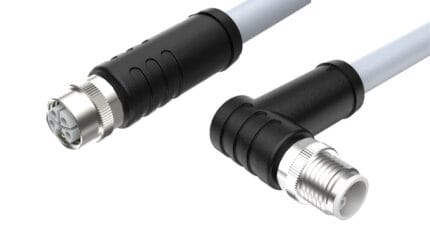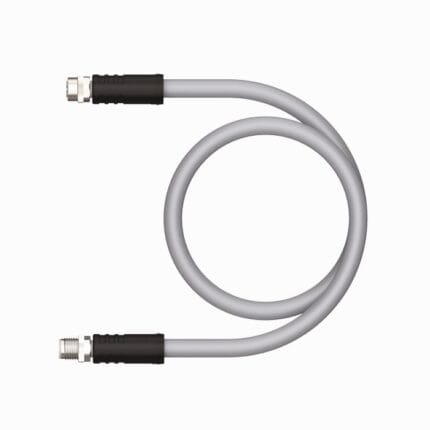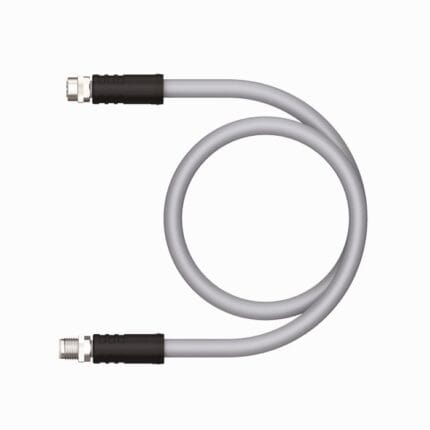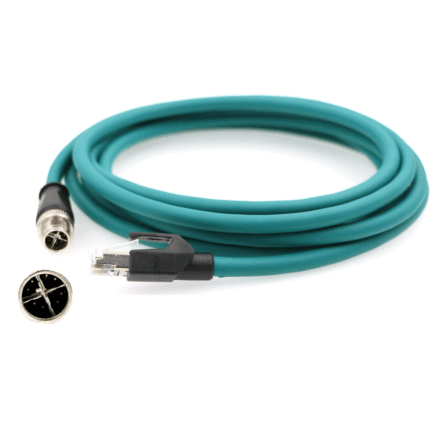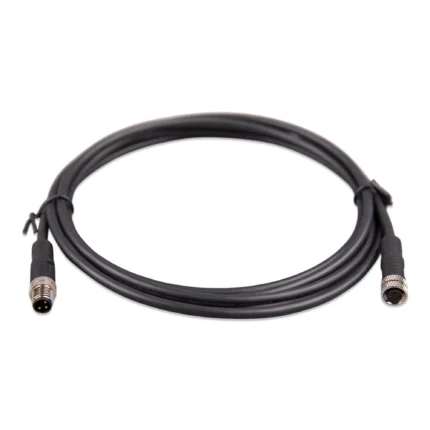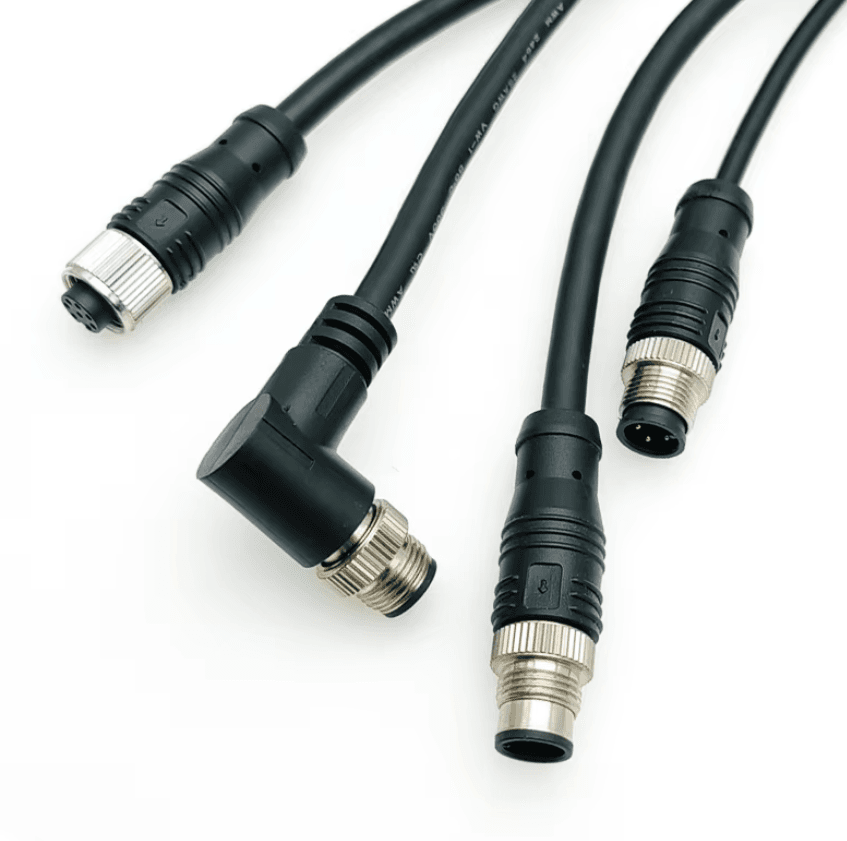
M12 A-Coded PVC/PUR Straight or Right-Angle Extension Cable
This M12 PVC PUR cable is offered in straight or right-angle A-coded bodies with 3 to 8 positions, so the two decisions are jacket compound and exit direction. PVC for dry enclosures, PUR for oil, coolant, UV and flexing runs. Built to length.
Overview
Choosing between jacket materials is the cheapest decision on the drawing and one of the most expensive to get wrong. An M12 PVC PUR cable shipping with the wrong compound will work perfectly for three months and then start cracking, swelling or going stiff, and by then the labor to replace it dwarfs the few percent the better material would have cost. This build covers straight and right-angle A-coded bodies from three to eight positions, so the two choices you actually have to make are the jacket and the exit direction.
Key Specifications
| Connector | M12 A-coded male / female, 3 / 4 / 5 / 8 pin |
|---|---|
| Interface standard | IEC 61076-2-101 |
| Ingress rating | IP67 in the mated state |
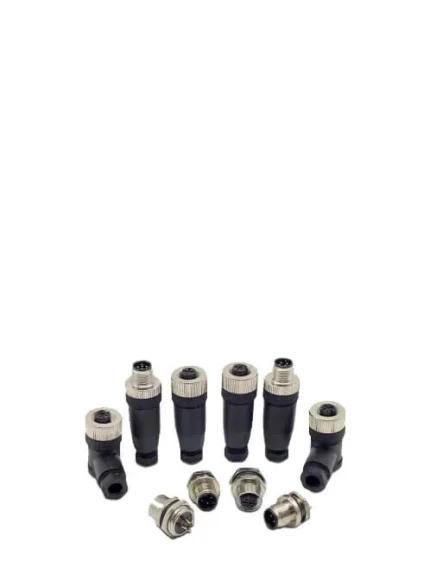
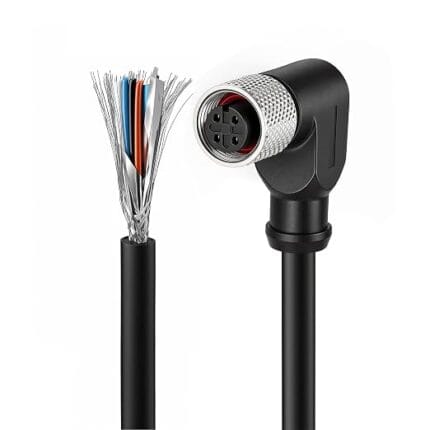
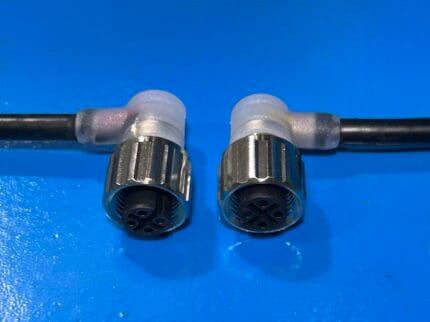
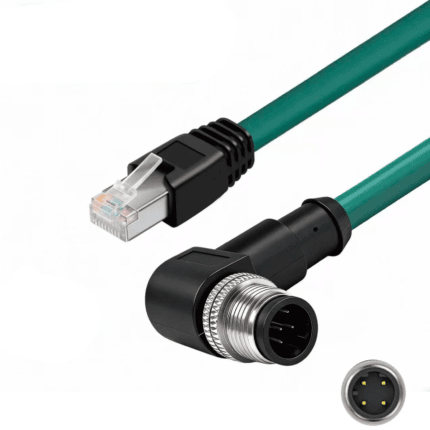
| Orientation | Straight or right-angle 90 degree overmold |
| Jacket options | PVC general purpose, PUR oil and UV resistant |
| Rated voltage | 60 / 30 V depending on pin count |
| Rated current | Up to 4 A per pin |
| Operating temperature | -25 to +85 °C |
| Mating cycles | >100 |
What actually kills a jacket
Not age. Five mechanisms do almost all the damage, and they look different on the bench, which is how you can tell them apart on a failed part.
| Mechanism | What it looks like | Material that resists it |
|---|---|---|
| Plasticizer extraction by oil and coolant | Surface goes tacky then hard, fine cracking at the bend | PUR, and halogen-free PUR for the aggressive case |
| Hydrolysis in warm wet areas | Softening, loss of tensile strength, sometimes a sour smell | Special hydrolysis resistant PUR grades |
| Abrasion against cable track and structure | Shiny rubbed patches then exposure of the braid | PUR, plus a supported route |
| UV and ozone outdoors | Chalky surface, surface microcracking on one side only | UV stabilized PUR or a dedicated outdoor compound |
| Cold embrittlement | Cracks when bent after a cold soak, fine starts when warm | PUR stays flexible well below PVC working range |
PVC or PUR: read the exposure first
PVC is not the bad option. Inside a dry enclosure with no coolant, no abrasion and no sunlight it performs for years, costs less and handles better in high volume assembly. The mistake is reaching for it by default and then routing the cable through the splash zone. Polyurethane costs more and resists the things that kill PVC, which is why it is the default recommendation anywhere the route is unclear.
| Factor | PVC | PUR |
|---|---|---|
| Purchase cost | Lower | Higher, and usually worth it |
| Oil and cutting fluid | Poor, plasticizer migrates out | Good to excellent |
| Abrasion and drag chain | Not recommended | Designed for it |
| UV and outdoor exposure | Needs stabilization and still ages | Good |
| Low temperature flexibility | Stiffens noticeably | Stays flexible |
| Hydrolysis in warm wet areas | Generally acceptable | Specify the resistant grade |
| Handling and stripping | Easy and forgiving | Firmer, needs the right tooling |
Drag chain duty is a third category
Continuous flex is not a material choice so much as a construction one. Compound, strand lay, screening and the way the conductors are cabled together all change when the cable has to survive millions of cycles, and a standard jacketed cordset will fail even if the jacket material is nominally right. If the run goes into a cable carrier, tell us the stroke, the cycle rate and the bend radius and we will quote the correct continuous flex drag chain cordset rather than re-purposing a fixed installation build.
Straight or right-angle: the clearance arithmetic
A straight body needs the strain relief length plus several cable diameters of bend radius ahead of it before the cable can turn. A right-angle body turns immediately, so it saves that whole envelope, at the cost of deciding which way the cable leaves. Skipping that decision is how assemblies arrive unable to be installed.
| Build | Envelope it needs | Pick it when |
|---|---|---|
| Straight both ends | Slender across the body, deep along the axis | The run leaves into open space |
| Right-angle at the device | Turns at once, saves the bend radius envelope | The device sits against a surface or beside another port |
| Right-angle at the panel | Same saving at the cabinet wall | Enclosure depth or a crowded bulkhead is the constraint |
| Right-angle both ends | Minimum depth at both ends, hardest to route | Clearance rather than cost is the binding constraint |
| Straight with service loop | Depth plus room for slack | The assembly will be disconnected repeatedly |
For right-angle bodies always specify the clocking direction on the drawing, counted around the mating axis. If you are unsure, a photograph of the installed device face is enough for us to recommend one.
Typical applications for this m12 pvc pur cable
- General factory automation drops inside dry enclosures where PVC is the sensible choice
- Machine tools and machining cells where coolant mist reaches every cable within a meter
- Outdoor panels, gantries and conveyors needing UV stability and low temperature flexibility
- Packaging and printing lines where the route rubs against structure for its whole life
- Mixed builds, with PVC in the cabinet and PUR on the section exposed to oil
What to put on the drawing
- Pin count and which contacts are actually used.
- End combination – straight or right-angle at each end, with clocking.
- Jacket, chosen from the exposure rather than the price list.
- Length along the route, plus whether any part of it moves.
- Medium the cable touches: oil type, coolant, solvent, sunlight, temperature.
- Quantity, and whether you need prototypes first.
Workmanship and testing
For M12 A-Coded PVC/PUR Straight builds the line runs to IPC/WHMA-A-620 Class 3 under ISO 9001, terminating 32 to 12 AWG. Every M12 build gets a continuity and pinout check before it is boxed, and seal checking is quoted whenever an ingress rating is on the drawing.
Material declarations against RoHS and REACH are issued per project, alongside the dimensional and electrical reports agreed at quotation; see certifications, compliance and material declarations. Where your drawing names a UL style or another approval, the build follows your drawing and ships with the supporting document rather than a claim of our own. The 90-degree exit is formed in the tool itself; the exit options and their clearances are set out under right-angle cable assembly forms and tooling. The wider context is covered under what automation programs ask for. Tooling for this build is cut in our own tool room and belongs to your program, so a repeat run years later starts from the same tool.
Custom builds and ordering
M12 A-Coded PVC/PUR Straight prototype lots start from 1 to 50 pcs and ship in 3 working days; production requires 500 pcs and runs 14 working days after sample approval. Tooling not already held adds around 10 working days. Your part number and labeling go on OEM and ODM M12 shipments, and material certificates and first-article reports are on offer.
Related M8 and M12 assemblies
- M12 Drag Chain Cable, Continuous Flex Cordset
- M12 IP69K Washdown Cable with Stainless Steel Coupling Nut
- M12 8-Pin A-Coded Right-Angle / Straight Extension Cable
- M8 / M12 5-Pin Right-Angle PUR Sensor Cable
- Cobot Arm Cable Harness with Drag-Chain Jacket
- Custom Industrial Robot Wire Harness
Full ranges: circular M8 and M12 cable assemblies and custom wire harnesses.
Frequently Asked Questions
Is PUR always the better choice?
No. In a dry enclosure with no abrasion or chemicals PVC performs well and costs less. PUR is specified against the exposure, not against the price list.
How do I tell which mechanism killed my last cable?
Look at where the damage starts. Surface cracking at the bend points at oil exposure, rubbed patches point at abrasion, and one-sided chalking points at UV.
Can one run use both materials?
Yes, though it is usually simpler to run a single jacket throughout. Where mixed builds make sense we will say so on the quote.
What do you need to know for a drag chain application?
Stroke length, cycle rate, bend radius and the number of cycles expected per day. Continuous flex is a construction question more than a material one.
Why does the exit direction matter?
Because a right-angle body can be clocked several ways and only one clears the neighboring port. Without it, assemblies can arrive impossible to install.
| Connector | M12 A-Coded Male/Female (3 / 4 / 5 / 8 pin) |
|---|---|
| Standard | IEC 61076-2-101 |
| IP Rating | IP67 |
| Orientation | Straight or Right-angle (90°) |
| Jacket Options | PVC (general), PUR (oil/UV resistant) |
| Rated Voltage | 60 / 30 V (depending on pin count) |
| Rated Current | up to 4 A per pin |
| Operating Temperature | -25 to +85 °C |
| Mating Cycles | >100 |