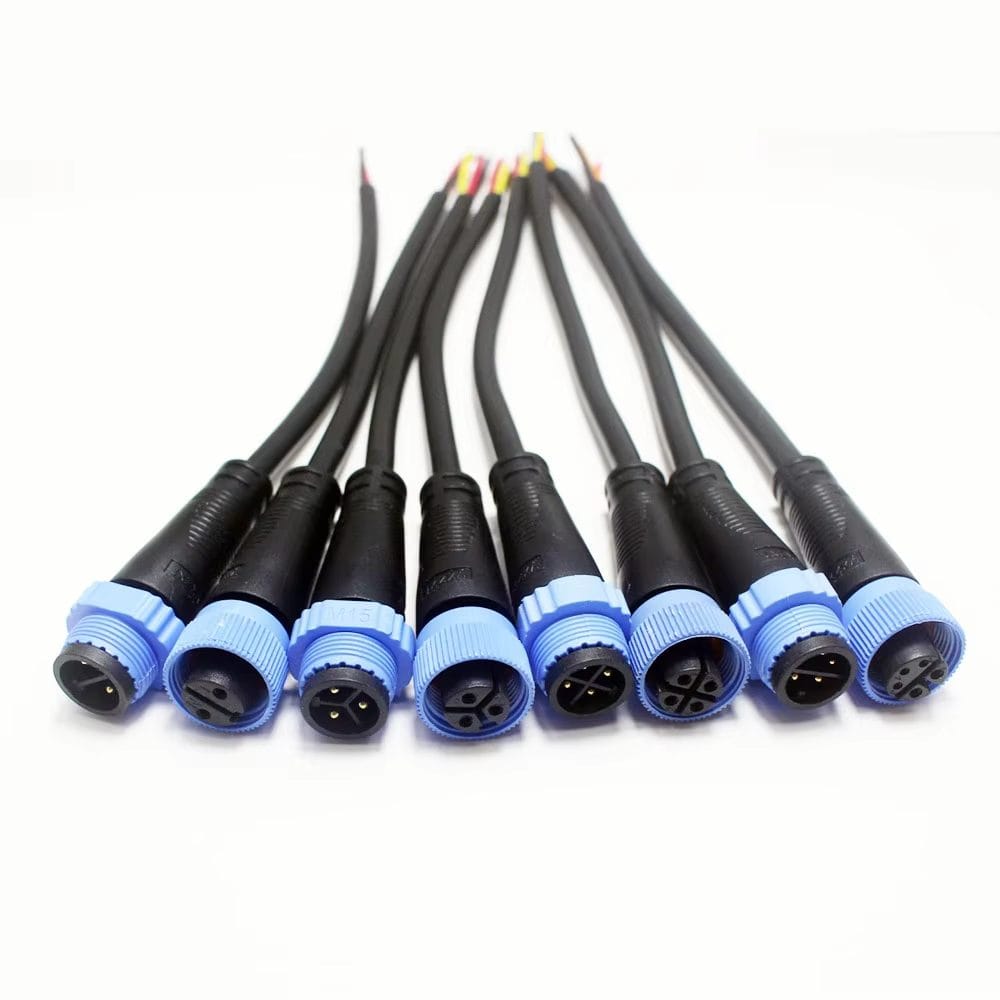
M15 4-Pin Waterproof Cable for Outdoor LED Lighting
An M15 waterproof cable is the pole-top problem solver: a 15 mm screw-lock shell with a silicone O-ring seal, molded inline or as an F-type branch that splits one street-light feed into two or three fixtures without a junction box. IP67 when mated, IP68 class on request.
Overview
An M15 waterproof cable is the pole-top problem solver: a 15 mm screw-lock shell with a silicone O-ring seal, molded inline or as an F-type branch that splits one street-light feed into two or three fixtures without a junction box. IP67 when mated, IP68 class on request.
The Branch Body Is the Whole Idea
Most outdoor lighting connections exist to answer one question: how does one feed become two fixtures ten meters apart without a junction box rotting at the top of a pole. The M15 F-type answers it mechanically – the branch is designed into the overmold as one sealed piece, one-in-two-out or one-in-three-out, so the only joints left on the pole are the connector couplings themselves. Contractors who switch from junction-box splices to branch-molded leads typically shorten the pole-top install to minutes and remove the most common water-ingress point in the same stroke.
What Water Actually Attacks First
Not the connector face – the cable entry. So the build philosophy here is grommet-first: tell us your cable outer diameter and we match the compression grommet to it, because a 6 mm cable in an 8 mm grommet is a wicking path no IP rating can save. The face seal is a silicone O-ring compressed by the coupling nut to IP67 under the IEC 60529 code, with IP68-class builds available for submerged or buried-adjacent duty.
Electrical Room Between M12 and M20
Four-pin builds in this size class commonly run 125 to 250 V at 5 to 10 A on 0.3 to 1.5 mm2 conductors – enough for a driver-fed luminaire with a dimming or signal pair, which is exactly what the 2+3 and 4-position layouts exist for. Against an M12 it gives more current and a bigger gland; against an M20 it is roughly a third smaller and less expensive at fixture count, which is why it dominates street, tunnel and display-chain wiring.
Applications for This M15 Waterproof Cable
Street and roadway luminaire pole taps, landscape and flood fixture chains, tunnel and bridge lighting, wall washers, and the internal power distribution of outdoor LED display and advertising installations are the home ground. The same body serves solar street-light feeds, PV combiner auxiliaries, marine deck lighting, agricultural implements and irrigation controllers – anywhere the seal has to hold for seasons, not weeks.
Coupling and Mounting Variants
Inline is the majority build, but the same insert family mounts to fixture gear trays as a rear-nut panel socket, and the branch bodies come in F, T and Y geometries for different pole-top topologies. All variants share the O-ring face seal and grommet set, so swapping a straight run for a branch does not change the ingress rating or the gasket math on the luminaire.
Ordering and Custom Legs
Tell us inline or branch, how many outgoing legs and the length of each, pin count, gauge, jacket and the end treatment on every tail – stripped and tinned, crimped terminals, or terminated into the driver. Because the harness is molded as one piece, leg lengths are specified up front and delivered exactly; there is no field adjustment to get wrong.
How Each Assembly Is Verified
Sealed assemblies are leak tested before packing; every unit is continuity and hipot tested and the overmold is pull-tested. Shells are glass-filled PA66 rated UL94 V-0, or nickel-plated brass where impact is expected. Ratings follow the IEC 60529 IP code, material declarations ship with the batch, and any market approval should be named at the enquiry so the build and documentation match it.
What to Put on the Drawing for a M15 Waterproof Cable
A m15 waterproof cable is released against a drawing, not a catalog description. Put the connector family and keying on each end, the pinout or polarity map, the finished length measured between the mating reference planes, the cable construction you want, and the acceptance tests you expect. If the M15 4-pin waterproof connector has to clear a panel cutout or a bracket, give that envelope too. Anything left open is agreed in writing before tooling or a production slot is committed.
Where a value is not fixed by your drawing we do not invent one. Contact rating, jacket material, sealing class and test limits are recorded as confirm per build, and the released drawing is what the first article is checked against. Send a marked-up sample if a drawing is not available; we confirm the pinout back to you in writing before any M15 Waterproof Cable is built.
How to Request a Quote for a M15 Waterproof Cable
Send a drawing or BOM, a physical sample, or a written requirement. We log the interface, the application conditions, the environment and the target quantity together, then return an acknowledgement with a list of anything still missing. Pricing is confirm per RFQ and is quoted against the released specification, not against a generic m15 waterproof cable description.
If the design is not final, say so: we quote the prototype route and hold the production tooling decision until the first article is approved. Drawings are handled under a mutual NDA before they are received. The same document then carries the build from sample through repeat orders, which keeps the M15 4-pin waterproof connector consistent across batches.
Matching the Jacket and Seal to the Install Site
Tell us what the assembly actually sits in: rain, hose-down spray and dust, cleaning agents, UV exposure, repeated flexing or long static runs. Jacket compound, shield construction and seal geometry follow from that description, and we build to the material you name on the drawing. We do not publish a generic rating for a custom m15 waterproof cable; the sealing class and the test that proves it are agreed per project and recorded as confirm per build.
If the mating side already has a defined interface, the assembly is built to match it rather than to an assumed standard. A photograph of the install site and the mating part is often enough to settle the exit direction and the clearance. Where a compliance document is needed, the scope is listed at quotation and supplied with the shipment instead of being claimed in advance.
Strain Relief at the M15 4-Pin Waterproof Exit
The transition from a rigid connector to a flexible cable is where most field failures start. On this build the overmold bonds to the jacket so a pull lands on the molded body instead of on the crimp. Keep the first bend outside that transition, avoid tying the lead tightly against the shell, and do not use the cable as a handle when unplugging. Exposure to rain, hose-down spray and dust makes a stiff exit worse, because the jacket does not relieve the lever on its own.
Where the design needs a different exit angle, a longer boot or an additional clamp, that is a tooling question and is settled before production. We mold the exit rather than bending a finished plug, and the geometry is kept under your part reference so a repeat order matches the m15 waterproof cable you approved.
Fit Check Before You Release the Build
Before release, mate a sample to the real counterpart, not a similar one. Check the keying, the wrench or finger clearance around the coupling, the exit direction relative to the nearest bracket, and the length between the mating reference planes. On outdoor equipment and washdown zones, a M15 4-pin waterproof connector that fits the panel but fouls the cover is a common and avoidable revision.
Record the cable diameter you qualified against, especially where a gland or seal is involved. A M15 Waterproof Cable built at either edge of a seal window does not forgive tolerance scatter the way one in the middle does. Photographs of the fitted sample are kept with the part reference so a later order can be compared against the same configuration.
Related Cable Ranges
Also see the rest of the Screw-Lock Molded Cable, the Circular M-Series Cable Assemblies range for smaller sensor-duty waterproof builds, and Custom Wire Harnesses for bespoke lighting looms.
RoHS and REACH declarations are provided per project together with the agreed test reports; the documentation scope is listed under certifications and compliance. If your drawing specifies a UL style, we build to that drawing and supply the UL reference with the shipment instead of substituting an equivalent. For the sealed version we follow the gasket path and overmold-to-jacket bond practices documented under waterproof sealing design and validation. The wider context is covered under build-to-print cable assemblies. Any tooling we cut for this part stays yours, maintained in our own tool room under your part reference.
| Connector series | M15 (M15 x 1.0 coupling) |
|---|---|
| Pin count | 4, 2, 3, 5, 2+3 |
| Body style | Inline, F-type branch (1-in-2-out, 1-in-3-out), T-type, Y-type |
| Rated voltage | 125-250 V class (build-dependent) |
| Rated current | 5-10 A class (build-dependent) |
| Jacket material | PVC, Rubber, Silicone |
| Ingress rating | IP67 when mated, IP68 class on request |
| Cable OD range | 5 mm to 9 mm |
| Cable cross-section | 0.3 mm2 to 1.5 mm2 (24-16 AWG) |
| Temperature range | -40 to +85 C |