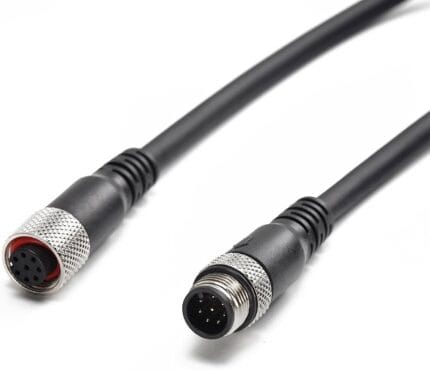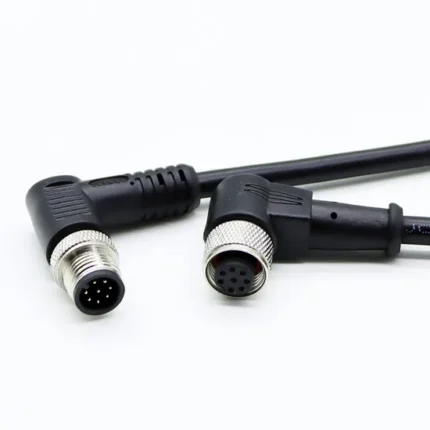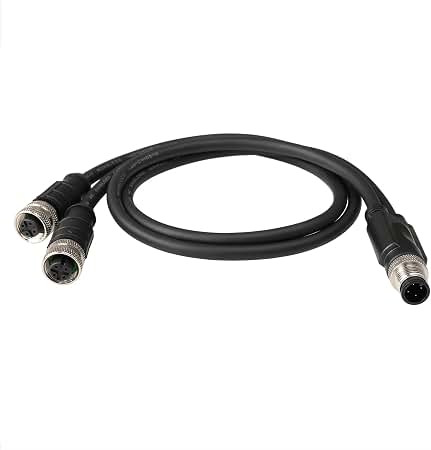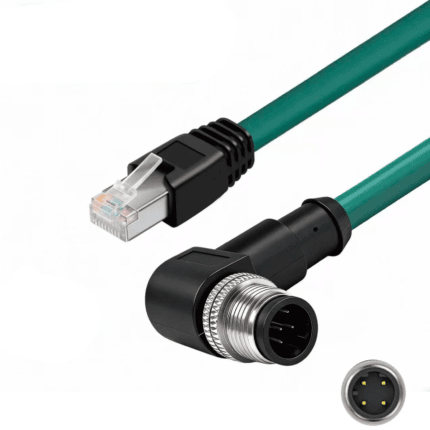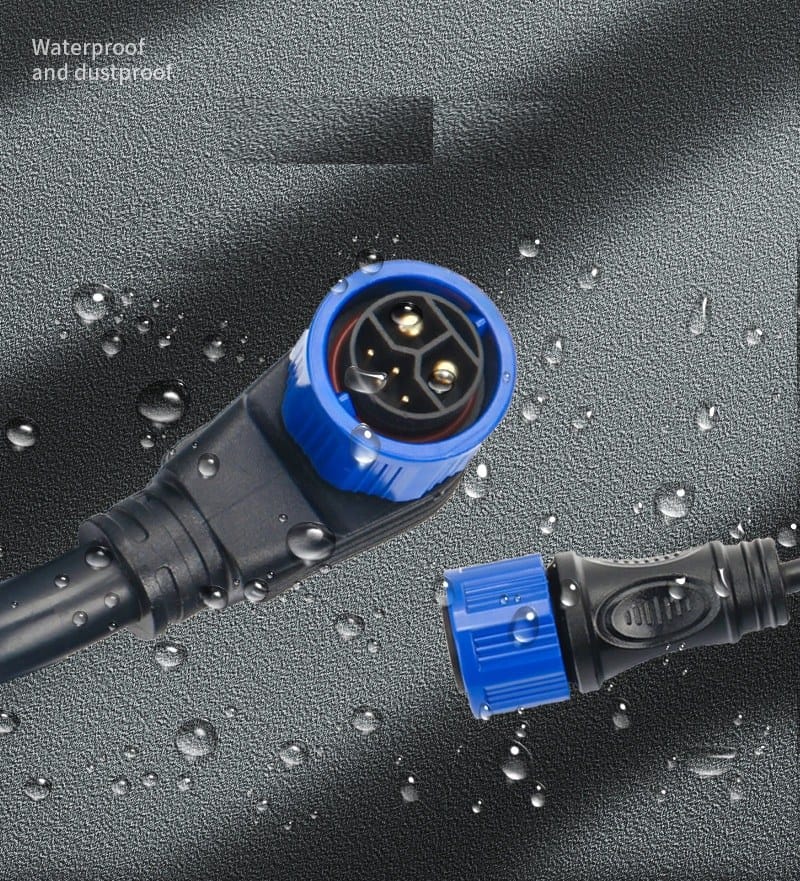
IP67 Right-Angle M23 Power Cable (2+4 Pin)
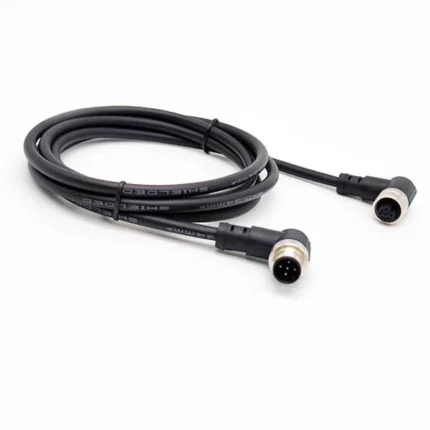
This IP67 right angle m23 power cable carries a 2 plus 4 hybrid contact layout, pairing heavier power contacts with signal contacts in one sealed, 90-degree connector for servo axes, robot dress packs and outdoor feeders.
Overview
This IP67 right angle m23 power cable carries a 2 plus 4 hybrid contact layout, pairing heavier power contacts with signal contacts in one sealed, 90-degree connector for servo axes, robot dress packs and outdoor feeders.
A 2+4 hybrid contact arrangement keeps motor power and encoder or brake signaling inside a single connector, so one cable run serves the whole axis. The right-angle exit points the cable along the mounting surface, which reduces the loop radius a robot dress pack needs at the joint and keeps the connector profile low on drive enclosures.
Key Specifications
The table below lists the configuration shown in the product photo.
Why the Right-Angle Exit Exists
Exit direction is usually the last thing specified and the first thing that causes trouble on site. A straight connector projects along the axis it is plugged into, which means the cable has to leave perpendicular to the panel and then turn back again. In an enclosure with a door swing or a hinge nearby, that protruding body plus the bend radius of a power-sized cable can occupy more space than the designer allowed.
Turning the exit ninety degrees solves several problems at once. The cable leaves parallel to the mounting face, so it can run flat against a surface instead of standing off it. The installed height above the panel drops to roughly the connector body rather than the body plus the cable’s minimum bend. And anything moving past that face — a robot link, a tracker arm, a gate leaf — has a much flatter profile to clear.
On articulated robots the benefit is measured differently but comes to the same thing. Dress packs have a limited amount of slack to manage at each joint, and every extra inch of loop the coupling forces into the cable has to be taken up somewhere in the cycle. A ninety-degree exit reduces the loop radius the geometry demands, which is often the difference between a dress pack that runs cleanly through the working envelope and one that catches.
Understanding the 2+4 Hybrid Split
Hybrid M23 inserts divide their positions between two contact sizes: fewer, larger contacts that carry current, and more numerous finer contacts that carry signals. The 2+4 arrangement here puts two power positions alongside four signal ones, which suits a compact axis where the motor needs supply plus a modest set of control and feedback circuits.
The important warning is that hybrid M23 is a family, not a single part. The same shell is produced with several different power-plus-signal splits, and because the insert keyways differ between them a 2+4 plug will not mate into a receptacle built for a different arrangement. Always read the contact layout off the motor or drive receptacle rather than assuming the count from the shell size.
Construction and Materials
The molded body turns the cable ninety degrees out of the coupling axis, and a sealing cap with a blue grip covers the mating face when the connector is unmated, keeping dust and moisture out of the contacts during storage and installation. The threaded coupling nut locks the pair together, and the heavy circular jacket is sized for the power core and signal cores it carries.
The right-angle body is molded with the bend inside the potting, so the seal path stays continuous around the corner, and the unmated face is protected by the molded cap rather than a loose dust plug. Power and signal contacts are crimped in one insert.
Keeping the bend inside the molded body is the detail that matters for a sealed build. An assembled right-angle shell asks an individual gasket to seal reliably at a corner, where compression is hardest to keep even. Putting the turn inside the overmold means there is one continuous encapsulation around the conductors and one straight seal line at the mating face.
Typical Applications
Servo motor drops are the core use: one sealed connection supplying the motor while carrying encoder, brake or thermal circuits in the same run, with the cable leaving parallel to the motor face instead of projecting into a guard or a cable tray.
Robot dress packs use this form where coupling space at a joint is rationed. Because the exit does not demand extra loop length, the dress-out can be kept tight to the arm and the protective sleeve can follow a predictable path through the full range of travel.
Mobile and washdown equipment suits both properties at once: the IP67 mating seal survives routine high-pressure cleaning, and the low profile keeps the connector out of harm’s way on machines that are regularly maneuvered through tight spaces.
Solar trackers, gate drives, lift controls and similar outdoor installations use it where the cable has to clear a hinge, bracket or arm travel. The right-angle exit lets the run leave along the structure rather than standing proud of it, so it dodges the moving parts instead of being crushed by them.
It also turns up anywhere an enclosure is shallow. On drive cabinets and compact junction boxes, a straight connector plus its bend radius sometimes simply does not fit behind the door, and this body is what fits instead.
Keeping the Unmated Face Sealed
Every sealed connector has an unguarded moment: the interval before mating, or after a service disconnect. During machine build that interval can be weeks, and dust, coolant mist or plaster dust settling on bare contacts is a common cause of intermittent faults that appear only after commissioning.
The molded sealing cap supplied on this build covers the mating face for that whole window. Because it is part of the assembly rather than a separate item in a bag, it stays with the connector through installation instead of being separated from it in transit.
Compatibility and Fitment
The contact layout mates with matching 2+4 hybrid M23 panels and connectors; confirm the contact arrangement on your drive or motor before ordering, since M23 hybrids are produced in several power-plus-signal splits. The thread form follows the common M23 coupling used across industrial drive platforms, in line with IEC 61076-2-102 dimensions.
Send us both ends of the circuit. Where one side is a hybrid M23 receptacle and the other terminates to screw terminals or a different connector family entirely, we build to that pair rather than fitting adapters into the run.
Routing and Installation Notes
Decide the exit direction before ordering if you can. Because the body is molded rather than rotatable, swapping a right-angle build for a straight one after the fact means a new cable rather than a field adjustment.
Support the cable close to the connector. A power-sized cable is heavy, and letting its weight hang off a ninety-degree body puts sustained leverage on exactly the point where the jacket enters the molding.
Do not use the sealing cap as a strain member, and refit it whenever the connector is left unmated on a machine that has not yet been commissioned.
Custom Builds and Ordering
Hybrid splits other than 2+4, different cable constructions and custom lengths are produced on request. Send the axis schedule or drawing and we will match the connector set to it. Prototype and sample lots run from 1 to 50 pieces; production orders start at 500 pieces per part number.
Packaging and Shipping
Each cable ships with the sealing cap in place, bagged and boxed. Volume packaging with your labels is available.
Quality and Compliance
Continuity through every contact plus a sealing-cap fit check are done before shipment. Hybrid assemblies are visually inspected for full overmold encapsulation at the right-angle body. See the IEC 61076-2-102 M23 connector standard for the governing interface specification.
RoHS and REACH declarations are provided per project together with the agreed test reports; the documentation scope is listed under certifications and compliance. If your drawing specifies a UL style, we build to that drawing and supply the UL reference with the shipment instead of substituting an equivalent. The 90-degree exit is formed in the tool itself; the exit options and their clearances are set out under right-angle overmold tooling options. The wider context is covered under cable assemblies for industrial automation and robotics. Any tooling we cut for this part stays yours, maintained in our own tool room under your part reference.
Frequently Asked Questions
Will this mate with any M23 hybrid receptacle? No. Only one built for the same 2+4 contact layout. Check the arrangement on the receptacle before ordering.
Can the exit direction be changed after purchase? No. The right-angle body is molded; the orientation is decided at build.
Is the sealing cap included with every unit? Yes. Each cable ships with the cap fitted.
Can power and signal circuits be tested separately? Yes. Continuity is checked through every contact, and hybrid assemblies are inspected for full encapsulation.
Related Cable Ranges
Browse the related ranges: Circular M-Series Cable Assemblies Automotive Wire Harnesses Screw-Lock Molded Cable.
For the feedback-only side of an axis compare the M23 encoder feedback cable and the M23 17-pin encoder feedback cable.
| Connector Type | M23 hybrid, right angle, sealed coupling |
|---|---|
| Contact Layout | 2 power + 4 signal (2+4 pin) |
| Application | Servo power with feedback, robotics, drives |
| Ingress Rating | IP67 when mated, sealing cap on unmated end |
| Coupling | Threaded, knurled nut |
| Orientation | 90-degree right angle |
| Jacket Color | Black |