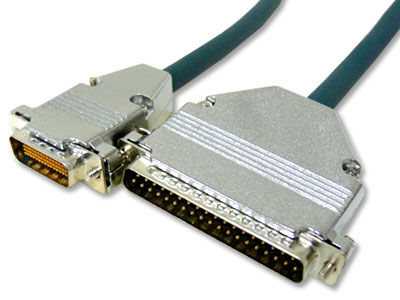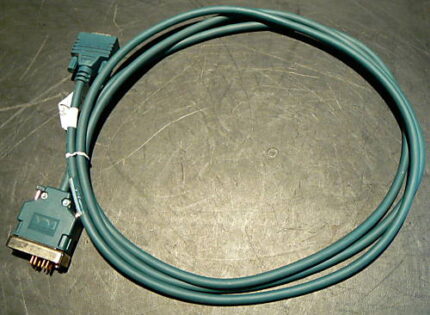
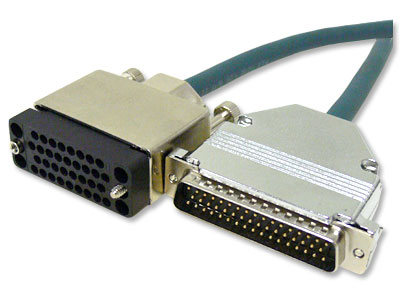
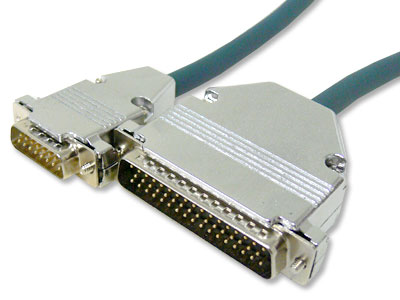
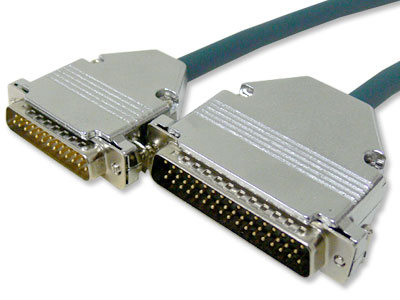
DB50 to DB25 DTE Serial Cable
This db50 db25 dte cable links a legacy router, CSU/DSU or serial concentrator DB50 port to DB25, V.35 M/34 or DB15 equipment. Twenty-five 28 AWG twisted pairs under foil and braid, in a PVC jacket, wired straight-through, crossover or to your diagram.
Overview
A db50 db25 dte cable is the serial lead between a legacy router or CSU/DSU with a DB50 port and the DB25, V.35 or DB15 equipment at the other end. The DB50 end is the SCSI-2-style half-pitch or full-pitch D-Sub shell that turns up on older Cisco hardware and serial concentrators; the far end is whatever the target device presents. Ours is twenty-five twisted pairs of 28 AWG stranded tinned copper under an overall foil plus braid shield with a drain wire, in a PVC jacket, wired straight-through, crossover or to your drawing.
Key Specifications
| Connector A | DB50 male, metal hood with thumbscrews |
|---|---|
| Connector B | DB25 male or female, V.35 M/34 male, or DB15 male |
| Pin-out | DTE or DCE per inquiry; standard Cisco / serial pin-out on file |
| Conductor | 28 AWG stranded tinned copper, 25 twisted pairs |
| Shielding | Overall foil + braid, drain wire |
| Jacket | PVC, black or beige, 8 mm to 10 mm OD |
| Length | 1 m to 10 m standard; OEM on request |
| Build | Pin-out verified to your drawing |
Which end combination do you need on this db50 db25 dte cable
The DB50 end is fixed; everything else is a choice. The three common builds break out the same DB50 port three different ways, and picking the wrong one is the usual reason a replacement cable does not work on the first try. Look at the port on the far device rather than at the old cable – the old cable may itself have been an adapter stack.
| Variant | Far end | Where it is used | Note |
|---|---|---|---|
| DB50 to DB25 | DB25 male or female | Legacy router and CSU/DSU serial ports | The default build; gender set by the far port |
| DB50 to V.35 | V.35 M/34 male | Leased-line connections on older serial hardware | Same signals, different connector |
| DB50 to DB15 | DB15 male | Serial concentrators and some terminal servers | Fewer signals carried |
| DB50 to DB50 | DB50 male | Patch and extension between two DB50 ports | Straight-through unless you say otherwise |
DTE or DCE: the question that decides the pinout
This is where most of these orders go wrong, and it is not a subtle distinction. A DTE device expects to transmit on the pin a DCE device expects to receive on, so a straight-through cable that joins two DTE ports crosses transmit and receive and nothing comes up. The fix is either a crossover build or a null-modem adapter, and knowing which you need starts with knowing what is at each end. Routers and terminals are DTE; modems, CSU/DSUs and most serial concentrator ports are DCE. If you connect DTE to DCE, build straight-through. DTE to DTE, build crossover.
| End A | End B | Build you need | Common example |
|---|---|---|---|
| DTE | DCE | Straight-through | Router to CSU/DSU |
| DTE | DTE | Crossover | Router to router back-to-back, or router to terminal |
| DCE | DCE | Crossover | Two concentrator ports patched together |
| Either | Unknown | Send the equipment list | We will confirm before cutting cable |
Where the DB50 shell comes from
DB50 is not one connector, it is a shell size that two different pitches borrowed. The half-pitch version is the one people mean when they say SCSI-2 style, and it is what you find on the serial and high-density ports of older networking hardware. The full-pitch version is mechanically larger and will not fit the same hood. Both are D-subminiature family connectors, and the tell is simple: hold a ruler across the contact row and compare it to the DB25 you already have. If you are unsure, photograph the port with something for scale and send it.
Shielding and pair count on a 25-pair run
Twenty-five twisted pairs is a lot of cable, and at 28 AWG the conductors are thin enough that a long run needs the shield doing real work. Foil gives high-frequency coverage, braid carries low-frequency interference and fault current, and the drain wire is what lets you terminate the foil properly instead of twisting it into a pigtail that stops working above a few hundred kilohertz. Both ends are metal-hooded shells with thumbscrews, so the screen is bonded to the hood at each end and the shield runs the whole length of the link. If the equipment at either end grounds the shell, tell us – that changes how we terminate the drain.
Typical applications for this db50 db25 dte cable
- Legacy router and CSU/DSU serial console connections
- Serial concentrator to modem or terminal
- V.35 leased-line connections on older serial hardware
- Custom serial patch cables for broadcast and industrial control
- Keeping a legacy serial link alive during a migration
How to specify your build
- Both connector types and genders – DB50 to DB25, V.35 or DB15.
- DTE or DCE at each end, or the equipment make and model.
- Pin-out – straight-through, crossover, or your drawing.
- Length, and whether the run crosses power.
- Hood style and jacket color.
- Quantity, and whether this is a sample or a production order.
Workmanship and testing
Workmanship on DB50 builds follows IPC/WHMA-A-620 Class 3, the line is run under ISO 9001, and the termination range is 32 to 12 AWG. No DB50 assembly is boxed before 100% continuity and pinout are confirmed, and seal checking is quoted whenever an ingress rating is on the drawing.
Every production run can ship with RoHS and REACH declarations and the electrical report agreed at quotation; see certifications and material declarations. UL styles and other named approvals are built to drawing: we source to the style you specify and document it, rather than asserting a listing we do not hold. This assembly is built on the four lines covered under cable assembly and wire harness production, with nothing in the build handed to an undisclosed subcontractor. More background: cable assemblies for test and measurement. Tooling is quoted separately, cut in-house rather than brokered out, and owned by you.
Custom builds and ordering
Quote DB50 builds from 1 to 50 pcs and they ship in 3 working days; at volume the minimum is 500 pcs with 14 working days after approval. Tooling not already held adds around 10 working days. OEM and ODM DB50 runs go out under your part number and labeling and material certificates plus first-article reports are available.
Related D-Sub and serial assemblies
- SCSI Cable Assembly, HD68 to HD68
- LFH60 to DB37 RS-449 / V.35 DCE Serial Cable
- DB9 to RJ45 Serial / Console Cable
- 2V2 / 3W3 / 5W5 Mixed-Contact D-Sub Cable
- 13W3 to VGA (HD15) Mixed-Contact D-Sub Cable
- Mini-SAS HD Cable, SFF-8643 to SFF-8644
Full range: signal and data cable assemblies.
Frequently Asked Questions
Do I need DTE or DCE?
Routers and terminals are DTE; modems, CSU/DSUs and most concentrator ports are DCE. DTE to DCE is straight-through, DTE to DTE is crossover.
Can you build to a Cisco pin-out?
Yes, standard Cisco and generic serial pin-outs are on file. If yours is non-standard, send the diagram and we build to that.
Is the shield connected at both ends?
The screen is bonded to the metal hood at both ends by default. Tell us if either device grounds the shell and we will adjust the drain termination.
How long can the run be?
1 m to 10 m as standard. Beyond that, send the baud rate and the environment and we will confirm before quoting.
| Connector A | DB50 male, metal hood with thumbscrews |
|---|---|
| Connector B | DB25 male or female, V.35 M/34 male, or DB15 male |
| Pin-out | DTE or DCE per inquiry; standard Cisco / serial pin-out on file |
| Conductor | 28 AWG stranded tinned copper |
| Jacket | PVC, black or beige, 8 mm to 10 mm OD |
| Length | 1 m to 10 m standard; OEM on request |
Related products
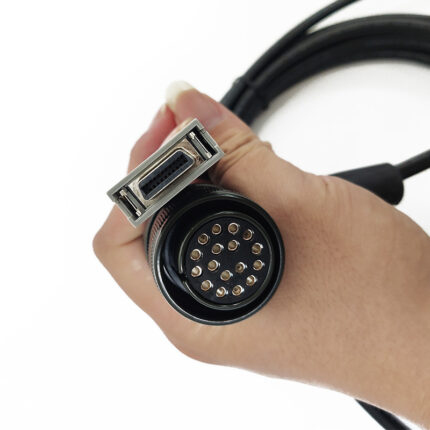
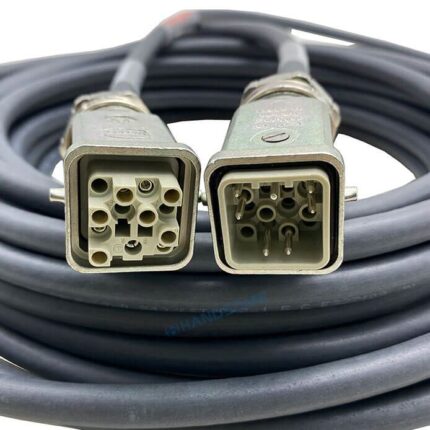
KUKA Robot Encoder Cable Compatible with 00-174-775
This kuka encoder 174775 cable is wired to the KUKA pin assignment for part 00-174-775, running encoder power and the data pair from the robot axis back to the controller. Six cores plus one pair under foil and braid, in a matte black PUR drag-chain jacket. A compatible replacement, not an OEM part.