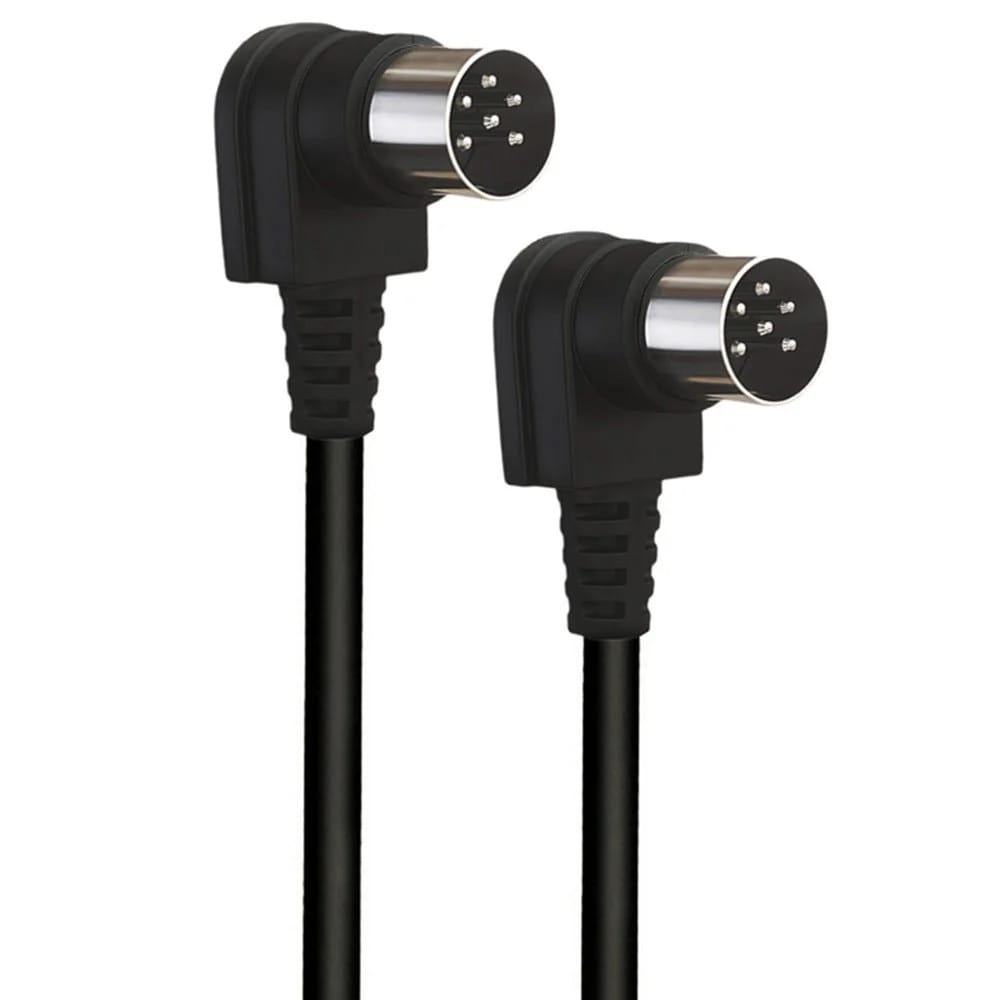
6-Pin DIN Male to Male Dual Right-Angle Cable
A 6 pin DIN cable with right-angle plugs on both ends, so the run sits flat against a panel instead of projecting out of it.
Last updated: 13 September 2026
Overview
A 6 pin DIN cable with right-angle plugs on both ends is bought for one of two reasons: the equipment is still in service and needs a spare, or the run has to sit flat against a panel because there is no depth behind it. Six-pin DIN turns up on recording gear, on some industrial control links and on power connections for radio equipment, and there is no single pinout across all of them. So it is worth being precise before you plug it in.
Key Specifications
| Connector A | 6-pin DIN male (right angle) |
|---|---|
| Connector B | 6-pin DIN male (right angle) |
| Shell | Standard 13.2 mm DIN body |
| Wiring | Straight-through, pin 1 to pin 1, unless you specify otherwise |
| Cable | Shielded multi-core |
| Jacket | PVC |
| Strain Relief | Molded low-profile bodies at both ends |
| Exit Direction | Clocked to order so both plugs face the same way |
A field guide to the DIN family
All of these shells look similar from the front and none of them mate with each other. Count the pins, then measure the body:
| Pins | Body | What it is usually used for | Comment |
|---|---|---|---|
| 3 pin | 13.2 mm | Mono audio and some speaker links | Often confused with a small XLR |
| 4 pin | 13.2 mm | Power, control and some video links | No agreed pinout across uses |
| 5 pin | 13.2 mm | MIDI, and stereo audio on older gear | MIDI uses only three of the five |
| 6 pin | 13.2 mm | Recording gear, control links, radio power | Check the pinout before you connect |
| 8 pin | 13.2 mm | Multi-channel audio and broadcast | Sometimes has a center pin |
| Mini-DIN | 9.5 mm | Keyboard, mouse, S-video and data | Smaller body, will not mate with standard DIN |
That table is a mechanical identification guide built on the industry-standard definitions for the DIN connector family. It is not a pinout: the pinout has to come from your equipment.
Identifying the cable you are replacing
- Count the pins on the plug face, not the holes in the socket.
- Measure the body. About 13.2 mm is standard DIN; about 9.5 mm is a mini-DIN and needs a different cable.
- Note the keyway position and which way the angled bodies point when the plug is seated.
- Check what the conductors carry. Six-pin shells have been used for audio, for control and for DC power, and the conductor size differs between them.
- Photograph both ends straight on and send them with the inquiry.
We build straight-through, pin 1 to pin 1, unless you tell us otherwise. We do not infer a pinout from the pin count.
Why the original failed
- Bent pins. These plugs get pushed in blind at the back of a rack. A misaligned plug bends a pin, and a bent pin is the usual cause of a channel that works intermittently.
- Shield broken where the cable enters the angled body. The right-angle exit is a natural flex point.
- Weight hanging off the socket. A cable with no support puts a lever on the panel connector until the solder joints crack.
- Plugging the wrong shell in. Forcing a five-pin into a six-pin socket damages both.
- Age. Some of these cables are 30 years old and the jacket has simply gone brittle.
Fitting and verifying a replacement
- Power down before you connect. Several of the applications for this shell carry DC power.
- Align the keyway and push straight in. Never rock a DIN plug into place.
- Confirm the function at both ends before you tidy the run away.
- Support the cable within 150 mm of each plug so its weight is not on the socket.
- If a channel is missing, check the seating and the pinout before you condemn the cable.
Typical Applications for This 6 Pin DIN Cable
- Recording and broadcast equipment where the sockets sit close together
- Industrial controllers and legacy control surfaces still in daily use
- DC power and control links on radio and audio equipment
- Shallow enclosures and shelves with no room for a straight plug
- Spares held against equipment that can no longer be re-sourced
How to specify your build
- Pin count and shell size from a photo of the plug face.
- Pinout, or a statement that straight-through is what you want.
- Exit direction on each plug, and whether they must match.
- Conductor size if the run carries power.
- Length along the actual route.
- Shielded or unshielded.
- Quantity, and whether this is a prototype or a production order.
Workmanship and testing
Assembly and inspection follow IPC/WHMA-A-620 Class 3 workmanship criteria under our ISO 9001 quality management system, and every unit passes 100% continuity and pinout testing before it is packed. Conductor range is 32 to 12 AWG. Straight-through wiring is verified conductor by conductor, and the angled bodies get a seating check. Dimensions quoted for the shell are the industry-standard values; your assembly is built and verified to your drawing.
Custom builds and ordering
Prototype builds start from 5 pcs and ship in 3 working days; production orders start at MOQ 500 pcs and ship 14 working days after approval. New tooling for a non-standard exit direction adds about 10 working days. OEM and ODM builds ship under your part number and labeling, with material certificates and first-article reports available on request. Factory audits and video line tours can be arranged.
Related DIN and audio assemblies
If you are keeping older equipment in service, these are the other shells in the same family:
- 8-Pin DIN Male to Female Panel-Mount Extension Cable
- 5-Pin DIN Dual Right-Angle MIDI Audio Cable
- 4-Pin MIDI DIN Male to Female Extension Cable
- 3.5mm to MIDI 6-Pin DIN Audio Cable
- Turntable Tonearm Cable with DIN and Dual RCA Options
- Mini-DIN6 PS/2 Y Splitter Cable, 6 in
- 6.35mm TRS 90 Degree Audio Cable
Full range: audio and video cable assemblies.
Frequently Asked Questions
Is a 6-pin DIN the same as MIDI?
No. MIDI uses the five-pin shell and only three of its pins. Six-pin DIN is a different connector with a different pinout.
Can you wire it to my pinout?
Yes. Send the pinout and we build to it. Straight-through is the default when you do not specify one.
Do both right-angle plugs face the same way?
They can. Tell us the direction and we clock both bodies to match.
Why did my old cable stop working after years of service?
Usually a broken shield at the flex point or a bent pin, in that order. Both are easy to check before you order a replacement.
What is the minimum order?
Five pieces is the prototype minimum and those ship in 3 working days. Production quantities start at 500 pcs, 14 working days after sample approval.
| Connector A | 6-pin DIN male (right angle) |
|---|---|
| Connector B | 6-pin DIN male (right angle) |
| Jacket | PVC |
| Shell | Standard 13.2 mm DIN body |
| Wiring | Straight-through, pin 1 to pin 1, unless you specify otherwise |
| Cable | Shielded multi-core |
| Strain Relief | Molded low-profile bodies at both ends |
| Exit Direction | Clocked to order so both plugs face the same way |
Related products
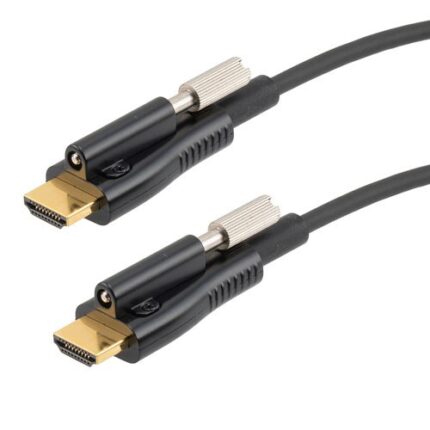
Active Optical HDMI Cable for Boardrooms and Ceiling Projectors
An active optical HDMI cable puts the high speed signal path onto fiber so a long boardroom or ceiling projector run stays slim enough to pull through conduit. Marked source and display ends, aramid strength member, hybrid copper for power and control. Tell us the route and we quote the length with a service loop.