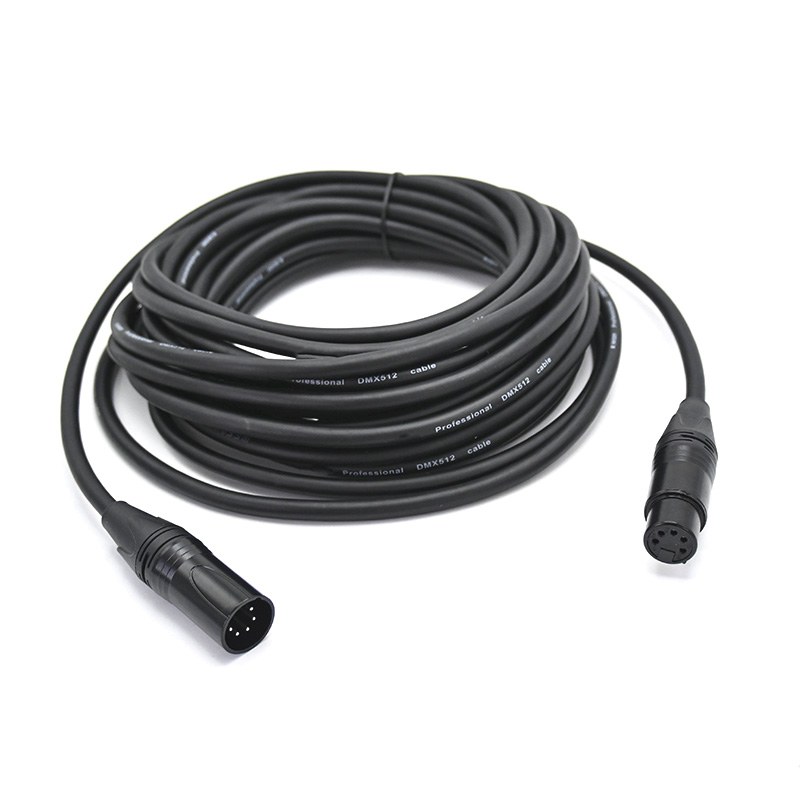
DMX512 Lighting Cable with 3-Pin or 5-Pin XLR
A DMX512 lighting cable built around an impedance controlled data pair with foil and braid screening, in 3-pin or 5-pin XLR. Straight, right angle, pancake or sealed overmolded builds, plus bulk cable and crimp tooling for on-site termination. Terminators and adapter leads in the same order.
Overview
Every lighting fault that looks like a console problem is usually a physical layer problem in
disguise. Fixtures flicker, answer the wrong channel, or vanish from the end of the chain, and the cause is
in the copper and the connectors far more often than in the desk. A DMX512 lighting cable
is specified for that physical layer: an impedance controlled data pair, a screen that holds along the whole
run, and connectors that survive being pulled across a stage floor every night of the tour.
Key Specifications
| Interface | 3-pin XLR or 5-pin XLR, male to female |
|---|---|
| Conductor | 22 AWG data pair (pending supplier datasheet) |
| Characteristic impedance | 110 ohm nominal (pending confirmation) |
| Shielding | Foil screen plus braided screen |
| Insulation | Polyethylene on the data pair |
| Connector styles | Straight, right angle, pancake low profile |
| Sealed option | Overmolded weather resistant build, rating pending test |
| Field option | Bulk cable with connectors and crimp tooling |
| Data pair | One impedance controlled twisted pair |
| Termination | 120 ohm terminator and adapter leads on request |
| Jacket | Color coded jacket so data runs read apart from audio |
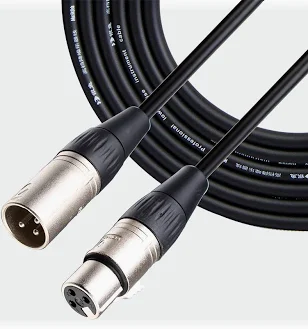
Three pin or five pin: the argument, and the answer
The control standard is unambiguous. ANSI E1.11, the DMX512-A standard, specifies a five pin XLR for the
data link and prohibits the three pin XLR that the lighting industry had already adopted on budget and DJ
gear. The field is equally unambiguous: three pin is everywhere, on fixtures, on cheap dimmer packs and on
gear that predates the standard.
| Question | 3-pin XLR | 5-pin XLR |
|---|---|---|
| What the standard says | Prohibited for DMX512 by ANSI E1.11 | The connector the standard specifies |
| Where you meet it | DJ and budget fixtures, older dimmer packs | Consoles, dimmer racks, professional fixtures |
| Pin assignment | 1 screen, 2 data 1-, 3 data 1+ | 1 common, 2 data 1-, 3 data 1+, 4 and 5 second link |
| The real risk | A microphone cable with phantom power reaches a fixture | None of that, and a second pair is available |
| What we build | Yes, with adapter leads to 5-pin | Yes, as the standard build |
Decide at the design stage which the house infrastructure will use. Retrofitting a building wired for
three pin later is tedious work, and the argument is usually settled by what the console and dimmer racks
present.
What the standard actually requires
DMX512-A is built on
EIA-485 differential
signaling: 250 kbit/s, in packets of up to 512 channel slots after a start code. That framing is why the
cable matters. Reflections and impedance steps corrupt edges, and corrupted edges become flicker at the far
end of the chain.
| Item | Industry practice | Why |
|---|---|---|
| Topology | Daisy chain, not a star | Stubs reflect and upset packet timing |
| Termination | A terminator across data+ and data- at the far end | Absorbs the reflection that upsets the last fixtures |
| Load | Up to 32 unit loads on one universe | The EIA-485 driver limit; beyond that, split |
| Cable | Impedance controlled twisted pair with a screen | Microphone cable distorts the edges |
| Splitting | A proper splitter or opto-isolated distribution | A Y lead does not work |
Those are the industry definitions. Cabling for portable and permanent installations was separated into
its own project after 2003, one document covering portable DMX cable and a second covering permanent
installation. The figures your assembly is verified to are the ones on your drawing.
What is inside the jacket
- One impedance controlled data pair rather than a generic audio pair
- Foil screen over the pair to hold the characteristic impedance along the run
- Braided screen over the foil for mechanical strength and coverage
- Polyethylene insulation on the pair, which is what the impedance figure depends on
- Color coded jacket so data runs can be told apart from audio at a glance
Standard documents for this class of link describe a nominal characteristic impedance in the 110 to 120
ohm range depending on the document and the cable type. The nominal figure for your build is stated per your
drawing.
Right angle, pancake and weather resistant builds
Where fixtures are packed tightly on a bar or set into a floor, a straight plug does not fit. Right angle
and pancake connectors keep the cable flat against the fixture body and stop the plug being knocked sideways
during load in. For facade and outdoor work we offer an overmolded sealed version with a gasket at the
mating face. The rating for that build is stated per your drawing and pending the test you require.
Planning the chain
Chains are limited by total length and by the number of fixtures hanging off them, and the practical limit
comes sooner on a touring rig with many connectors in the path than on one clean installed run. Plan the
chain rather than letting it grow, terminate the far end, and keep data cable away from dimmer power. For
long installed routes we supply bulk cable with connectors and crimp tooling so the run is terminated to the
measured length on site.
Typical applications for this DMX512 lighting cable
- Fixed installs in theaters, houses of worship and performance halls
- Architectural facade lighting with a permanently exposed run
- Touring rigs struck and rebuilt night after night
- Studio and broadcast lighting grids running alongside our XLR microphone cable
- Stage boxes and portable dimmer racks, where a 1/4 TRS to XLR cable covers the audio side
How to specify your build
- Connector — 3-pin or 5-pin, and what the venue has standardized on.
- Ends — male to female as standard; right angle or pancake where needed.
- Cable construction — data pair gauge and screening.
- Environment — indoor, touring, or a sealed build for an exposed run.
- Length — measured, or bulk with crimp tooling for site termination.
- Quantity, and whether terminators and adapters go in the same order.
Workmanship and testing
Build standard for DMX512 Lighting builds is IPC/WHMA-A-620 Class 3 under ISO 9001, with terminations from 32 to 12 AWG. No DMX512 unit is packed until continuity and pinout check out, and seal checking is quoted whenever an ingress rating is on the drawing.
Every production run can ship with RoHS and REACH declarations and the electrical report agreed at quotation; see certifications and material declarations. UL styles and other named approvals are built to drawing: we source to the style you specify and document it, rather than asserting a listing we do not hold. Termination, molding and verification happen in-house see our assembly lines in Longgang so the process that made your sample is the process that runs the order. Related reading: what stage and studio work demands. Tooling is quoted separately, cut in-house rather than brokered out, and owned by you.
Custom builds and ordering
On DMX512 Lighting builds, prototype lots run from 1 to 50 pcs and leave in 3 working days. Production runs of 500 pcs and up ship 14 working days after approval. Tooling not already held adds around 10 working days. DMX512 builds go out under your part number and labeling, and we provide material certificates and first-article reports when asked.
Related stage and studio assemblies
- XLR Microphone Cable, Balanced Three Pin Male to Female
- 1/4 TRS to XLR Cable 6.35 mm Balanced Lead for Monitors
- Balanced IEM Cable with Detachable Two-Pin and MMCX
- 12G-SDI Coax Cable Assembly, BNC to BNC
- Cat6A Rugged Locking Patch Cord for Stage and AVoIP
Full range: audio and video cable assemblies.
Frequently Asked Questions
Is 3-pin actually wrong, or just frowned upon?
The standard prohibits it and specifies 5-pin. In practice 3-pin is everywhere on budget and DJ gear.
Build to whatever the venue standardized on, and use adapters where a chain has to cross between the two.
Can I use microphone cable in an emergency?
It will often pass data over a short run and it is not the right cable. It lacks the impedance and
capacitance characteristics the link expects, and the faults it produces are hard to trace.
Do I need a terminator?
Yes, at the far end of every chain. Without one, reflections come back up the run and the last fixtures
misbehave in ways that look like addressing faults.
How many fixtures can go on one universe?
Plan to the driver load limit — 32 unit loads is the industry figure — and to 512 channels per universe.
Beyond either, split with a proper splitter rather than a Y lead.
| Interface | 3-pin XLR or 5-pin XLR, male to female |
|---|---|
| Conductor | 22 AWG data pair class |
| Characteristic impedance | 110 ohm nominal class |
| Shielding | Foil screen plus braided screen |
| Insulation | Polyethylene on the data pair |
| Connector styles | Straight, right angle, pancake low profile |
| Sealed option | Overmolded weather resistant build |
| Field option | Bulk cable with connectors and crimp tooling |
| Data pair | One impedance controlled twisted pair |
| Termination | 120 ohm terminator and adapter leads on request |
| Jacket | Color coded jacket so data runs read apart from audio |
Related products
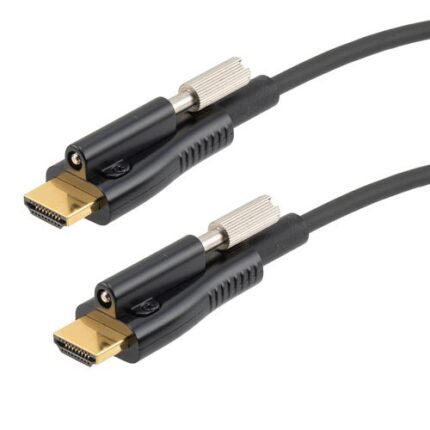
Active Optical HDMI Cable for Boardrooms and Ceiling Projectors
An active optical HDMI cable puts the high speed signal path onto fiber so a long boardroom or ceiling projector run stays slim enough to pull through conduit. Marked source and display ends, aramid strength member, hybrid copper for power and control. Tell us the route and we quote the length with a service loop.
USB-C to DisplayPort Cable for High Refresh Monitors
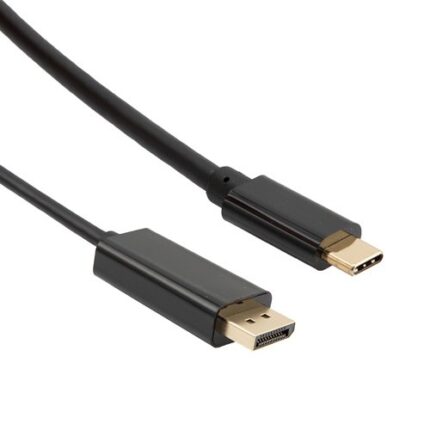
A USB-C to DisplayPort cable carries native DisplayPort signaling out of a USB-C port, bi-directional and without a converter in the path. Latching shell, gold plated contacts, reinforced molding at the USB-C end. Tell us your source, monitor and target refresh format and we will build the length to it.