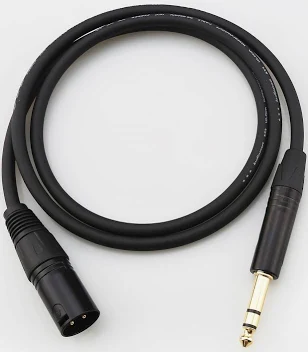
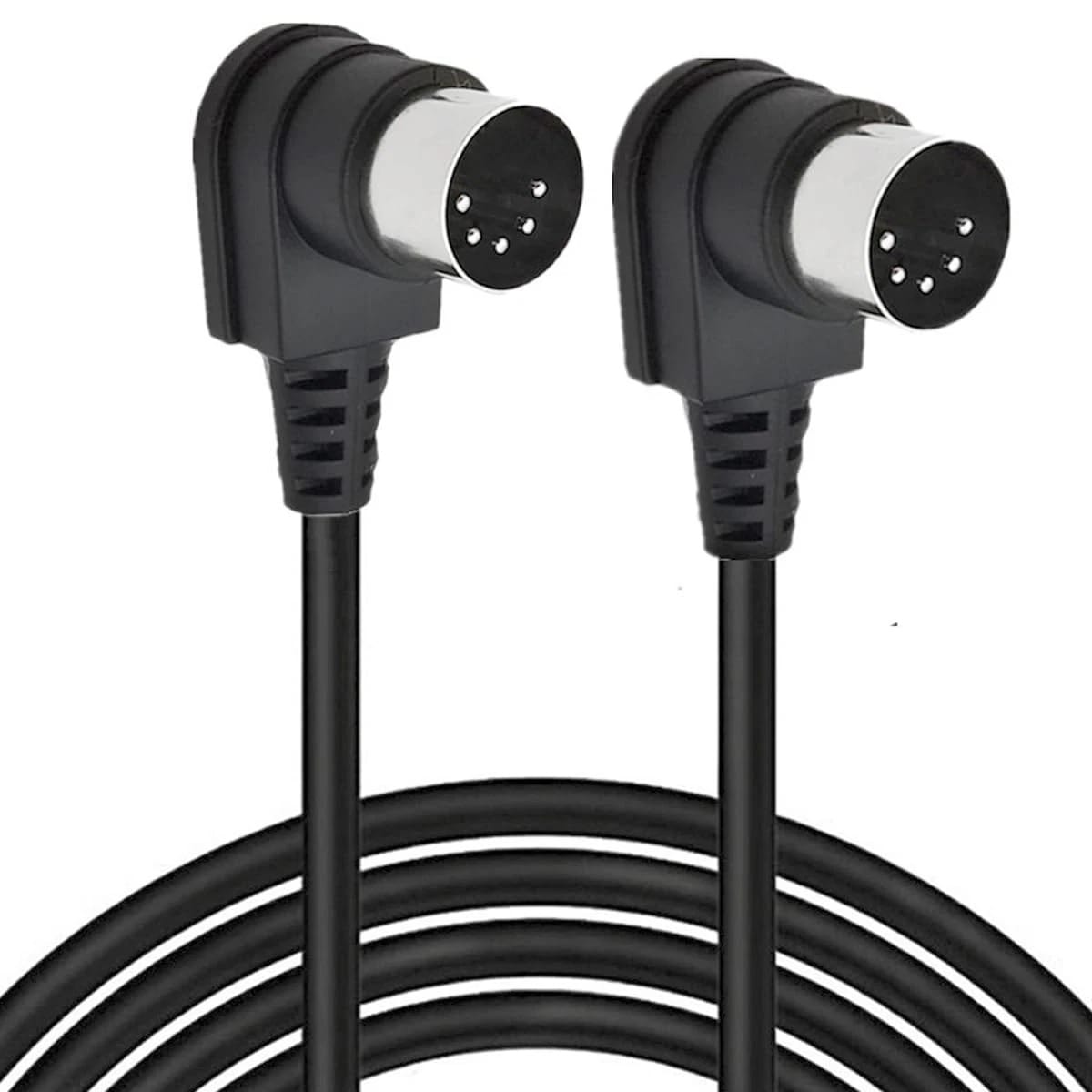
5-Pin DIN Dual Right-Angle MIDI Audio Cable
A dual right angle midi cable with 5-pin DIN plugs on both ends, so the run sits flat against the back of a rack or a synth.
Last updated: 13 September 2026
Overview
A dual right angle midi cable solves a physical problem rather than an electrical one. MIDI sockets sit in a row on the back panel of a synth or an interface, next to power, audio and CV. A straight plug occupies about 50 mm of depth in front of the panel and blocks the socket beside it. This build puts both plugs at 90 degrees so the cable leaves flat against the panel, which is the difference between a rack that closes and one that does not.
Key Specifications
| Connector A | 5-pin DIN male (right angle) |
|---|---|
| Connector B | 5-pin DIN male (right angle) |
| Wiring | Pins 4 and 5 straight through, pin 2 shield, per the standard |
| Cable | Shielded multi-core with an overall screen |
| Jacket | PVC |
| Strain Relief | Molded, low-profile right-angle bodies |
| Exit Direction | Clocked to order so both plugs face the same way |
| Build standard | Built to the pinout you send if it differs from the standard |
Why the angle matters more than the cable
Nothing about the signal changes with an angled plug; MIDI is a 5 mA current loop and does not care. What changes is the mechanical load on the socket and on everything around it:
| Problem with a straight plug | What the right angle fixes | Where it matters most |
|---|---|---|
| Blocks the neighboring socket | The plug clears the jack beside it | Patch bays and multi-port interfaces |
| Forces a tight bend at the exit | The cable leaves parallel to the panel | Shallow racks and wall-mounted shelves |
| Levers the socket when knocked | The load goes into the panel, not the connector | Touring racks and mobile rigs |
| Stands proud of a rear panel | Rear clearance drops to the shell depth | Equipment against a wall |
One thing to check before you order: angled plugs can be clocked in different directions. If the two ends have to point the same way in your rack, say so and we build them matched.
Identifying the MIDI sockets on your equipment
- Count the pins: five. A five-pin DIN socket at this size is almost always MIDI. A six-pin or eight-pin shell in the same family is not.
- Check the shell diameter. Standard DIN is about 13.2 mm. The smaller mini-DIN bodies are a different connector entirely.
- Look at the labels. MIDI IN, OUT and THRU are usually printed on the panel, and the direction matters: an OUT connects to an IN.
- Note the clearance in front of and beside each socket, so the angled body actually fits.
- Decide which way each plug should point before you order, not after it arrives.
The interface itself is described in the MIDI specification: a current loop on pins 4 and 5 driving an opto-isolator, with the shield on pin 2. Your cable is built to the pinout you send where it differs from that.
Why MIDI leads still fail
- Broken shield at the relief. These leads get coiled and un-coiled constantly, and the drain wire is what goes first.
- Bent pins. The pins are soft and the keyway is easy to miss in a dark rack. One bent pin and the link is dead.
- Plug half out. A DIN plug that is not fully seated makes partial contact and produces intermittent note data, which is routinely misdiagnosed as a software problem.
- Cheap unshielded cable. Next to a power supply or a dimmer pack, an unshielded lead picks up enough noise to corrupt data.
- Angled bodies catching on rack strips and being levered sideways when the rack is moved.
Fitting and verifying a MIDI run
- Power down before connecting. It is not strictly required, but it avoids surprises with older gear.
- Align the keyway and push straight in until the shell seats. Never rock it.
- Connect source OUT to destination IN. OUT to OUT and IN to IN pass nothing.
- Send a note and watch for activity at the receiving end, not just a link light.
- Wiggle each plug gently while notes are running. Any drop-out is a seating or shield problem.
Typical Applications for This Dual Right Angle MIDI Cable
- Hardware synth racks where sockets sit close together
- Desktop synths and controllers pushed back against a wall
- Patch bays and stage boxes with limited rear clearance
- Live rigs where a protruding plug would be knocked
- Permanent studio wiring that never gets re-patched
How to specify your build
- Exit direction on each plug, and whether they must match.
- Length along the actual route.
- Shielded, which is the default for this interface.
- Jacket: PVC, or a softer jacket where the lead is coiled often.
- Pinout if it differs from the standard.
- Marking with your part number for rental and touring stock.
- Quantity, and whether this is a prototype or a production order.
Workmanship and testing
Assembly and inspection follow IPC/WHMA-A-620 Class 3 workmanship criteria under our ISO 9001 quality management system, and every unit passes 100% continuity and pinout testing before it is packed. Conductor range is 32 to 12 AWG. Angled bodies get a seating check so a plug that will not fully enter a socket does not reach you. Pin functions quoted above are the industry-standard MIDI definitions; your assembly is built and verified to your drawing.
Custom builds and ordering
Prototype builds start from 5 pcs and ship in 3 working days; production orders start at MOQ 500 pcs and ship 14 working days after approval. New tooling for a non-standard exit direction adds about 10 working days. OEM and ODM builds ship under your part number and labeling, with material certificates and first-article reports available on request. Factory audits and video line tours can be arranged.
Related MIDI and DIN assemblies
Tight racks usually need more than one angled lead:
- 6.35mm (1/4 inch) to MIDI 5-Pin DIN Female Cable
- 4-Pin MIDI DIN Male to Female Extension Cable
- 6-Pin DIN Male to Male Dual Right-Angle Cable
- 8-Pin DIN Male to Female Panel-Mount Extension Cable
- 3.5mm TRRS 4 Pole Right Angle Cable
- Guitar Pedal Patch Cable with Low Profile Pancake Plugs
- DMX512 Lighting Cable with 3-Pin or 5-Pin XLR
Full range: audio and video cable assemblies.
Frequently Asked Questions
Do both right-angle plugs point the same way?
They can. Tell us the direction you need and we clock both bodies to match, which is what most racks require.
Is this the same as a 6-pin or 8-pin DIN cable?
No. MIDI uses the five-pin shell. Six-pin and eight-pin versions look similar and are wired differently.
Can I have one straight end and one angled end?
Yes, mixed builds are common. Just say which end is which.
Why does my link drop notes intermittently?
Check the plug seating first, then the shield. A half-seated DIN plug is the usual cause and it looks fine from the front.
What is the minimum order?
Five pieces is the prototype minimum and those ship in 3 working days. Production quantities start at 500 pcs, 14 working days after sample approval.
| Connector A | 5-pin DIN male (right angle) |
|---|---|
| Connector B | 5-pin DIN male (right angle) |
| Jacket | PVC |
| Wiring | Pins 4 and 5 straight through, pin 2 shield, per the standard |
| Cable | Shielded multi-core with an overall screen |
| Strain Relief | Molded, low-profile right-angle bodies |
| Exit Direction | Clocked to order so both plugs face the same way |
| Build standard | Built to the pinout you send if it differs from the standard |
Related products
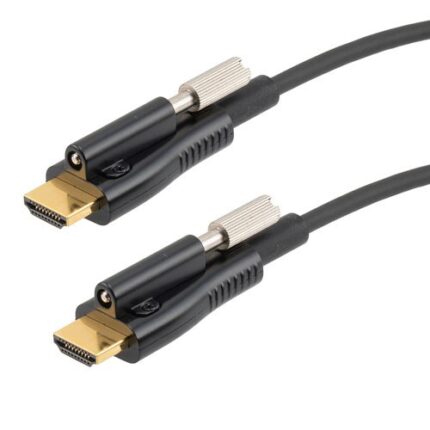
Active Optical HDMI Cable for Boardrooms and Ceiling Projectors
An active optical HDMI cable puts the high speed signal path onto fiber so a long boardroom or ceiling projector run stays slim enough to pull through conduit. Marked source and display ends, aramid strength member, hybrid copper for power and control. Tell us the route and we quote the length with a service loop.

Assistive Listening Neckloop with Breakaway Safety Release
An assistive listening neckloop turns a receiver output into a magnetic field that the telecoil in a hearing aid picks up directly. This one adds a breakaway safety release at the neck that parts under a steady pull and re-seats by hand, so a caught loop does not tighten on the wearer. Built to your receiver wiring.