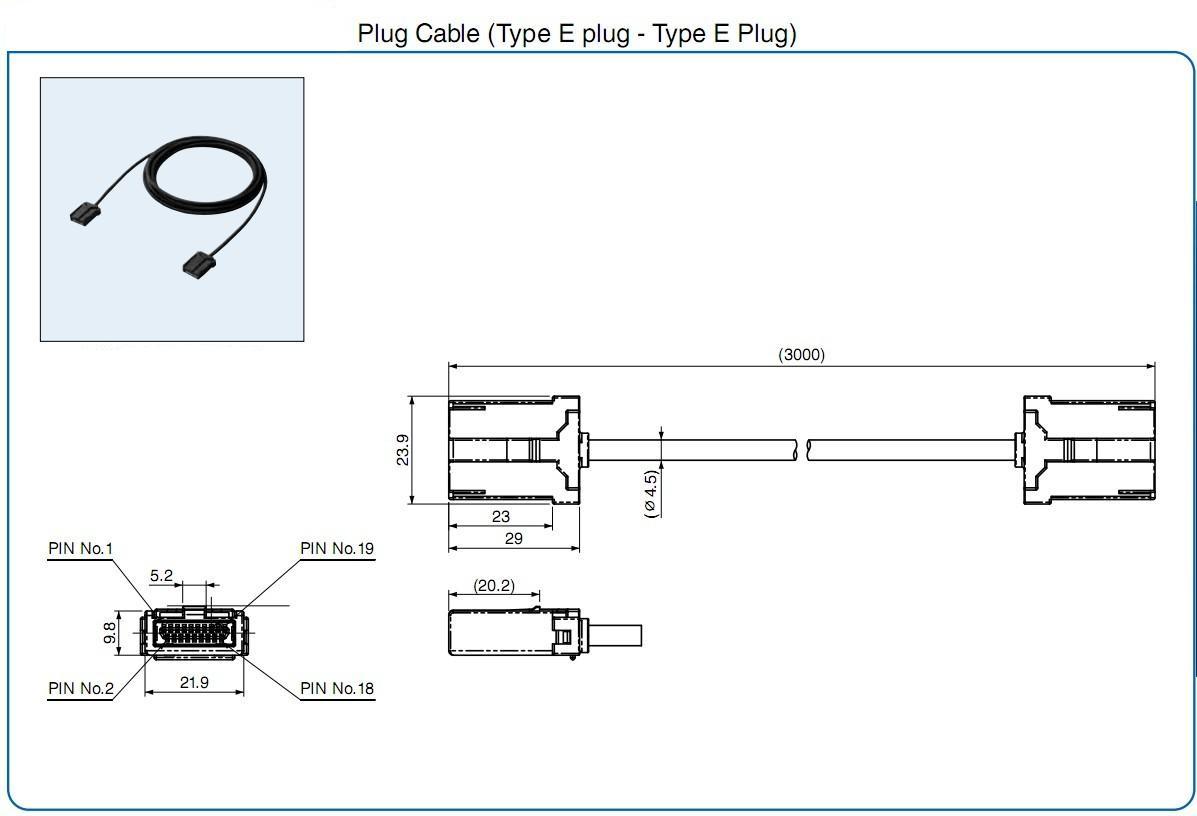
HDMI Type E Automotive Cable
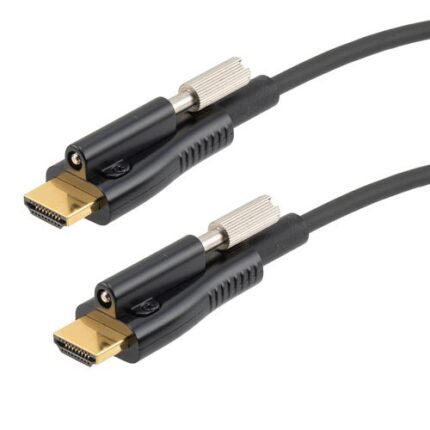
An hdmi type e automotive cable with a locking Type-E plug at each end for in-cabin video. Keyed shell mates one way only, foil plus braid shield, built to the length your trim route needs.
Overview
An hdmi type e automotive cable is the HDMI build for inside a
vehicle. Type-E carries the same 19 signals as the connector on a television, but the shell is keyed
so it only mates one way and it has a locking tab that holds the plug in the socket. Those two features
exist because a car is a vibration chamber with a wide temperature range, and a consumer HDMI plug held
in by contact friction alone will walk out of its socket over a few thousand kilometers of rough road.
If you are specifying an in-cabin video run, this is the form factor the job calls for.
Key Specifications
| Connector A | HDMI Type-E (Automotive) male, locking tab, 19 pin |
|---|---|
| Connector B | HDMI Type-E (Automotive) male, locking tab, 19 pin |
| Cable Length | Custom on request (typical 1-5 m) |
| Jacket | Black PVC |
| Application | In-vehicle infotainment, head unit to rear-seat display |
| Retention | Locking tab on the plug, keyed shell |
| Shielding | Foil plus braid over the signal pairs |
| Conductor | Stranded copper, 19 signal conductors |
| Overmold | Black PVC body at each end |
| Build | Length, jacket and shielding per your drawing |
What makes Type-E different from the plug on your TV
Four HDMI connector types exist and they are all 19 pin. Choosing between them is a mechanical
question rather than an electrical one, which is exactly why the wrong one gets ordered so often. The
shells are defined in the HDMI
specification.
| Type | Where you meet it | Retention | Suits a moving vehicle? |
|---|---|---|---|
| A, Standard | TVs, monitors, projectors | Friction only | No – it walks out under vibration |
| C, Mini | Cameras, some tablets and single-board computers | Friction only | No |
| D, Micro | Action cameras, slim tablets | Friction plus a latching shell on some builds | No |
| E, Automotive | Head units, in-cabin displays, roof monitors | Locking tab plus a keyed shell | Yes – this is what it is for |
Adapters that step between Type-E and Type-A exist, and in a vehicle they are a bad idea: every
adapter removes the locking feature and adds a lever arm on a socket that is soldered to a board behind
the dashboard trim. Specify Type-E at both ends.
What the cable has to survive inside a cabin
Two stresses dominate, and neither of them appears on a consumer cable specification sheet.
- Vibration and thermal cycling. A dashboard cycles from cold soak to full sun, and
the trim expands and contracts against the cable with it. A plug that is not locked backs out a
fraction of a millimeter at a time until the picture drops. - Electrical noise. Ignition, alternator and high-current switching loads share the
vehicle ground with the head unit. Shielding quality, and how the shield is bonded at the plug, decide
whether you get a clean picture or intermittent sparkle.
Then come the installation realities. The run usually goes under carpet and behind trim panels, so
the jacket has to survive being pulled past sharp metal, and the length has to be right the first time
because getting back behind a dashboard is expensive. Temperature range, vibration profile and any
vehicle-maker specification for your program are stated on your drawing and verified to the values you
give us.
Check the socket before you order
The most common ordering mistake on this part is assuming a socket is Type-E because the equipment
is fitted to a vehicle. Some head units and roof-mounted monitors ship with Mini or Micro HDMI, and a
few use full-size Type-A. Confirm from three things: the shape of the socket face, the presence of a
locking tab recess, and the equipment documentation. Where the display is a retrofit panel, ask the
panel supplier rather than judging from a photograph of the front.
Routing the run through the vehicle
Fit the cable where the vehicle maker fits harnesses: along existing runs, behind trim, and well
clear of airbag deployment paths, seat mechanisms and the pedal box. Where the cable passes sheet
metal, fit a grommet or an edge protector, because a jacket chafed by vibration becomes an
intermittent fault months after the build, and intermittent faults in a finished vehicle are expensive
to find. Leave a small service loop at the display end so the unit can be pulled for service without
anyone yanking the cable, and secure the harness at intervals instead of letting it lie loose under
carpet where it will be trodden on at every door.
Keep video away from high-current power runs where you can, especially on vehicles with
aftermarket amplifiers or a winch, and tell us about them when you order so the shielding is chosen
for the installation rather than for the catalog.
Typical applications for this hdmi type e automotive cable
- Head unit to a dashboard display in a factory infotainment system
- Head unit to rear-seat entertainment screens in passenger cars and people carriers
- Roof-mounted monitors in shuttle, coach and minibus installations
- Demonstration and exhibition vehicles, where the display is fitted and removed repeatedly
- Fleet builds that also need a
flush
mount HDMI extension at the trim line
How to specify your build
- Length, measured along the trim route, including the drop behind the panel.
- Confirm both ends are Type-E from the equipment documentation.
- Shielding – tell us the noise environment if the vehicle is a diesel, an EV with
high-current switching, or carries aftermarket amplifiers. - Jacket – standard PVC, or a harder-wearing material for a run under carpet.
- Quantity, and whether this is a prototype, a fleet program or spares stock.
For HDMI Type E Automotive builds the line runs to IPC/WHMA-A-620 Class 3 under ISO 9001, terminating 32 to 12 AWG. Each HDMI unit passes a continuity and pinout check before it ships, and seal checking is quoted whenever an ingress rating is on the drawing.
Custom builds and ordering
HDMI Type E Automotive prototype lots start from 1 to 50 pcs and ship in 3 working days. Production requires 500 pcs and runs 14 working days after approval. Tooling not already held adds around 10 working days. Private-label HDMI runs ship under your part number and labeling, and material certificates plus first-article reports are available.
Every production run can ship with RoHS and REACH declarations and the electrical report agreed at quotation; see certifications and material declarations. UL styles and other named approvals are built to drawing: we source to the style you specify and document it, rather than asserting a listing we do not hold. Termination, molding and verification happen in-house see our assembly lines in Longgang so the process that made your sample is the process that runs the order. More background: cable assemblies for broadcast and pro AV. Tooling is quoted separately, cut in-house rather than brokered out, and owned by you.
Related automotive and video assemblies
- Car Dashboard Flush Mount USB + HDMI Extension
- Car USB-C Data Cable with Right Angle Plug
- Car Dashboard Flush Mount USB-A + 3.5 mm Audio
- Ultra High Speed HDMI Cable for 8K Video Walls
- Active Optical HDMI Cable for Boardrooms and Ceiling Runs
- VR Link Cable, 5 m Hybrid Fiber with 90 Degree Plug
- Dual USB-C Twin Port Car Dashboard Flush Mount
Full range: automotive cable and wire harness.
Frequently Asked Questions
Can I use a normal HDMI cable with an adapter instead?
You can, and the adapter removes the locking tab, which is the whole reason Type-E exists. In a
moving vehicle, do not.
Is Type-E electrically different from Type-A?
No. Same 19 signals, same protocol. The difference is mechanical: a keyed shell and a locking
tab.
How long can an in-cabin run be?
One to five meters covers most cabins. For a coach or a long wheelbase vehicle, tell us the route
length and we will build and test to it.
My head unit has a smaller socket. What do I order?
Confirm the shape and order the matching type. Mini and Micro HDMI are mechanically different from
Type-E and from each other.
| Connector A | HDMI Type-E (Automotive) male, locking tab, 19 pin |
|---|---|
| Connector B | HDMI Type-E (Automotive) male, locking tab, 19 pin |
| Cable Length | Custom on request (typical 1-5 m) |
| Jacket | Black PVC |
| Application | In-vehicle infotainment, head unit to rear-seat display |
| Retention | Locking tab on the plug, keyed shell |
| Shielding | Foil plus braid over the signal pairs |
| Conductor | Stranded copper, 19 signal conductors |
| Overmold | Black PVC body at each end |
| Build | Length, jacket and shielding per your drawing |
Related products
Active Optical HDMI Cable for Boardrooms and Ceiling Projectors
An active optical HDMI cable puts the high speed signal path onto fiber so a long boardroom or ceiling projector run stays slim enough to pull through conduit. Marked source and display ends, aramid strength member, hybrid copper for power and control. Tell us the route and we quote the length with a service loop.