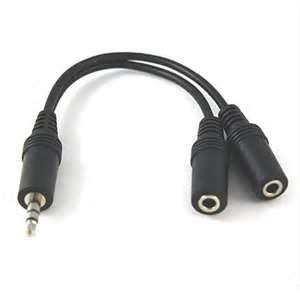
3-5mm Stereo Y Splitter Cable
A 3 5mm stereo splitter cable with one 3.5mm TRS plug and two 3.5mm TRS sockets, for two listeners or two line inputs from one source. Passive parallel split, molded fork, length and socket pitch to your drawing.
Overview
This 3.5mm stereo splitter cable takes one stereo source to two
listeners, or to two destinations, with no electronics in between. A single 3.5mm TRS plug goes into
the phone, tablet, laptop or mixer, and two 3.5mm TRS sockets come out the other side. It is the
simplest useful adapter in audio and the most misused one, because “it works” and “it works properly”
are different statements once you put two loads on one output. Before you order a hundred of them for
a venue or a classroom, it is worth knowing what the parallel connection does to level and to the
source.
Key Specifications
| Connector A | 3.5 mm TRS male (3-pole, stereo) |
|---|---|
| Connector B | 3.5 mm TRS female socket (2x) |
| Cable Length | Custom on request (typical 15–30 cm) |
| Jacket | Black PVC |
| Application | Sharing one audio source between two headphones / speakers |
| Wiring | Tip and ring paralleled to both sockets, sleeve common |
| Conductor | Stranded copper |
| Housing | Molded plug and sockets with strain-relief boot |
| Split type | Passive parallel, no active buffer |
| Build | Length, jacket color and socket spacing per your drawing |
Why a 3 5mm stereo splitter cable cannot drive two loads for free
Two sockets wired in parallel present half the impedance of one, and the output stage of a phone or
a laptop is designed around a load it expects to see. A source that is comfortable driving a single
32 ohm headphone sees 16 ohm once you split it. What follows depends on the source: a well designed
output simply gets quieter, a marginal one distorts on peaks, and a very marginal one current-limits
and clips. None of that is a defect in the cable; it is
impedance
matching doing what it does.
| What you are feeding | Typical result with a passive split | Better answer |
|---|---|---|
| Two pairs of low-impedance headphones | Noticeably quieter, softer bass, clipping on loud passages | A headphone distribution amplifier with a separate gain stage per output |
| Two powered speakers or an amplifier input | Fine; line inputs are high impedance and barely load the source | The passive split is correct here |
| Two recording inputs or mixer channels | Fine, watch the ground reference between them | Split after the source, keep the runs short |
| Two mixed devices, headphones plus a speaker | Levels are linked; one volume control for both | A mixer between source and outputs |
So the honest guidance is this: splitting to two inputs is exactly what this cable is for, and it
costs you nothing. Splitting to two headphones works, but you are sharing one output stage, and if the
result is too quiet the fix is an amplifier, not a better cable.
Stereo, TRS and the TRRS trap
The plug here has three contacts: tip left, ring right, sleeve common. That is a stereo unbalanced
connection, and it is not the four-pole TRRS jack used by headsets. Push a three-pole plug into a
four-pole socket and the microphone contact gets shorted to the common, which on many devices is read
as a headset with a pressed button, or as no headset at all. Two rules follow. If the source is a
phone headset jack and you need the mic as well, this is the wrong part. If the source is a
headphone-only or line output, this is the right part and a TRRS version would buy you nothing. Where
the distinction matters, we also build
balanced in-ear monitor leads with
a separate return per channel, which is a different problem solved a different way.
Build details that decide how long it lasts
A Y splitter lives at the end of a cable that gets pulled, and the joint where one jacket becomes
two is where they fail. Three things matter in the build.
- Socket spacing. Two 3.5mm socket bodies side by side need enough pitch that two
plug barrels do not fight for the same space. Tell us the widest plug you will insert. - Strain relief at the fork. The branching point should be a molded body, not two
cables taped into one. - Crosstalk. The two outputs run alongside each other for their whole length, so
the pair is screened through the splitter section rather than left as loose conductors.
What to check when a split sounds wrong
If one listener is silent, swap the two plugs first: a socket that has lost its spring contact is
more common than a broken conductor. If both are quiet, split at the source and check the source’s own
volume and any output setting that changes depending on what it thinks is plugged in. If there is hum,
the cause is nearly always a charging source sharing mains with the amplifier, not the splitter. And
if one channel is missing from both outputs, look for a plug that is not fully seated in the source
jack before you suspect the wiring.
Typical applications for this 3 5mm stereo splitter cable
- Two listeners sharing one phone, tablet or laptop output on a flight or in a car
- Splitting a portable player into a stereo pair of desktop speakers
- Duplicating a line-level feed to two amplifiers in a small AV setup
- Classrooms and language labs, where the source is one device and the listeners are two
- Test benches that need the same signal into two analyzers, alongside
a 3.5mm to MIDI DIN
lead for the instruments next to it
How to specify your build
- What the two outputs feed — headphones, line inputs, or both.
- Length, typically 15 to 30 cm, longer if the sockets have to reach a panel.
- Socket pitch, if you have bulky plugs to insert.
- Jacket color and whether the two legs should be marked L and R.
- Quantity, and whether this is resale stock with retail packing.
3-5mm Stereo Y builds are assembled and inspected to IPC/WHMA-A-620 Class 3 criteria, with ISO 9001 as the quality system over 32 to 12 AWG work. continuity and pinout are verified on each 3-5mm assembly before packing, and seal checking is quoted whenever an ingress rating is on the drawing.
Custom builds and ordering
3-5mm Stereo Y prototype builds start from 1 to 50 pcs and are out in 3 working days; production is quoted from 500 pcs at 14 working days after sample approval. Your part number and labeling go on OEM and ODM 3-5mm shipments, and material certificates and first-article reports are available on request. We hold 100 sets of mold tooling in house, so a standard body needs no tooling time and a new one adds about 10 working days.
Every production run can ship with RoHS and REACH declarations and the electrical report agreed at quotation; see certifications and material declarations. UL styles and other named approvals are built to drawing: we source to the style you specify and document it, rather than asserting a listing we do not hold. Termination, molding and verification happen in-house see the assembly lines behind this build so the process that made your sample is the process that runs the order. Related reading: cable assemblies for broadcast and pro AV. Tooling is quoted separately, cut in-house rather than brokered out, and owned by you.
Related audio assemblies
- 6 in Mini-DIN6 PS/2 Male to 2 Female Y Splitter
- 3.5mm to MIDI 6-Pin DIN Audio Cable
- Balanced IEM Cable with Detachable Two-Pin and MMCX
- Assistive Listening Neckloop with Breakaway Release
- 3.5 mm AUX Audio Female Panel Mount Extension
- Turntable Tonearm Cable with DIN and Dual RCA
- XLR Microphone Cable, Balanced Three Pin
Full range: audio and video cable assemblies.
Frequently Asked Questions
Why is it quieter with two headphones plugged in?
Two loads in parallel halve the impedance the source sees. The output stage delivers less voltage
into it, so both listeners get less level. A headphone amplifier fixes it.
Can I use this to combine two microphones into one input?
No. Combining sources needs a mixer. Wiring two outputs together with a split cable drives each
source into the other.
Does it carry the microphone channel on a phone headset?
No. This is a three-pole TRS splitter carrying left, right and common only.
Will one socket work if the other is empty?
Yes. Each socket is a full stereo connection and they are independent apart from sharing the
source.
| Connector A | 3.5 mm TRS male (3-pole, stereo) |
|---|---|
| Connector B | 3.5 mm TRS female socket (2x) |
| Cable Length | Custom on request (typical 15–30 cm) |
| Jacket | Black PVC |
| Application | Sharing one audio source between two headphones / speakers |
| Wiring | Tip and ring paralleled to both sockets, sleeve common |
| Conductor | Stranded copper |
| Housing | Molded plug and sockets with strain-relief boot |
| Split type | Passive parallel, no active buffer |
| Build | Length, jacket color and socket spacing per your drawing |