
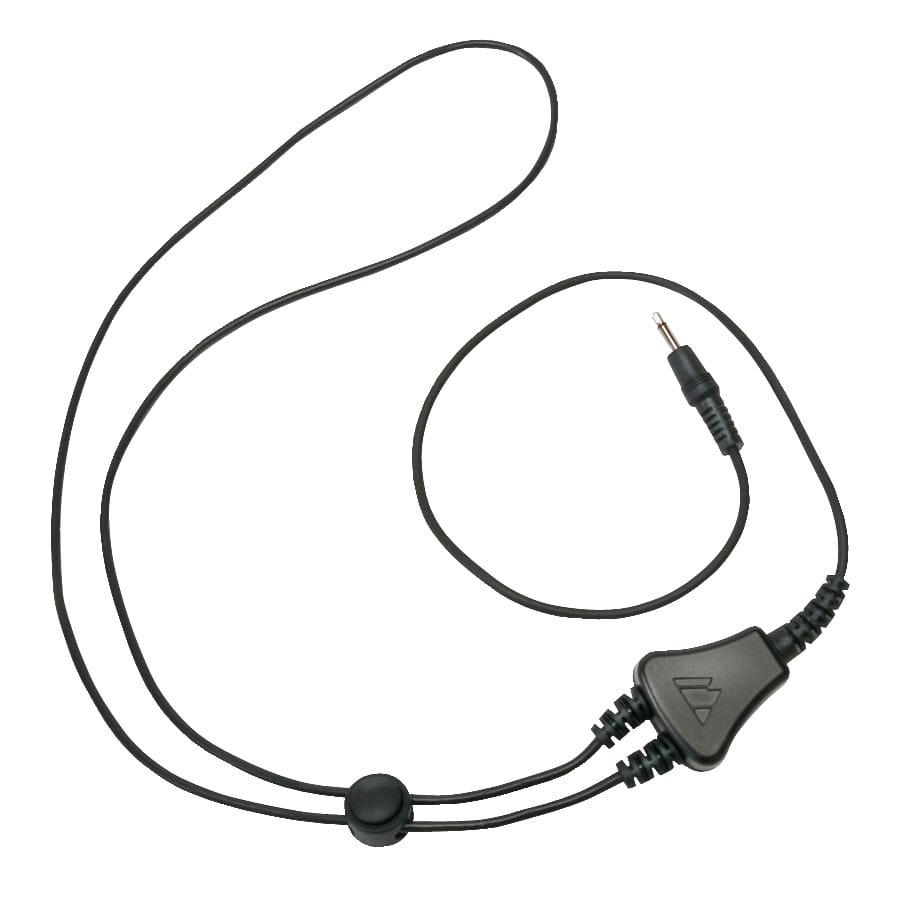
Assistive Listening Neckloop with Breakaway Safety Release
An assistive listening neckloop turns a receiver output into a magnetic field that the telecoil in a hearing aid picks up directly. This one adds a breakaway safety release at the neck that parts under a steady pull and re-seats by hand, so a caught loop does not tighten on the wearer. Built to your receiver wiring.
Overview
An assistive listening neckloop is the last half meter of an assistive
listening system: it turns the output of a receiver into a magnetic field that the telecoil in a hearing
aid picks up directly, with no room acoustics in the way and no headset that has to be cleaned between
users. Because it is worn around the neck by members of the public, the two things that decide whether it
is fit for a venue are the field it produces and what happens when it gets caught on something. This build
addresses the second with a breakaway release at the neck that parts under a steady pull and re-seats by
hand.
Key Specifications
| Interface | 3.5 mm TRS or TRRS plug to neckloop |
|---|---|
| Safety feature | Breakaway release at the neck, re-seatable |
| Loop material | Soft touch TPE, wipe clean |
| Cable length | 74 to 84 cm (pending confirmation) |
| Optional build | Version with a 3.5 mm headset tap |
| Field strength | Not yet verified, pending measurement |
| Compliance files | Pending supplier confirmation |
| Color | Black; other colors on request |
| Breakaway action | Parts under a steady pull and re-seats by hand |
| Cleaning | Wipe down between users, no fabric covering |
| Packing | Bulk packed for venue issue, or retail packing on request |
Why the breakaway release exists
A loop worn around the neck will get caught: on a theater seat back when the wearer stands up, on a
lanyard, on the arm of a helper leaning across a row, on a wheelchair handle or a bed rail, on machinery in
any venue where the public is near moving equipment. A closed loop has nowhere to go when that happens; the
pull goes straight to the wearer’s neck.
A breakaway release puts a deliberate weak point in the loop. Under a steady pull the halves part, the
tension is gone, and the wearer is left holding a cable instead of being held by one. Staff re-seat it by
hand in seconds with no tools and no spare parts, which matters when a venue issues fifty of these before a
performance and cannot retire one every time it is pulled.
Treat the breakaway as a requirement rather than an option wherever loops are issued to the public, and
make sure the staff handing them out can re-seat it. A release nobody can put back together is a loop that
quietly leaves service.
What the loop has to deliver
The telecoil in a
hearing aid is an inductor with an open magnetic circuit, and it senses the vertical component of the field
around the wearer’s neck. IEC 60118-4 defines a reference magnetic field strength level of 400 mA/m for this
class of system, and IEC 62489-1 covers how the components are measured and specified.
Those are industry definitions and they apply to an installed system rather than to one cable. What
matters for a neckloop is whether it works with the receiver you run: the loop is a low impedance coil
driven with current rather than voltage, so the driver output, the number of turns and the conductor
resistance all have to be considered together. Field strength for this build is stated per your drawing and
measured against the receiver you name.
Neckloop inductance and the receiver you run
- The loop is current driven; an output meant for headphones will not drive it correctly
- Long runs and thin conductors add resistance the driver has to overcome
- Metal in the seat frame, the floor or a lanyard clip changes the field the wearer receives
- Two loops working in the same room interfere with each other; spacing matters
Where they are used
- Theaters and concert halls issuing receivers at the door and collecting them at the end
- Houses of worship and lecture halls with a fixed assistive listening installation
- Courtrooms and council chambers where proceedings are amplified for participants
- Museums and visitor centers running guided audio for tours
- Healthcare waiting areas where a receiver is handed to a patient
Compatibility
The plug is a 3.5 mm connector and we build both three conductor and four conductor versions, because
receivers from different makers wire the ring and sleeve differently. Ordering the wrong one gives you a
loop that is silent on one channel or that only works when the plug is held at an angle. Tell us which
receiver model you run and we will match the wiring, or supply both. A version with a 3.5 mm headset tap is
available where a personal headset has to run from the same receiver.
Comfort and hygiene
The loop is made from a soft touch TPE that stays flexible and can be wiped down between users, and it
is light enough that most people stop noticing it after a few minutes. The cable length is short by design:
long enough to reach a receiver clipped to a belt, without slack that catches on things. A loop that is
uncomfortable gets taken off and left on the seat, which is the real failure mode in a venue issuing these
night after night.
Typical applications for this assistive listening neckloop
- Venue issue counters where loops are handed out and collected every session
- Fixed installs in theaters, courts and houses of worship
- Replacement stock for a receiver fleet that is missing its loops
- Tour groups and visitor centers running one receiver per guide position
- Mobile presentation vehicles, alongside builds such as an HDMI Type E automotive cable
How to specify your build
- Receiver model — it decides the plug wiring, three or four conductor.
- Breakaway — confirm it is required, and the pull you want it to part at.
- Loop material and color — standard black soft touch TPE, or a color you nominate.
- Length — how far the receiver sits from the neck in your setting.
- Headset tap — yes or no, and on which side of the loop.
- Packing — bulk for a venue store, or individual packing for resale.
- Quantity, and whether the venue needs a field strength measurement before sign-off.
Workmanship and testing
Workmanship on Assistive Listening Neckloop builds follows IPC/WHMA-A-620 Class 3, the line is run under ISO 9001, and the termination range is 32 to 12 AWG. continuity and pinout are verified on each Assistive assembly before packing, and seal checking is quoted whenever an ingress rating is on the drawing.
Every production run can ship with RoHS and REACH declarations and the electrical report agreed at quotation; see certifications and material declarations. UL styles and other named approvals are built to drawing: we source to the style you specify and document it, rather than asserting a listing we do not hold. Termination, molding and verification happen in-house see cable assembly and wire harness production so the process that made your sample is the process that runs the order. Related reading: cable assemblies for broadcast and pro AV. Tooling is quoted separately, cut in-house rather than brokered out, and owned by you.
Custom builds and ordering
Quote Assistive Listening Neckloop builds from 1 to 50 pcs and they ship in 3 working days. At volume the minimum is 500 pcs with 14 working days after approval. Tooling not already held adds around 10 working days. Your part number and labeling go on Assistive shipments, and material certificates and first-article reports are available on request.
Related audio assemblies
- 3.5 mm TRRS 4 Pole Right Angle Cable
- 3.5 mm Stereo Y Splitter Cable
- Turntable Tonearm Cable with DIN and Dual RCA Options
- SDI BNC Cable Assembly for Studios and OB Vans
- Toslink Digital Optical Audio Cable
Full range: audio and video cable assemblies.
Frequently Asked Questions
Does the breakaway release weaken the loop in normal use?
No. It holds through ordinary handling and parts under a sustained pull. If it is coming apart while
people put the loop on, tell us and we will build to the pull figure on your drawing.
Can staff re-seat it?
Yes, by hand in seconds. Show the team handing them out once, and a pulled loop goes straight back into
the issue stock.
Will it work with the receivers we already own?
Usually, provided the plug wiring matches. Give us the model and we will build the right version, or send
both types to try.
Can you measure the field strength for our file?
We can measure the loop with the receiver you name and report the result. We do not publish a generic
performance claim for it.
| Interface | 3.5 mm TRS or TRRS plug to neckloop |
|---|---|
| Safety feature | Breakaway release at the neck, re-seatable |
| Loop material | Soft touch TPE, wipe clean |
| Cable length | 74 to 84 cm class |
| Optional build | Version with a 3.5 mm headset tap |
| Field strength | Stated per your drawing |
| Compliance files | Stated per your drawing |
| Color | Black; other colors on request |
| Breakaway action | Parts under a steady pull and re-seats by hand |
| Cleaning | Wipe down between users, no fabric covering |
| Packing | Bulk packed for venue issue, or retail packing on request |
Related products
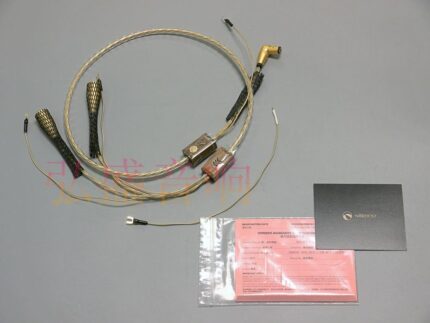
Turntable Tonearm Cable with DIN and Dual RCA Options
A turntable tonearm cable is the one link in a vinyl system where the wiring, the screening and the ground path are all audible. Built with DIN 5-pin or dual RCA ends, a separate ground spade and two shielding layers, to the pinout on your drawing. Send a photo of the back of the deck and we will match it.
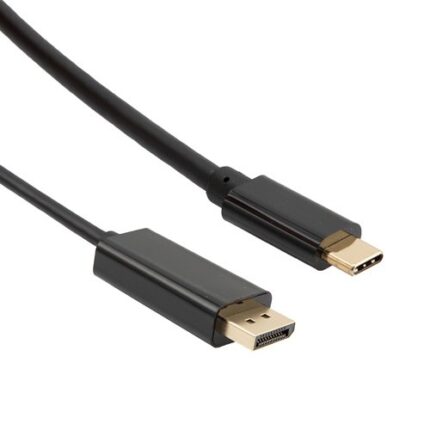
USB-C to DisplayPort Cable for High Refresh Monitors
A USB-C to DisplayPort cable carries native DisplayPort signaling out of a USB-C port, bi-directional and without a converter in the path. Latching shell, gold plated contacts, reinforced molding at the USB-C end. Tell us your source, monitor and target refresh format and we will build the length to it.