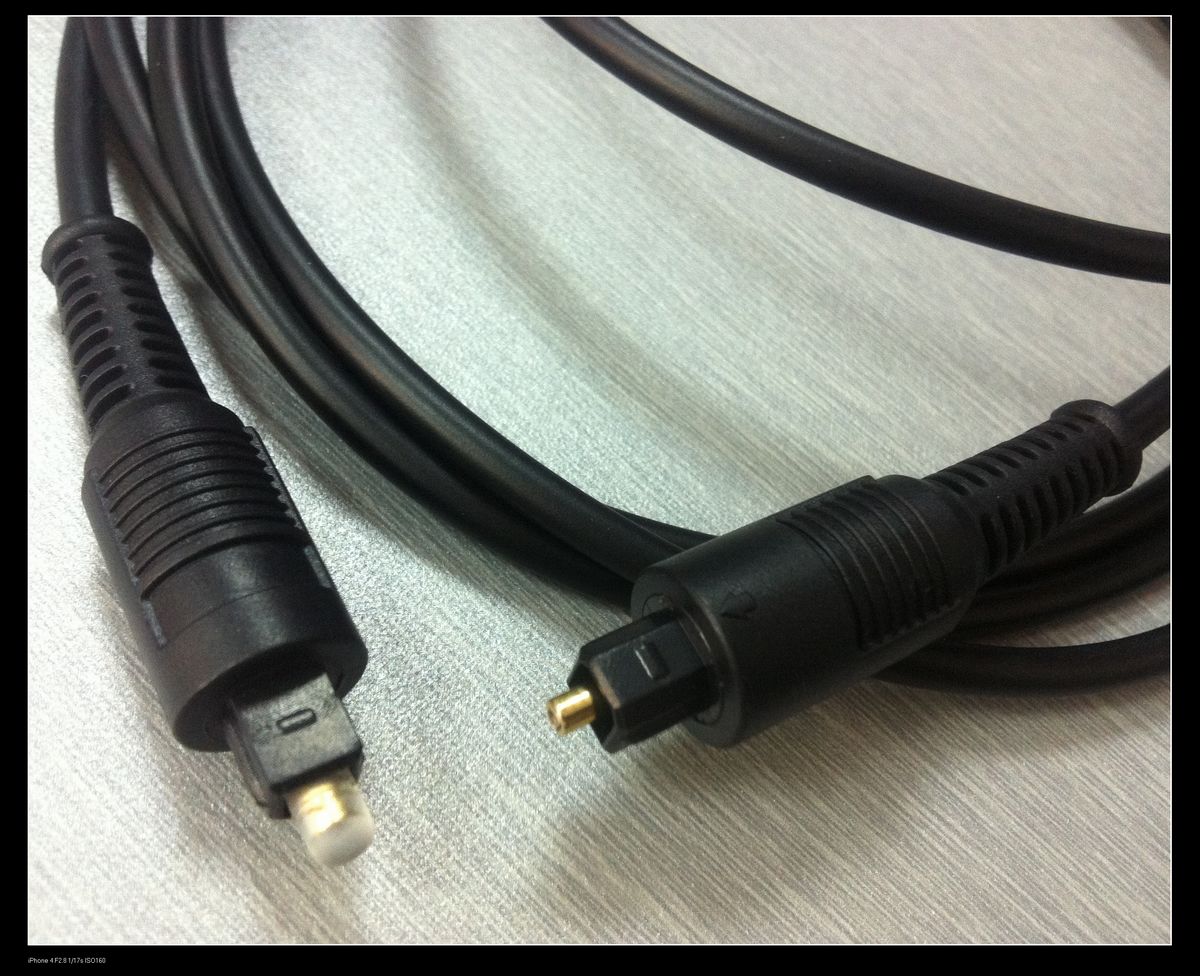
Toslink Digital Optical Audio Cable
A toslink digital optical cable carrying an S/PDIF stream between a TV, console or player and a soundbar, receiver or DAC. Immune to ground-loop hum, plastic optical fiber, protective end caps, length to your run.
Overview
A toslink digital optical cable carries audio as pulses of light along
a plastic fiber, which buys you one thing that copper cannot: complete immunity to ground loops. If a
TV and an amplifier are on different mains circuits and hum through an analog connection, an optical
link removes the electrical path entirely and the hum goes with it. It is also the only digital audio
output on a great many televisions and consoles, which is why these leads are still specified on new
installations. The trade-offs are bandwidth and fragility, and both are worth understanding before you
run one through a wall.
Key Specifications
| Connector A | Toslink square male, molded housing |
|---|---|
| Connector B | Toslink square male, molded housing |
| Cable Length | Custom on request |
| Jacket | Black PVC |
| Application | TV / game console to soundbar or AV receiver digital audio |
| Fiber | Plastic optical fiber (POF) |
| Wavelength | Around 650 nm, red light |
| Signal | S/PDIF digital audio stream |
| End caps | Clear protective caps over the optical tips |
| Build | Length, jacket color and fiber type per your drawing |
What a toslink digital optical cable can carry, and what it cannot
The stream on this cable is S/PDIF, the consumer digital audio format carried over optical fiber. It
moves two channels of uncompressed PCM, or a compressed multi-channel bitstream. What it does not move
is any of the lossless high-bitrate formats that modern disc and streaming sources can output, because
those need more bandwidth than the interface was ever given. That is the single most common
disappointment in the field: a customer plugs in optical, selects a Dolby TrueHD or DTS-HD Master
Audio track, and gets stereo.
| Format | Over this optical link? | Notes |
|---|---|---|
| 2-channel PCM | Yes | The format’s home ground; sample rate limited by the equipment at each end |
| Dolby Digital, DTS | Yes | Compressed multi-channel, the reason optical became standard on TVs |
| Dolby Digital Plus, lossless TrueHD / DTS-HD MA | No | Needs an HDMI audio path instead |
| Object-based immersive audio | No | Needs HDMI, usually with audio return |
Those are properties of the interface rather than of our cable. For a full bandwidth multi-channel
path, run Ultra High Speed HDMI
and let the receiver do the decoding.
Plastic fiber, and the length limit that comes with it
Consumer optical leads use
plastic optical
fiber rather than glass, because the large core is forgiving of the cheap LED transmitter and of
dust on the end face. The cost is attenuation: over plastic fiber the practical working length for a
reliable link is a few meters, and beyond that the receiver starts losing lock, which usually shows up
as intermittent dropouts rather than as a clean failure. For longer runs, either specify a glass-fiber
build or move the source and the receiver closer together. Bend radius matters too — a tight kink
behind a cabinet is a permanent loss, because the fiber does not recover.
- Keep the run short and gently curved. No right-angle bends, no staples through the jacket.
- Leave the clear protective caps on until the moment you plug in. A dusty end face is the most
common cause of a “dead” cable. - Seat the plug fully; the shell clicks and the tip should sit flush.
- If the link drops at high sample rates only, suspect length and fiber condition before the
equipment.
When optical is not the right answer
Two cases argue against it. The first is mechanical. Plastic fiber does not like being pulled,
stapled or bent tightly, so a run through a wall cavity with sharp bends is better served by a coaxial
digital lead, which survives the installation and carries the same stream. The second is bandwidth: if
the source can output lossless or object-based audio and the receiver can decode it, optical gives
that up, and an HDMI path with audio return is the correct choice. Choose optical when you need
galvanic isolation between two pieces of equipment, or when it is the only digital output on the
source. Choose something else when you need bandwidth, or when the run has to survive being pulled
through a building.
Fitting the connector to the socket
This is the full-size square Toslink shell. It is not Mini-Toslink, the 3.5mm optical jack found on
some laptops and portable recorders, and the two are not mechanically compatible without an adapter.
Check the socket shape before ordering, and check it again on portable equipment, where a 3.5mm jack
may be an analog headset socket, a Mini-Toslink output, or both. Where a device only offers an analog
output, the digital conversion has to happen somewhere else in the chain.
Typical applications for this toslink digital optical cable
- Television to soundbar, where the TV has no coaxial digital output
- Game console and media player to an AV receiver
- Set-top box to a DAC in a two-channel system
- Any installation with a ground-loop hum that will not clear on analog
- Racks and racks of mixed equipment, alongside
fiber hybrid data cabling
where copper and optical share the same tray
How to specify your build
- Length, measured along the route, and the fiber type if it is beyond a few
meters. - Socket type — full-size Toslink, or Mini-Toslink if the equipment has the small
jack. - Jacket color and material, especially for a run inside a wall.
- Caps — shipped fitted, or bulk packed loose for fast installation.
- Quantity, and whether you need retail packing for resale.
Build standard for Toslink Digital Optical Audio builds is IPC/WHMA-A-620 Class 3 under ISO 9001, with terminations from 32 to 12 AWG. continuity and pinout are tested on each Toslink unit before it is packed, and seal checking is quoted whenever an ingress rating is on the drawing.
Custom builds and ordering
On Toslink Digital Optical Audio builds, prototype lots run from 1 to 50 pcs and leave in 3 working days. Production runs of 500 pcs and up ship 14 working days after approval. Tooling not already held adds around 10 working days. Toslink OEM and ODM shipments carry your part number and labeling, and material certificates and first-article reports are available on request.
Every production run can ship with RoHS and REACH declarations and the electrical report agreed at quotation; see certifications and material declarations. UL styles and other named approvals are built to drawing: we source to the style you specify and document it, rather than asserting a listing we do not hold. Production runs on the same lines described under cable assembly and wire harness production, where cutting, termination, molding and 100 percent electrical verification sit under one roof. More background: our broadcast and pro AV work. Tooling is quoted separately, cut in-house rather than brokered out, and owned by you.
Related audio and fiber assemblies
- Ultra High Speed HDMI Cable for 8K Video Walls
- Active Optical HDMI Cable for Boardrooms and Ceiling Runs
- Cat6a Fiber Hybrid Cable for Machine to Cabinet
- Turntable Tonearm Cable with DIN and Dual RCA
- XLR Microphone Cable, Balanced Three Pin
- 1/4 TRS to XLR Cable 6.35 mm Balanced Lead
Full range: audio and video cable assemblies.
Frequently Asked Questions
Why am I only getting stereo from a surround track?
The lossless multi-channel formats do not fit through an S/PDIF optical link. Select a Dolby
Digital track, or use HDMI for lossless audio.
How long can the run be?
A few meters on plastic fiber is the practical figure. For longer runs, ask for a glass-fiber build
or re-position the equipment.
Is this the same as Mini-Toslink?
No. This is the full-size square shell. Mini-Toslink uses a 3.5mm plug and needs a different build
or an adapter.
My link drops out intermittently. Cable or equipment?
Check the end faces for dust first, then the bend radius, then the length. Intermittent dropout at
one sample rate only is almost always a margin problem on the fiber.
| Connector A | Toslink square male, molded housing |
|---|---|
| Connector B | Toslink square male, molded housing |
| Cable Length | Custom on request |
| Jacket | Black PVC |
| Application | TV / game console to soundbar or AV receiver digital audio |
| Fiber | Plastic optical fiber (POF) |
| Wavelength | Around 650 nm, red light |
| Signal | S/PDIF digital audio stream |
| End caps | Clear protective caps over the optical tips |
| Build | Length, jacket color and fiber type per your drawing |
Related products
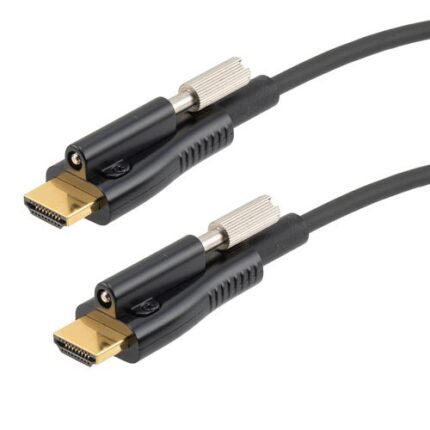
Active Optical HDMI Cable for Boardrooms and Ceiling Projectors
An active optical HDMI cable puts the high speed signal path onto fiber so a long boardroom or ceiling projector run stays slim enough to pull through conduit. Marked source and display ends, aramid strength member, hybrid copper for power and control. Tell us the route and we quote the length with a service loop.
USB-C to DisplayPort Cable for High Refresh Monitors
A USB-C to DisplayPort cable carries native DisplayPort signaling out of a USB-C port, bi-directional and without a converter in the path. Latching shell, gold plated contacts, reinforced molding at the USB-C end. Tell us your source, monitor and target refresh format and we will build the length to it.