GX16 Aviation Plug Cable, Threaded Circular Cordset, Panel Mount Option
A GX16 aviation plug cable couples with a knurled threaded nut instead of a latch, so it will not walk loose on a machine that runs unattended for a shift. Two to ten contacts, straight or right-angle plug, or a flange receptacle for the panel.
Last updated: 13 September 2026
Overview
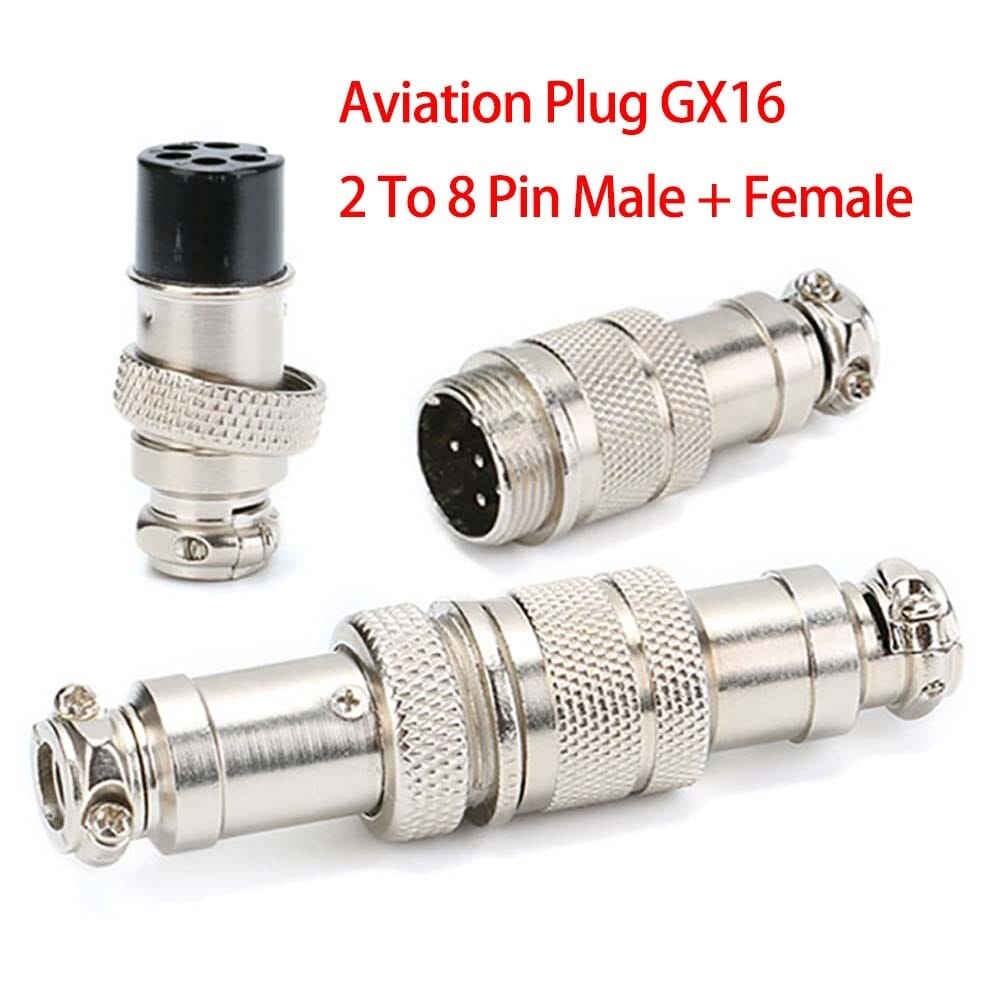
A GX16 aviation plug cable is the cheap, tough, threaded circular connector that turns up on everything from a spindle drive to a lighting truss. The whole reason to choose it is the coupling: a knurled nut that screws onto a matching thread on the receptacle, so nothing in the joint depends on spring tension in a plastic latch or on friction between two smooth barrels. That makes it the right answer wherever a machine runs unattended for a shift at a time and nobody is watching the connectors. We build these with 2 to 10 contacts, as a straight or right-angle cable plug, or with a flange receptacle for a panel feed-through.
Why it is called an aviation plug
The nickname comes from the family of threaded circular connectors developed for aircraft, where a connector had to stay mated through vibration, pressure changes and temperature swings, and where a plug that came loose was not an inconvenience. The design answers that with three features that are all still doing the same job on a factory floor: a threaded coupling that cannot be pulled off, a metal shell that carries the screen through to the equipment earth, and a keyed insert so the wrong plug cannot be forced into the wrong socket. The GX16 is a widely copied, general-purpose version of that idea, made in zinc alloy with a plated finish rather than to a military specification – which is why it costs what it does.
Choosing the pin count
The family spans a range of contact counts inside the same 16 mm shell, and there is a trade-off hiding in that range: as the pin count goes up, the individual contacts get smaller and carry less current. Start from the number of circuits you actually have to move, then go back and check whether any of them are power rather than signal. The answer usually pushes you towards a lower pin count with fewer, larger contacts rather than a higher one.
| Positions | Typical use | What to watch |
|---|---|---|
| 2 | DC power feed, loudspeaker and simple supply runs | Largest contacts, the right choice for current |
| 3 | Three-phase signal, sensor with supply and return, XLR-style audio | Common on bench instrumentation |
| 4 | Stepper motors, solenoid valves, two circuits plus returns | Still large enough for moderate current |
| 5 | Encoder and low-count feedback, DMX-style lighting runs | Signal only at this point |
| 6 – 8 | Multi-channel sensors, camera and ROV tether dry-ends | Contacts get noticeably smaller |
| 9 – 10 | Denser signal runs in one shell | Smallest contacts; check the current on every circuit |
Keyways: buy the two halves as a matched set
Insert arrangements are keyed so a plug will not enter a receptacle with a different contact layout – which is exactly what you want until you try to mix a plug from one source with a receptacle from another. The keyway positions are not identical between every maker, and the shells look alike enough that nobody notices until the parts will not mate or, worse, mate with the contacts misaligned. If you are adding to an existing installation, buy the plug and the receptacle together, or send us a photograph of the mating face and we will match it.
Thread, shell and screen continuity
The coupling nut is the retention; the thread is what makes it work, and it is worth finger-tightening properly rather than leaving it half on. The shell is metal with a conductive finish, which matters for two reasons: it gives the cable screen somewhere to go rather than leaving it floating at the connector, and it makes the whole assembly far more tolerant of being knocked than a plastic body would be. Termination is solder bucket as standard, because that is what suits prototype and mid-volume builds; crimp contacts are available once the volume justifies the tooling.
Key specifications
| Connector family | GX16 threaded circular (aviation plug) |
|---|---|
| Shell material | Zinc alloy with metal plating |
| Contact count | 2 to 10 positions |
| Termination | Solder bucket; crimp on request |
| Body styles | Straight plug, right-angle plug, flange panel receptacle |
| Coupling method | Knurled threaded coupling nut |
| Jacket options | PVC or PUR, black |
| Screening | Braid screen option, tied to shell |
| Length | Made to order |
Typical applications for this GX16 aviation plug cable
- CNC controller cabinets, spindle drives, limit switches and tool setters
- Stage lighting and LED wall power and data runs between truss sections
- Sensors, actuators, proximity switches and bench instrumentation
- Camera poles, ROV tether dry-ends, 3D printer tool heads
- Amateur radio rigs and test equipment with panel-mounted feeds
What to send us for a quote
- The pin count, and how many of the circuits are power rather than signal.
- Whether each end is a cable plug or a panel receptacle, straight or right-angle.
- The length you need, measured along the route rather than point to point.
- The jacket: PVC for a fixed indoor run, PUR where there is cutting oil or coolant mist.
- Whether you need a screen, and whether the shell should carry it through.
- A photograph of the mating face if you are replacing an existing part – keyways are hard to describe in words.
- Quantity, and whether this is a prototype or a production order.
Workmanship and testing
Our line is ISO 9001 certified and every assembly is built to IPC/WHMA-A-620 Class 3 workmanship across 32 to 12 AWG. Continuity and pinout are checked on every unit before packing, and seal checking can be quoted where an ingress rating is specified.
Custom builds and ordering
The prototype minimum is 5 pcs, out in 3 working days. Production starts at 500 pcs and ships 14 working days from approval. Tooling for a body we do not stock adds about 10 working days. Your part number, your label, your packaging – with material certificates and first-article reports on request.
Related circular and screw-lock assemblies
- Circular USB-C Screw Cable with metal M12 style coupling
- DC Screw Lock Cable with threaded retaining collar barrel plug
- Threaded Locking DC Pigtail 5.5×2.1mm
- MIL-DTL-5015 Circular Power Cable Assembly where a qualified military part is required
- DMX512 Lighting Cable with 3-pin or 5-pin XLR
- MIL-DTL-38999 Series III Military Circular Cable Assembly
The coupling works because of the thread on the nut and the receptacle rather than any latching feature. Full ranges: Screw-Lock Molded Cable • Signal and Data Cables • Panel Mount Cable.
Frequently Asked Questions
Why will my plug not fit a receptacle that looks identical?
Keyways. The insert arrangements are keyed so different layouts cannot be mixed, and the keyway positions are not the same between every maker. Buy the two halves as a matched set, or send a photograph of the mating face.
How many pins should I choose?
Start from the circuits you need, then check how many carry power. More positions in the same shell means smaller contacts and less current each, so a lower pin count is often the better answer.
Can I get a panel-mount version?
Yes – a flange receptacle for front or rear panel mounting, or a plug-to-plug extension if you just need to lengthen a run.
Is the shell screened?
The metal shell is conductive, so a braid screen can be tied to it and carried through to the equipment earth rather than left floating at the connector. Ask for the screened build if the run is near motors or drives.
What is the minimum order?
Minimum for a prototype run is 5 pcs, out the door in 3 working days. Volume production starts at 500 pcs and ships 14 working days after you approve the sample.
| Category | Screw-Lock Molded Cable |
|---|---|
| Connector family | GX16 threaded circular (aviation plug) |
| Shell material | Zinc alloy with metal plating |
| Contact count | 2 to 10 positions |
| Termination | Solder bucket; crimp on request |
| Body styles | Straight plug, right-angle plug, flange panel receptacle |
| Coupling method | Knurled threaded coupling nut |
| Jacket options | PVC or PUR, black |
| Screening | Braid screen option, tied to shell |
| Length | Made to order |
Related products
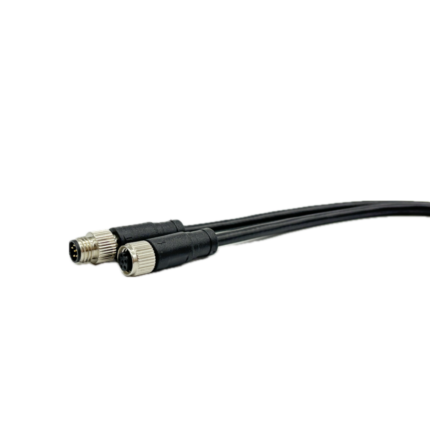
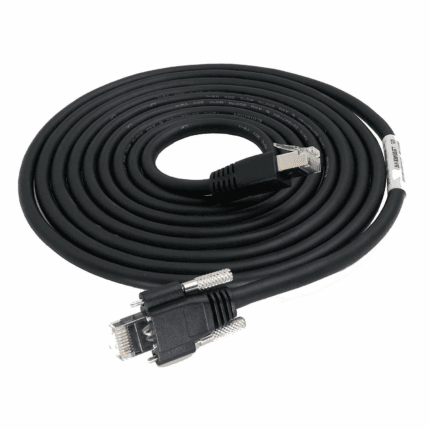
Cat6A RJ45 Screw-Lock GigE Vision Cable (S/FTP, High-Flex PUR, Drag Chain)
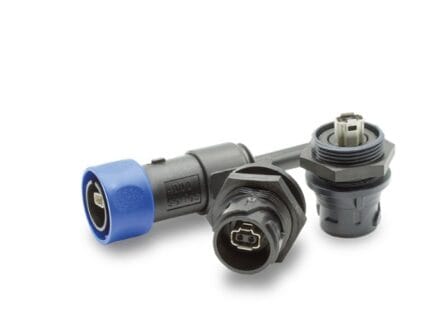
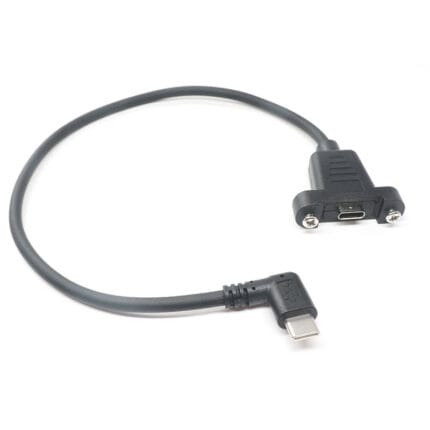
Right Angle Type C male USB Cable to Femal socket with screw-lock
Right‑Angle Screw‑Lock Type‑C Cable | Male to Female Extension Cord