USB-C Active Optical Cable for Long-Reach USB4 Class Links
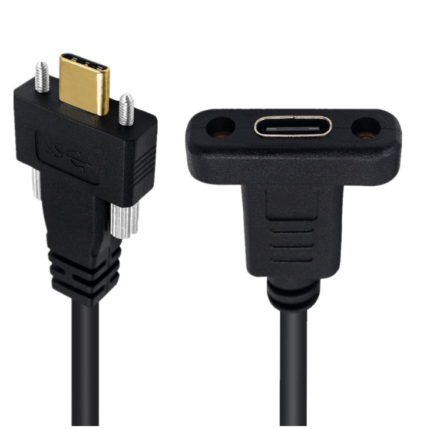
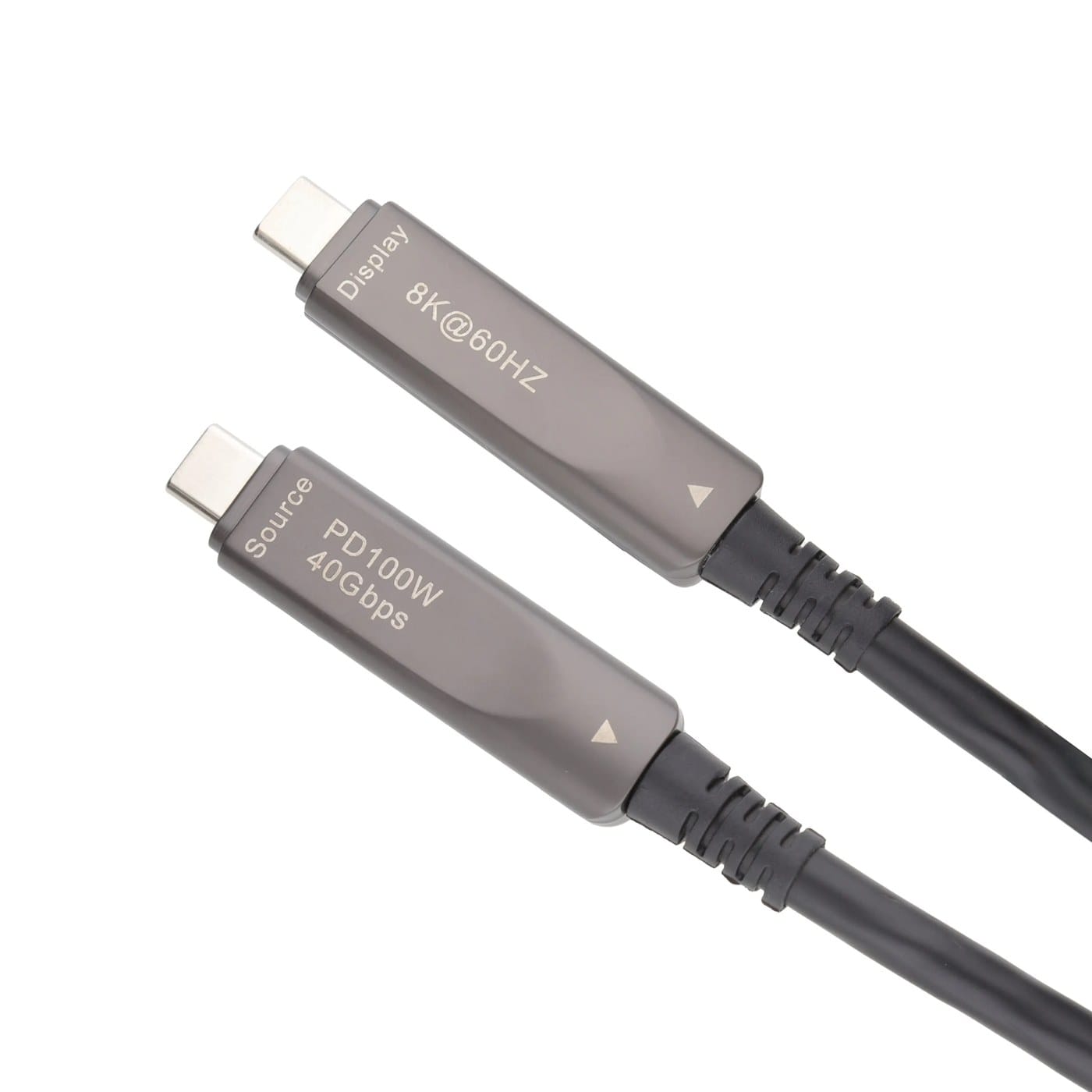
A USB-C active optical cable that converts the electrical signal to light at one end and back at the other, removing the reach limit on passive copper. 5 m, 10 m and 15 m, ends marked for direction. Confirm DisplayPort Alt Mode support per build before ordering.
Last updated: 13 September 2026
Overview
Passive copper USB-C runs are limited to a few meters before signal integrity collapses. A USB-C active optical cable converts the electrical signal to light at one end and back at the other, which removes the reach limit and also removes the copper path that causes ground loops between two separately powered devices. This range covers studio racks, RAID and external GPU enclosures, meeting rooms and industrial links where the distance rules out copper.
Key Specifications
| Product type | USB-C active optical cable assembly |
|---|---|
| Length options | 5 m / 10 m / 15 m |
| Data rate | 40 Gbps class – design target, to be confirmed |
| Power delivery | 100 W at 10 m, higher on shorter lengths – to be confirmed |
| Video | 8K60 class – design target, to be confirmed |
| DisplayPort Alt Mode | Stated per build – must be confirmed before ordering |
| Directionality | Ends marked on the assembly |
| Bend radius | Larger than a copper lead – check the route before ordering |
What the rating means, and where copper stops
The rates below are the USB-IF industry definitions, quoted so you can match the assembly to the host. What matters for an optical build is that the reach limit moves: copper loses margin with distance, an optical path does not, at least not over the lengths a building needs.
| Class | Defined signaling rate | Practical passive copper reach |
|---|---|---|
| USB 3.2 Gen 2 | 10 Gbps | A few meters, and it falls with host silicon |
| USB 3.2 Gen 2×2 | 20 Gbps | Shorter still; most passive leads are under 1 m |
| USB4 | 20 or 40 Gbps | Under 1 m for passive copper at the full rate |
| Active optical | Quoted 40 Gbps class here | 5 m, 10 m and 15 m, set by the build |
Where an optical assembly is the required answer
| Scenario | Why copper fails | What optical gives you |
|---|---|---|
| Run longer than a passive lead can hold | Silent fallback to a lower rate, or dropouts | Full rate at 5 m, 10 m or 15 m |
| Two separately powered cabinets | Ground potential difference carried on the copper | No copper path between the ends |
| Rack to control room runs | Distance plus electrical noise along the tray | Noise immune path over the same route |
| Ceiling or floor void runs | Length, and no way to re-pull a thicker copper lead | Thin, light assembly that pulls easily |
The three questions to ask before ordering
- Does this build carry DisplayPort Alt Mode? Not every active optical assembly does, and the ones that do not will charge and transfer data but will not drive a monitor. It is stated per build here rather than left implied.
- What is the actual power figure at the length you need? The wattage falls as the length rises, so a figure quoted for 5 m is not the figure at 15 m.
- Is the assembly directional? Optical hybrid assemblies usually are. The ends are marked on the assembly, and it will not work the other way round.
Power over an optical assembly
The optical path carries data only. Power still travels over copper conductors inside the same jacket, which is why the delivered wattage falls with length: the same voltage drop physics applies to those conductors as to any other lead. The 100 W at 10 m figure is a design target, and we quote the power level for the specific length you order rather than a single headline number.
Routing: two constraints copper does not have
Optical assemblies have a minimum bend radius that copper cables do not, and the connector boots are larger. Check both before ordering a long run for a rack that was originally wired for passive leads – the boot is what refuses to go through the existing gland, and a tight bend at the panel is what turns into an intermittent fault six months later.
What still has to be proven
Every figure in the list above is a design target. The data rate, the power levels, the 8K60 video claim and the Alt Mode support all need confirmation on production samples with the hosts the customer will actually use, because active assemblies negotiate differently with different controllers. We intend to publish the tested host matrix rather than the marketing number, and until that exists we will say what has been measured and what has not.
Typical applications for this USB-C active optical cable
- Studio racks and machine rooms where the host sits away from the desk, using an optical fiber path instead of copper
- RAID and external GPU enclosures on the other side of the room from the workstation
- Meeting rooms and classrooms, alongside our BYOD active USB-C cable for the table run
- Industrial links between two separately powered cabinets where ground loops have already caused trouble
- Panel passthroughs built with a waterproof USB-C bulkhead cable at the cabinet wall
Workmanship and testing
Workmanship follows IPC/WHMA-A-620 Class 3 and the line runs under ISO 9001. Conductors from 32 to 12 AWG are in range. Continuity and pinout are verified on 100% of units before packing; if you specify an ingress rating, seal checking on the batch can be quoted.
Custom builds and ordering
The prototype minimum is 5 pcs, out in 3 working days. Production starts at 500 pcs and ships 14 working days from approval. Tooling for a body we do not stock adds about 10 working days. Your part number, your label, your packaging – with material certificates and first-article reports on request.
Related assemblies
- BYOD Active USB-C Cable for Meeting Rooms and Classrooms
- Active Optical HDMI Cable for Boardrooms and Ceiling Projectors
- USB4 80Gbps Cable for Docks and eGPU Enclosures
- USB-C to DisplayPort Cable for High Refresh Monitors
- Ultra High Speed HDMI Cable for 8K Video Walls
- Waterproof USB-C Bulkhead Cable for Panel Mount Enclosures
Full range: signal and data cables.
Frequently Asked Questions
Will this drive a monitor?
Only if the build carries DisplayPort Alt Mode, and not all active optical assemblies do. It is stated per build here, so confirm it before ordering rather than after.
Can I plug it in either way round?
No. The assembly is directional and the ends are marked. It will not work if it is reversed.
Does the power figure hold at 15 m?
Power still travels over copper conductors in the same jacket, so the wattage falls with length. We quote the figure for the specific length you order.
What is the minimum order?
Minimum for a prototype run is 5 pcs, out the door in 3 working days. Volume production starts at 500 pcs and ships 14 working days after you approve the sample.
| Product type | USB-C active optical cable assembly |
|---|---|
| Length options | 5 m / 10 m / 15 m |
| Data rate | 40 Gbps class – design target, to be confirmed |
| Power delivery | 100 W at 10 m, higher on shorter lengths – to be confirmed |
| Video | 8K60 class – design target, to be confirmed |
| DisplayPort Alt Mode | Stated per build – must be confirmed before ordering |
| Directionality | Ends marked on the assembly |
| Bend radius | Larger than a copper lead – check the route before ordering |