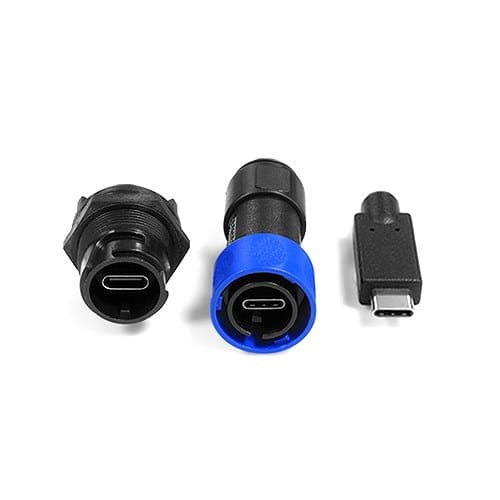
Circular USB-C Screw Cable with Metal M12 Style Coupling
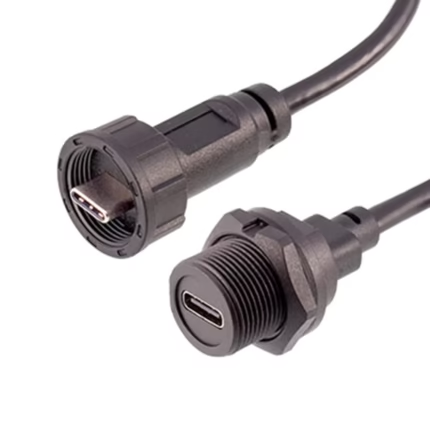
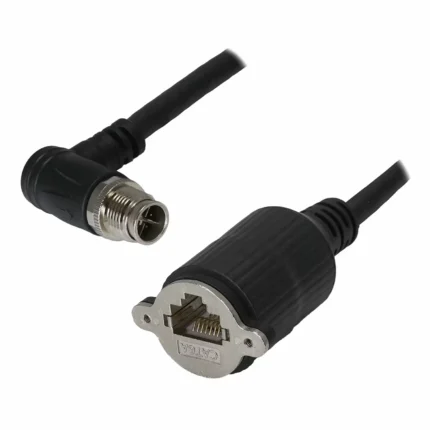
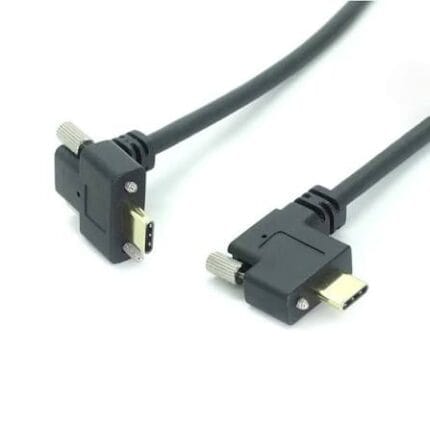
A circular usb-c screw cable puts a USB-C plug inside a round metal coupling that threads and seals the same way as the M12 connectors beside it, so one panel cut-out serves power, signal and USB. Shield bonded through the nut.
Overview
Most machine cells run M12 for power and sensors, then fall back to a fragile consumer connector the moment something needs USB. A circular usb-c screw cable closes that gap: a USB-C plug inside a round metal coupling that threads and seals the same way as the M12 connectors beside it, so the panel cut-out, the tightening habit and the spare parts list stay identical across the machine. It is a passive cordset carrying the full Type-C contact set.
Key Specifications
| Cable type | Sealed USB-C cordset with a circular metal coupling |
|---|---|
| Connector A | USB-C plug in an M12 style threaded metal shell |
| Connector B | USB-C plug, straight or right angle overmold |
| Contacts | Full Type-C contact set, 2 x 12 positions, per drawing |
| Data | USB 3.2 Gen2 class throughput, measured value pending |
| Power | High current charging path, rating pending confirmation |
| Ingress protection | Sealed when mated to the specified torque, report pending |
| Panel nut torque | 1.0 to 1.1 Nm, assembly specification pending |
| Temperature range | -35 to +70 C, pending confirmation |
Three ways USB gets pushed off a machine
| Failure | Why it happens on a machine | What the metal shell does |
|---|---|---|
| Plug works loose | Continuous vibration with no positive retention | Threaded coupling holds against vibration |
| Latch wears and drops out | Consumer latches are rated for occasional use, not a tool change per cycle | Metal thread does not wear out in the same way |
| No shield path to the housing | A plastic shell bonds nothing to earth | Coupling nut bonds the cable shield to equipment earth |
That third row is the one that gets missed. On a machine full of VFDs and servo drives, a shield that stops at a plastic shell is a shield that does very little.
Choosing between M12-style USB-C, IP67 RJ45 and plain M12
| Interface | Carries | Choose it when |
|---|---|---|
| M12-style USB-C (this cable) | USB data plus charging in one sealed port | The device is a camera, a laptop or a terminal that speaks USB |
| IP67 RJ45 | Ethernet, and PoE where specified | The device is networked rather than attached — see our IP67 RJ45 patch cable |
| M12 (A, D or X coded) | Sensor, actuator, fieldbus or industrial Ethernet | The device is a sensor, a valve or a drive — see our M12 X-code to RJ45 cable |
The rule of thumb is simple: if the thing you are plugging in was designed with a USB-C port, put a USB-C port on the machine. Converting to Ethernet to avoid a fragile connector costs a converter, a power supply and a failure point.
Torque and sealing
The mating face seals when the coupling is tightened to its specified nut torque, and the same interface stands up to a hose-down. Torque matters here in a way it does not on a push-fit connector: under-tightened, the seal does not compress; over-tightened, the thread and the seal both pay for it. Put the value on the drawing, fit the right tool at the bench, and the port will behave for years.
Panel cut-outs follow the circular footprint already used for M12 hardware, so a machine builder reuses one drilling pattern for power, signal and USB. Where the port must not be opened without a tool, a locking wire option is available.
Data and charging
The connector carries USB-C signaling and a charging path over the full Type-C contact set. Vendors publish throughput and current ratings for this class of sealed connector; we treat those as a lead, so the numbers go on the confirmation list rather than into the specification table until we hold a measured result. What we state plainly: it is built for USB 3.2 Gen2 class throughput and for high-current charging, and it is a passive cordset.
Typical applications for this circular usb-c screw cable
- Machine vision cameras and service laptops on sealed enclosures, alongside our waterproof USB-C panel pigtail on the enclosure side
- Operator stations and handheld terminals on AGVs and forklifts
- Test rigs and burn-in racks where the port is mated hundreds of times a day
- Outdoor kiosks and charging points exposed to rain and hose-down
- Medical carts and laboratory equipment that get washed between cases
How to specify your build
- End configuration — straight or right angle on either end, and which end gets the metal shell.
- Length, and whether the run is fixed or moving.
- Data class required, so we can confirm what the build has to meet.
- Charging current, if the port is used to charge as well as to transfer.
- Ingress rating required on the mated pair, which we quote only against a test report.
- Panel nut torque and cut-out if you are fitting a receptacle.
- Quantity, and whether this is a prototype or a production order.
Workmanship and testing
ISO 9001 covers the system and IPC/WHMA-A-620 Class 3 covers the work on Circular USB-C Screw builds, across 32 to 12 AWG. Every Circular build gets a continuity and pinout check before it is boxed, and seal checking is quoted whenever an ingress rating is on the drawing.
RoHS and REACH declarations are provided per project together with the agreed test reports; the documentation scope is listed under certifications and compliance. If your drawing specifies a UL style, we build to that drawing and supply the UL reference with the shipment instead of substituting an equivalent. The molded body is shot on our own presses; material choice and bond behavior follow the process described under how we run the overmold press. Related reading: build-to-print cable assemblies. Any tooling we cut for this part stays yours, maintained in our own tool room under your part reference.
Custom builds and ordering
Circular USB-C Screw lots run from 1 to 50 pcs, out in 3 working days. Volume starts at MOQ 500 pcs shipping 14 working days after approval. Tooling not already held adds around 10 working days. Circular orders go out under your part number and labeling, OEM or ODM, and material certificates and first-article reports can be supplied.
Related sealed USB and screw-lock assemblies
- Waterproof USB-C panel pigtail, 10 Gbps with dual screw lock
- USB 3.1 Type-A male to Type-C female screw-lock adapter cable
- Right-angle USB Type-C male to male screw-lock cable
- Right angle Type-C male cable to female socket with screw lock
- USB-C screw locking cable, side or top, 10 Gbps
- M12 X-code to RJ45 shielded industrial Ethernet cable
Full range: screw-lock molded cable assemblies.
Frequently Asked Questions
Can I use the same panel cut-out as M12?
Yes for the circular footprint we build to. Confirm the drilling pattern and plate thickness against the drawing before you cut metal.
Do you publish the data rate and charging current?
Not yet. Both are on the confirmation list and we would rather quote a measured result than repeat a vendor listing.
What torque should the coupling be tightened to?
Whatever your drawing states. Under-tightening leaves the seal uncompressed; over-tightening damages the thread and the seal.
Is it a passive cordset?
Yes. There is no active electronics in the assembly, so it behaves the way the two devices at each end negotiate.
| Cable type | Sealed USB-C cordset with a circular metal coupling |
|---|---|
| Connector A | USB-C plug in an M12 style threaded metal shell |
| Connector B | USB-C plug, straight or right angle overmold |
| Contacts | Full Type-C contact set, 2 x 12 positions, per drawing |
| Data | USB 3.2 Gen2 class throughput |
| Power | High current charging path |
| Ingress protection | Sealed when mated to the specified torque |
| Panel nut torque | 1.0 to 1.1 Nm class |
| Temperature range | -35 to +70 C class |