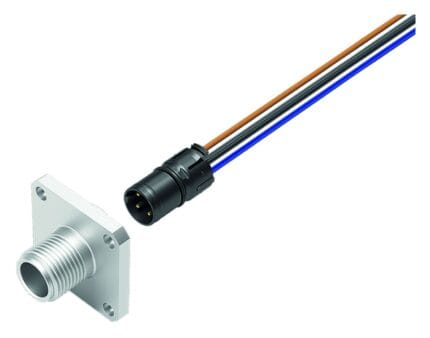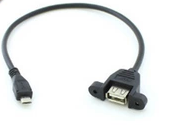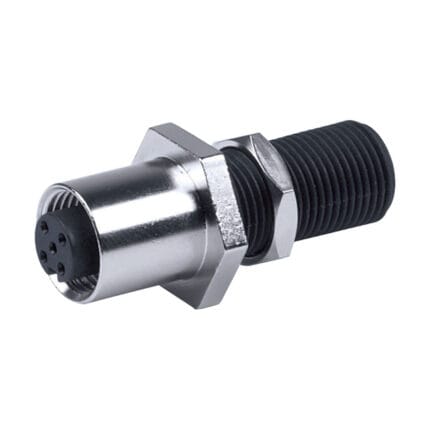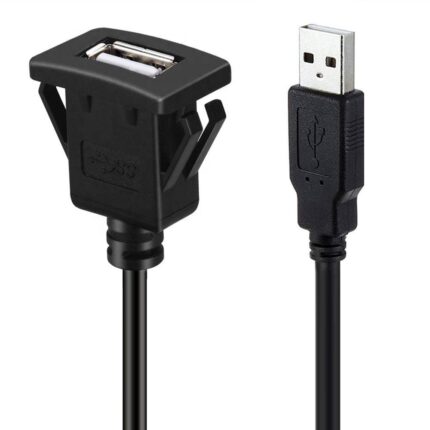
Flush Mount USB-C Receptacle, Threaded M21 Body for Dash Panels
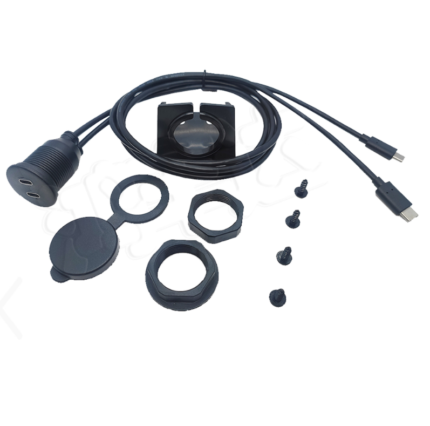
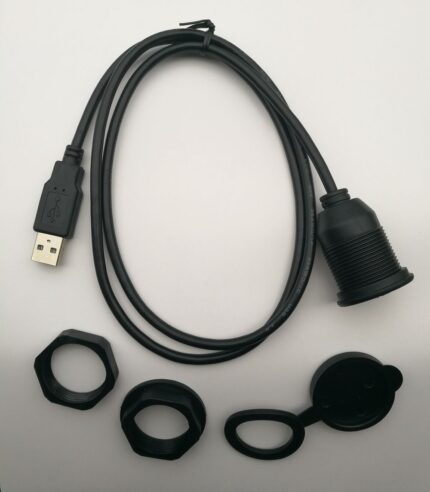
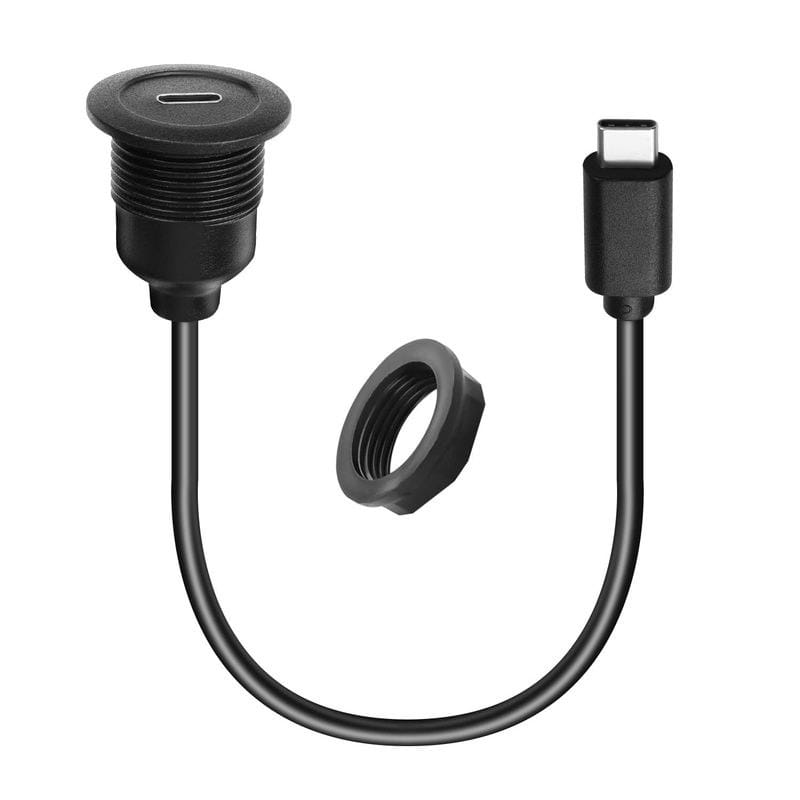
A flush mount USB-C receptacle in a threaded M21 body, retained by a locknut instead of a plastic clip, so a dashboard takes the load rather than the bezel. 10 Gbps data, power delivery to 100 W, screw cap and gasket.
Last updated: 13 September 2026
Overview
A flush mount USB-C receptacle solves one specific failure: the snap-in bezels sold for consumer installs work loose in a dashboard. Vibration, temperature cycling and the sideways pull of a phone on a short lead all feed into a plastic clip that was never designed for a vehicle. This version puts the receptacle in a threaded body, retained by a locknut from behind, so the panel takes the load instead of the clip.
Key Specifications
| Product type | Flush mount USB Type-C receptacle, threaded body |
|---|---|
| Mounting | Threaded body with locknut, fits panel thickness up to about 8 mm (pending confirmation) |
| Panel cut-out | Round about 22 mm, or M21 x 1.5 threaded (design target, confirm before cutting) |
| Data rate | USB 3.2 Gen 2, 10 Gbps (design target, pending supplier datasheet) |
| Power delivery | 60 W at 20 V / 3 A, or 100 W depending on version (pending confirmation) |
| Alternate mode | DisplayPort Alt Mode, 4K at 60 Hz (design target, pending supplier datasheet) |
| Ingress rating | IP67 with cap fitted or mated (pending supplier test report) |
| Tail lengths | 0.3 / 0.5 / 1 m (pending supplier confirmation) |
| Accessory | Screw cap and panel gasket |
| Typical use | Car, truck, RV and boat dashboards; machine operator stations |
| Finish options | Bezel style and finish selected per order, subject to supplier range |
| Connector durability | Mating cycles pending supplier datasheet |
M21 thread and what flush actually costs you
Flush is the right look on a dash and it is the harder install. A flush face has to sit within a tolerance that the fascia will show, and it gives you less material to clamp and less depth to hide a gasket. A protruding body is more forgiving and easier to seal, but it catches on things and looks like an aftermarket part.
| Flush mount, threaded body | Protruding / snap-in bezel | |
|---|---|---|
| Appearance | Sits level with the fascia | Stands proud of the panel |
| Retention | Locknut clamps the panel; the panel takes the load | Plastic clip takes the load |
| Vibration | Holds up in vehicles and vessels | Works loose over time |
| Panel thickness window | Has to be checked; thicker fascias need a longer thread | Tolerant within a wide clip range |
| Sealing | Gasket behind the flange plus a screw cap | Often relies on a rubber flap or nothing |
| Install | Needs access behind the panel and a torque check | Pushes in from the front |
| Fails by | Strip of the thread if overtightened | Clip fatigue and a rocking port |
For dashboards in cars, trucks, recreational vehicles and boats, take the threaded body. Check the panel thickness window before you order: comparable parts quote a maximum around 8 mm, and a thicker fascia needs a longer thread or a different body. Overtightening a metal locknut onto a soft or painted fascia cracks the finish and can distort the body enough to stop the plug seating.
Dash panel cut-out: measure twice
The aperture quoted on comparable parts is around 22 mm for the round version and M21 by 1.5 for the threaded version. Both are design targets from published competitor data, and the cut-out is the one dimension that cannot be recovered once a dash is drilled. Confirm it against the supplier drawing first, then cut.
| Check | Commonly quoted value | Why it matters | What to do |
|---|---|---|---|
| Round aperture | About 22 mm | Sets the whole install | Confirm against the drawing, then use the correct hole saw |
| Threaded version | M21 x 1.5 | The thread carries the clamp load | Confirm the pitch, not just the diameter |
| Panel thickness | Up to about 8 mm on comparable parts | A thicker fascia needs a longer body | Measure the fascia at the mounting point |
| Depth behind the panel | Set by the body plus the tail bend radius | A shallow dash leaves no room for the tail | Check clearance before you commit the position |
| Neighboring hardware | Whatever else lives on the panel | Hole saws need land between openings | Mark out the whole panel, not one hole |
Cap, gasket and what the rating covers
A gasket behind the flange seals against the fascia, and the screw cap seals the port when nothing is plugged in. The ingress figure for this class of product is quoted for the mated or capped condition, so a receptacle left open is not protected – the cap is not an accessory here, it is part of the seal. On a boat helm console or an open-machine station, specify the cap and make sure it is tethered, because an untethered cap on a vehicle is a cap that is lost by the second week.
What the port will do, and what decides it
Data rate, power delivery and alternate mode capability for this range come from the published figures of comparable products and are design targets until the supplier datasheet is on file. Power delivery is negotiated between the charger, the cable and the device, so a 60 W or 100 W figure describes a system and not a connector: a source that does not offer the profile will not deliver it regardless of what is fitted in the panel. USB-C alternate mode is the same story – the display capability depends on the source and the sink as much as on the receptacle.
Where this flush mount USB-C receptacle gets installed
- Car, truck and van dashboards and center consoles
- Recreational vehicle and caravan conversion panels
- Boat helm consoles and instrument panels exposed to spray
- Machinery operator stations where a service port is needed at hand height
- Agricultural and construction cab refits, alongside our Dual USB-C Twin Port Car Dashboard Flush Mount Extension Cable with Bracket
- Dash and console builders standardizing one cut-out across a model range
How to specify your build
- Cut-out – round or M21 threaded, off your panel drawing.
- Panel thickness at the mounting point, including any trim or trim ring.
- Tail length and termination – what it plugs into inside the dash.
- Power requirement – the source profile you need to negotiate, not just a watt figure.
- Cap and gasket – tethered cap, and the gasket material for the fascia.
- Finish and bezel style to match the rest of the panel.
- Quantity, and whether this is a prototype or a production order.
Workmanship and testing
Our line is ISO 9001 certified and every assembly is built to IPC/WHMA-A-620 Class 3 workmanship across 32 to 12 AWG. Continuity and pinout are checked on every unit before packing, and seal checking can be quoted where an ingress rating is specified.
Custom builds and ordering
The prototype minimum is 5 pcs, out in 3 working days. Production starts at 500 pcs and ships 14 working days from approval. Tooling for a body we do not stock adds about 10 working days. Your part number, your label, your packaging – with material certificates and first-article reports on request.
Related dash and panel hardware
- Single USB-C Female Car Dashboard Flush Mount Extension Cable with Bracket
- Car Dashboard Flush Mount USB + HDMI Extension Cable with Mounting Bracket
- Waterproof USB-C Panel Pigtail, 10 Gbps with Dual Screw Lock
- Dual Port USB Panel Mount with USB-C 100 W and USB 3.0 A
- Car USB-C Data Cable with Right Angle Plug for Dashboard Use
- USB-C Gen2 Data Cable, 10 Gbps, with 100 W Power Delivery
Full ranges: panel mount cable and automotive cable and wire harness.
Frequently Asked Questions
Is a threaded body really worth it over a snap-in bezel?
In anything that moves, yes. A snap-in clip carries the vibration load and the pull of the lead, and once it wears the port rocks and charging becomes intermittent. The locknut puts the load on the panel.
What panel thickness does it fit?
Comparable parts quote a maximum around 8 mm, but this is a design target. Measure the fascia at the mounting point and we will confirm the body before you order.
Does 100 W come out of the port automatically?
No. Power delivery is negotiated between the source, the cable and the device. The port is one part of that system, and the supply, fusing and wire gauge on the vehicle side decide the rest.
Is it waterproof with nothing plugged in?
Only with the cap fitted. The ingress figure for this class of part is quoted for the mated or capped condition, so keep the cap on an unused port.
| Product type | Flush mount USB Type-C receptacle, threaded body |
|---|---|
| Mounting | Threaded body with locknut, fits panel thickness up to about 8 mm class |
| Panel cut-out | Round about 22 mm, or M21 x 1.5 threaded class |
| Data rate | USB 3.2 Gen 2, 10 Gbps class |
| Power delivery | 60 W at 20 V / 3 A, or 100 W depending on version |
| Alternate mode | DisplayPort Alt Mode, 4K at 60 Hz class |
| Ingress rating | IP67 with cap fitted or mated |
| Tail lengths | 0.3 / 0.5 / 1 m class |
| Accessory | Screw cap and panel gasket |
| Typical use | Car, truck, RV and boat dashboards; machine operator stations |
| Finish options | Bezel style and finish selected per order, subject to supplier range |
| Connector durability | Stated per your drawing |
Related products