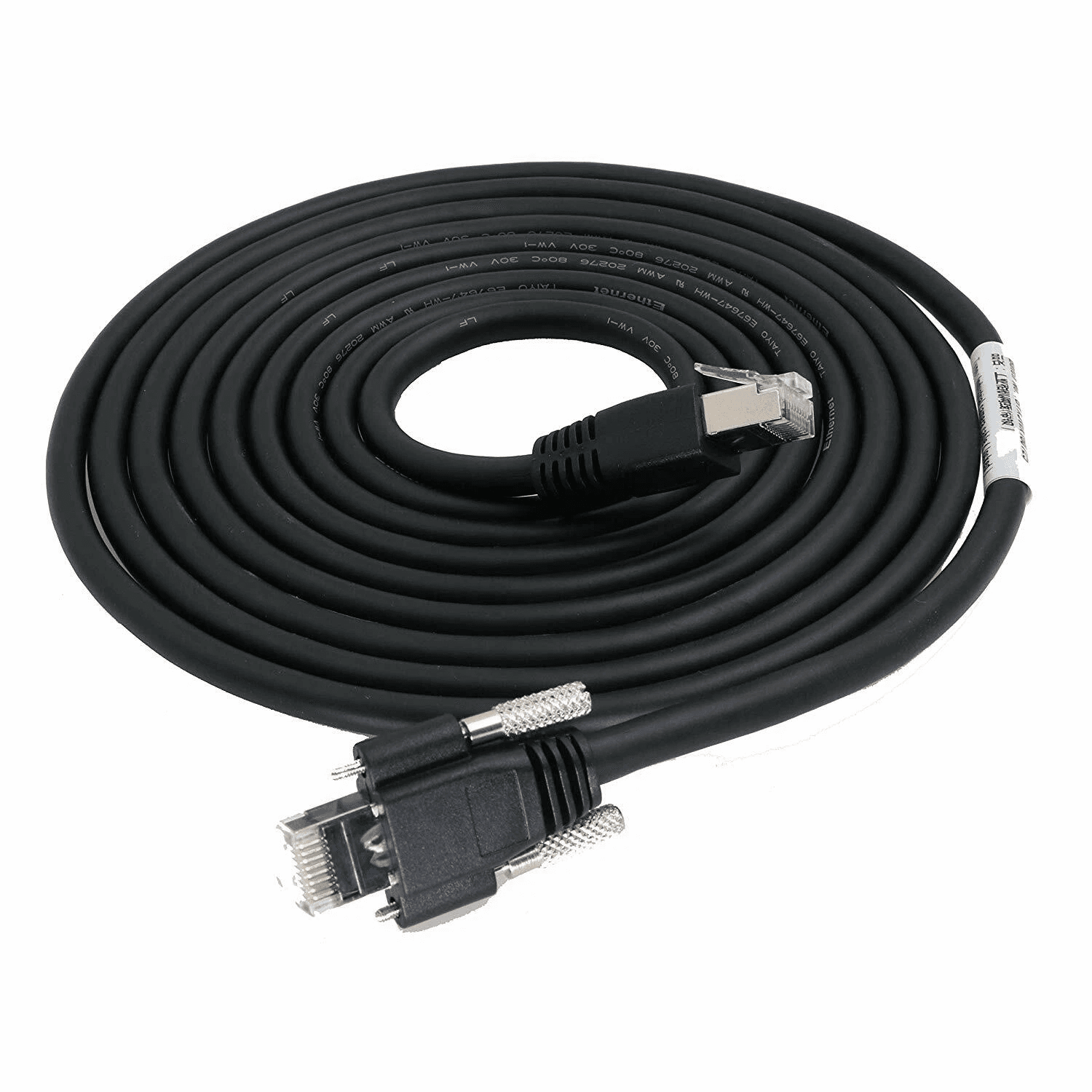
Cat6A RJ45 Screw-Lock GigE Vision Cable (S/FTP, High-Flex PUR, Drag Chain)
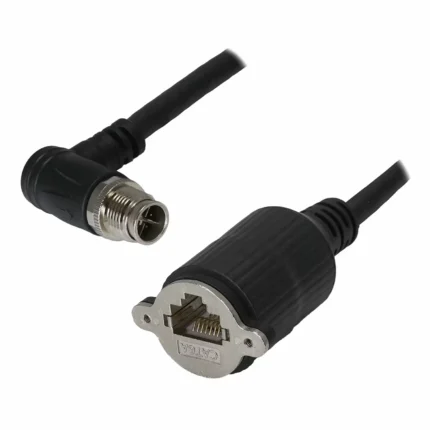
A Cat6A RJ45 screw lock cable ends in an RJ45 plug carrying two thumbscrews instead of the usual plastic latch, so vibration and cable movement cannot work it loose. S/FTP shielding, high-flex PUR jacket, made for GigE Vision cameras and moving machine axes.
Overview
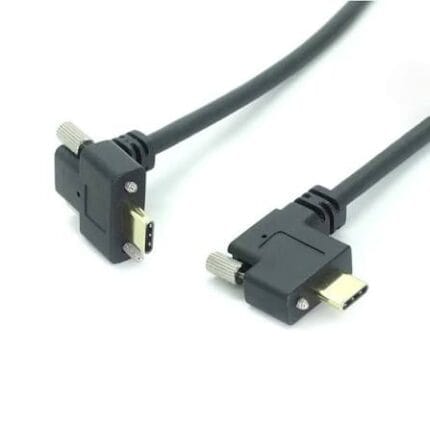
A Cat6A RJ45 screw lock cable for GigE Vision ends in an RJ45 plug carrying two thumbscrews instead of the usual plastic latch. The screws thread into the mating receptacle on the camera and hold the plug in place, so vibration and repeated cable movement cannot work it loose. The other end is a standard shielded RJ45 plug for the host adapter or switch. This is the connector style used on machine-vision cameras and on moving machine axes, where the click latch is the weakest point of the whole link and a dropped frame costs more than the cable.
Key Specifications
| Connector A | RJ45 8P8C male with twin thumbscrew lock, 4-40 UNC |
|---|---|
| Connector B | RJ45 8P8C male, shielded, standard latch |
| Category | ISO/IEC 11801 Class EA / TIA-568.2-D Category 6A |
| Data Rate | 10GBASE-T to 500 MHz, IEEE 802.3an; backward compatible 10/100/1000BASE-T |
| Conductor | 26 AWG stranded bare copper, 4 twisted pairs |
| Shielding | S/FTP – foil on each pair plus overall tinned copper braid |
| Jacket | High-flex PUR, oil and coolant resistant, black or green |
| Contact Plating | 50 uin gold over nickel |
| Length | OEM build to required length |
What GigE Vision actually asks of the cable
GigE Vision runs standard Ethernet physical layers under a camera control protocol, which means the link has to behave like a data link under continuous load, not like a sensor wire. It does not negotiate politely when the margin is gone: you get retries, jitter, or dropped frames at the trigger moment. The requirements below are the ones that decide whether the vision cell is stable.
| Requirement | Why it matters in a vision cell | What kills it |
|---|---|---|
| Sustained throughput | A camera streams continuously, not in bursts | A link that negotiates down, or retries under load |
| Noise margin | Drives, motors and weld power share the same cabinet | A shield that is not bonded through the connector |
| Connector retention | Gantries and pick-and-place heads never stop moving | A plastic latch that wears, snaps, or walks out |
| Flex life | The cable bends every cycle, sometimes millions of times | Solid conductor, or a boot that lets the cable flex at the crimp |
| Deterministic behavior | Trigger timing depends on stable latency | Marginal links that recover by retransmitting |
The interface itself is documented by the GigE Vision standard, and the values your assembly is built and verified to are the ones stated on your drawing.
S/FTP against plain FTP: where the braid earns its keep
| Construction | Structure | External noise | Between-pair crosstalk | Flex life of the screen |
|---|---|---|---|---|
| FTP (F/UTP) | One overall foil over four unscreened pairs | Good | Only what the twist provides | Foil fatigues and tears where the cable bends |
| S/FTP | Foil on each pair plus overall tinned copper braid | Best | Each pair is screened from the other three | Braid takes repeated bending far better than foil alone |
| U/FTP | Foil on each pair, no overall screen | Fair | Good | Foil on the pairs is the flex point |
| UTP | No screen at all | Poor near drives | Poor in bundles | Nothing to fatigue |
This build uses S/FTP: four twisted pairs of 26 AWG stranded bare copper, each pair wrapped in aluminum foil, with a tinned copper braid over the whole bundle. The metal connector shell bonds to the braid so the screen continues through the plug rather than stopping at the cable. On a machine with variable-frequency drives, that braid is the difference between a clean image and a link that retries every time the spindle accelerates.
Drag chain duty: bending, torsion and the strain relief
The failure point on a moving axis is almost never the conductor in the middle of the cable. It is where the cable leaves the connector, where the jacket is held and the copper has to flex. Three decisions move the life number.
- Conductor: stranded, and stranded for flex rather than for termination. 26 AWG stranded bare copper is the starting point here.
- Screen: braid over foil. A foil-only screen work-hardens and cracks at the same point the conductor is bending.
- Strain relief: the boot is molded over the braid rather than over the jacket, so flexing is transferred to the cable body and not to the crimp.
- Jacket: high-flex PUR chosen for oil, coolant and abrasion. PUR costs more than PVC and is the right choice wherever the run sees cutting fluid.
- Routing: keep the bend radius generous and supported. A drag-chain cable bent tighter than its rated radius will fail early no matter what it is made of.
If the axis twists as well as bends – a robot wrist, a rotating head – say so at the quoting stage, because torsion duty changes the stranding and the lay length. Our hybrid robot torsion cable is built for exactly that case, and the cobot arm harness covers the multi-circuit version.
Why the latch is the weak point
A standard RJ45 plug is held in by a plastic tab. It is a good design for an office patch panel and a poor one on a moving machine: the tab wears with every insertion, catches on cable ties and clothing, and once it is broken the plug is held in by friction alone. The thumbscrew version moves retention onto two 4-40 UNC screws that thread into the receptacle, so the plug cannot walk out and the load is taken by metal rather than by a molding. Contact plating is 50 uin gold over nickel, which is the finish that survives repeated mating in a dirty environment.
Where a cat6a rj45 screw lock cable belongs on the machine
- GigE Vision and industrial camera links on gantries, pick-and-place heads and moving axes
- Vision, PLC and switch drops inside enclosures that are shared with drives
- Any link where the camera is re-aimed or swapped during changeover, so the plug is mated and unmated regularly
- Drag chain and cable track runs, next to our GigE Vision screw-lock cable for the fixed sections of the same track
- Cells that convert to an M12 interface at the camera, where the M12 X-code to RJ45 cable is the usual partner
Ordering and lead time
Cat6A RJ45 Screw-Lock GigE lots run from 1 to 50 pcs, out in 3 working days; volume starts at MOQ 500 pcs shipping 14 working days after approval. Tooling not already held adds around 10 working days. Cat6A orders go out under your part number and labeling, OEM or ODM, and material certificates with first-article reports are available.
Workmanship and testing
ISO 9001 covers the system and IPC/WHMA-A-620 Class 3 covers the work on Cat6A RJ45 Screw-Lock GigE builds, across 32 to 12 AWG. No Cat6A unit is packed until 100% continuity and pinout check out, and seal checking is quoted whenever an ingress rating is on the drawing.
Material declarations against RoHS and REACH are issued per project, alongside the dimensional and electrical reports agreed at quotation; see certifications, compliance and material declarations. Where your drawing names a UL style or another approval, the build follows your drawing and ships with the supporting document rather than a claim of our own. Flex life is a construction decision made before tooling, following the conductor and jacket approach set out under continuous-flex construction and flex-life testing. More background: build-to-print cable assemblies. Tooling is quoted separately, cut in-house rather than brokered out, and owned by you.
Frequently Asked Questions
Do I need the screws on both ends?
Usually not. The camera end is the one that moves and the one with a threaded receptacle; the host end normally lands on a switch or a NIC with an ordinary jack, so a standard shielded plug is the right partner. Both ends can be screw-locked where the cabinet also moves.
Will this work with a 1 GigE camera?
Yes. The assembly is backward compatible with 10/100/1000BASE-T, so a Cat6A build on a 1 Gbit/s camera simply has margin to spare. That margin is often worth having when the run sits next to drives.
Can it go in a drag chain?
Yes, that is what the high-flex PUR jacket and the braid-over-foil screen are for. Tell us the bend radius and the cycle count and we will confirm the construction. If the motion is torsion rather than bending, specify that separately – it changes the cable.
Why PUR instead of PVC?
Cutting fluid, coolant and oil. PVC softens and cracks in that environment; PUR resists it. Where the run is dry and fixed, PVC is usually the more economical choice and we are happy to quote both.
Related assemblies
| Connector A | RJ45 8P8C male with twin thumbscrew lock, 4-40 UNC |
|---|---|
| Connector B | RJ45 8P8C male, shielded, standard latch |
| Category | ISO/IEC 11801 Class EA / TIA-568.2-D Category 6A |
| Data Rate | 10GBASE-T to 500 MHz, IEEE 802.3an; backward compatible 10/100/1000BASE-T |
| Conductor | 26 AWG stranded bare copper, 4 twisted pairs |
| Shielding | S/FTP – foil on each pair plus overall tinned copper braid |
| Jacket | High-flex PUR, oil and coolant resistant, black or green |
| Contact Plating | 50 uin gold over nickel |
| Length | OEM build to required length |