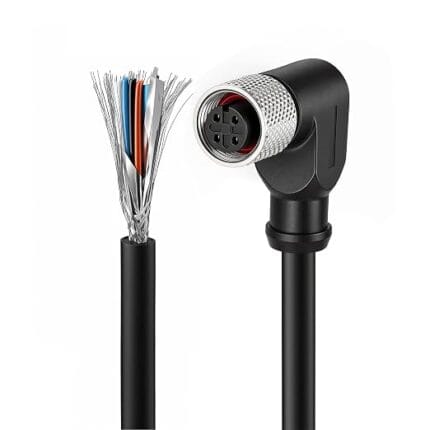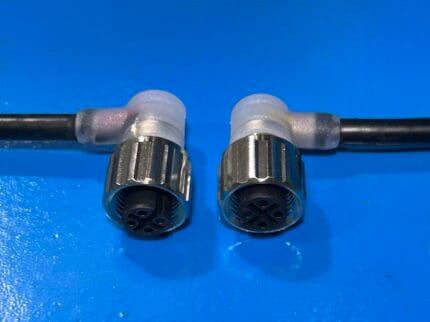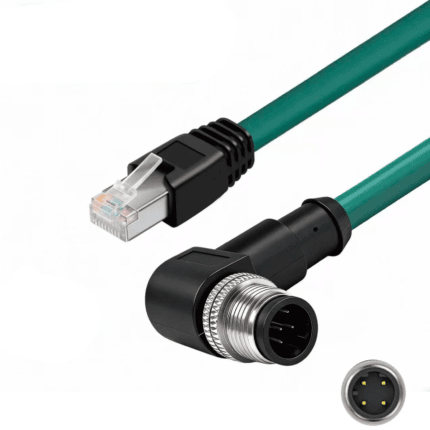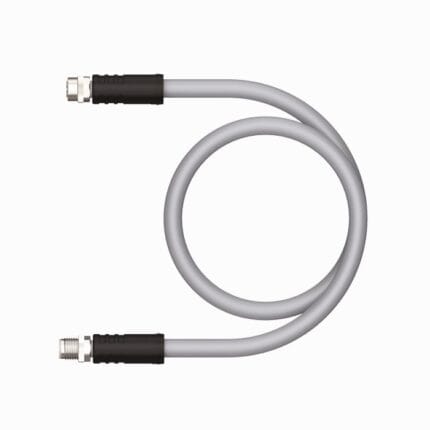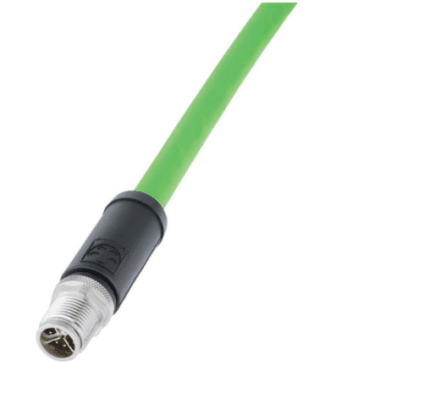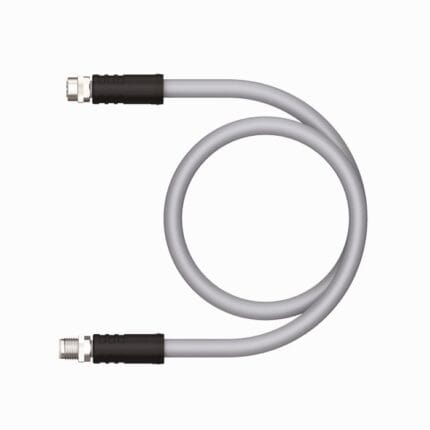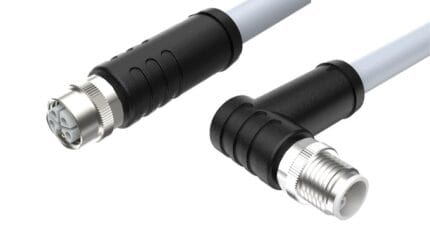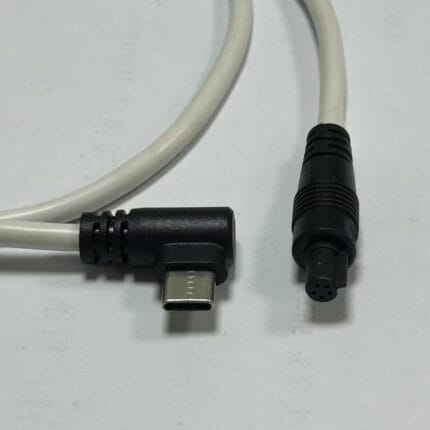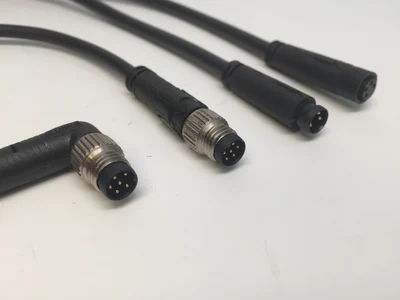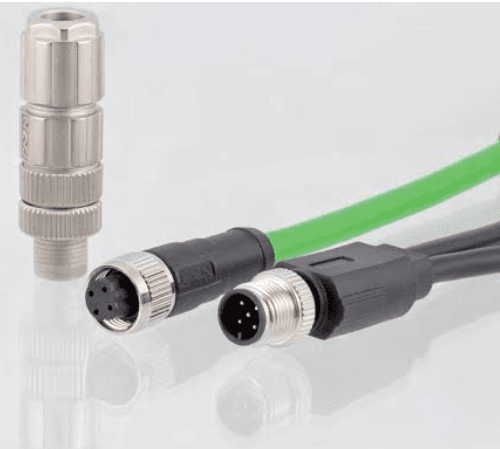
M12 IP68 / IP69K Food-Grade Stainless Steel Washdown Cable
This M12 ip69k food grade cable is specified against the washdown cycle rather than the load: stainless 316L coupling nut, seals chosen for the detergent, TPE or halogen-free PUR jacket. IP68 and IP69K per ISO 20653, -40 to +105 C, built to length.
Overview
An M12 IP69K food grade cable is specified against the cleaning cycle rather than against the electrical load. Nothing about the signal is unusual: A-coded, four or five positions, whatever the sensor needs. What changes is every material the cleaning crew sees. The coupling nut is stainless 316L rather than plated brass, the seal is chosen against the detergent rather than against water, and the jacket has to survive hot caustic, acid rinse and daily thermal cycling. Get any one of those wrong and the assembly fails long before the connector wears out.
Key Specifications
| Connector A | M12 A-coded 4 or 5-pin male, stainless 316L coupling nut |
|---|---|
| Connector B | M12 A-coded 4 or 5-pin female, stainless 316L coupling nut |
| Coding | A per IEC 61076-2-101 |
| Ingress rating | IP68 and IP69K, tested per ISO 20653 for the 9K step |
| Coupling nut material | Stainless steel 316L / 1.4404 class |
| Seal material | FKM or EPDM chosen against detergent chemistry |
| Jacket | TPE or halogen-free PUR, food-safe grade on request |
| Temperature | -40 to +105 °C, jacket dependent |
| Length | OEM build to required length |
Read the cleaning cycle, then choose materials
A washdown is not one event, it is a sequence, and each stage attacks something different. Specifying against “wet” is how standard PUR cordsets end up in the scrap bin after one season.
| Stage of the cycle | What it attacks | What survives it |
|---|---|---|
| Product residue and sugar solution | Leaves a film that dries and cements the thread | Smooth stainless nut, no plated brass to corrode |
| Caustic foam and high pH cleaner | Extracts plasticizer from standard PVC and PUR | Detergent resistant TPE or halogen-free PUR grade |
| Acid rinse and peracetic or chlorine sanitizer | Attacks seal elastomers not chosen for it | FKM or EPDM selected against the actual agent |
| Hot rinse and steam | Thermal cycling loosens anything tightened cold | Seal set with the right compression set behavior |
| High pressure jet at close range | Drives water past any marginal seal | IP69K rated joint, with the receptacle rated alike |
What the ingress ratings actually cover
The 9K step used on cleaning duty comes from ISO 20653 rather than from the IEC 60529 scale, and the numbers do not inherit from one another. IP68 covers continuous immersion at a depth agreed with the maker, while IP69K covers high pressure, high temperature spray directed from several angles. Clean-in-place duty typically needs both considered separately, along with the chemistry, which neither number addresses at all.
Why stainless instead of plated brass
Three reasons, all field-proven. Plated brass corrodes under caustic and acid cleaning, and once the nut surface pits it will not undo by hand. A nut that will not undo by hand gets removed with a tool, which destroys both the nut and the equipment receptacle behind it. And stainless avoids galling against a stainless receptacle thread, so the joint releases on the next service interval rather than never.
The seal is a chemistry decision, not a size
Two compounds cover most installations and they are not interchangeable. Tell us the cleaning agent by name if you have it, because “standard sanitiser” is not enough information to choose between them.
| Seal compound | Strong against | Weak against | Typical duty |
|---|---|---|---|
| EPDM | Caustic, hot water, steam, many polar cleaners | Oils, fats and some animal fat residues | Dairy, beverage and general CIP rinsing |
| FKM | Oils, fats, high temperature, many solvents | Some amines and hot steam regimes | Meat and ready-meal lines with fatty soils |
| NBR standard | Low cost general sealing | Most modern detergent and sanitizer regimes | Avoid in washdown zones |
The socket has to match, or the rating is decorative
This is the most expensive mistake in the category. An IP69K cable plugged into an ordinary IP67 receptacle gives you IP67, at best, because the sealing boundary is a shared responsibility. Specify the panel side to the same rating with stainless hardware, and if you cannot, ask us to quote the receptacle as part of the order so the two halves arrive together.
The socket has to match in two senses: the rating, and the keyway. Our download center carries a two-page M12 coding reference covering every letter from A to Y, with the pole counts and applications that go with each.
Claims we make and claims we do not
Comparable products in this category are marketed with detergent resistance testing and food contact references. We are not repeating those as our own claims ahead of the documentation. Tell us what evidence your hygienic specification requires and we will supply the document we hold for the material actually used, or say plainly that we do not have it. That is a slower answer than a marketing sentence, and it is the one that survives an audit.
Typical applications for this M12 IP69K food grade cable
- Sensor and actuator wiring on meat, dairy and ready-meal processing lines
- Filling, capping and labeling machines rinsed at every shift change
- Pharmaceutical suites where the cleaning agent is the aggressive part
- Conveyor and packaging equipment operating permanently in wet zones
- Outdoor coastal installations where salt spray replaces detergent as the threat
How to specify your build
- Coding and pin count – A-coded, four or five positions.
- Cleaning chemistry by name: caustic, peracetic, chlorine or a named agent.
- Water temperature and pressure at the nozzle.
- Seal compound, or let us choose against the chemistry above.
- Receptacle rating, and whether you want it quoted together.
- Length, color and quantity.
Workmanship and testing
M12 IP68 / IP69K builds are made to IPC/WHMA-A-620 Class 3 workmanship inside an ISO 9001 system, over a 32 to 12 AWG range. No M12 assembly is boxed before 100% continuity and pinout are confirmed, and seal checking is quoted whenever an ingress rating is on the drawing.
Material declarations against RoHS and REACH are issued per project, alongside the dimensional and electrical reports agreed at quotation; see certifications, compliance and material declarations. Where your drawing names a UL style or another approval, the build follows your drawing and ships with the supporting document rather than a claim of our own. The ingress rating is built into the joint, following the sealing structures set out in IP67 and IP68 sealing structures and validated against IEC 60529 before release. The wider context is covered under what automation programs ask for. Tooling for this build is cut in our own tool room and belongs to your program, so a repeat run years later starts from the same tool.
Custom builds and ordering
For M12 IP68 / IP69K builds, prototypes run from 1 to 50 pcs with a 3 working day turnaround. Volume orders begin at 500 pcs and ship 14 working days after approval. Tooling not already held adds around 10 working days. M12 builds go out under your part number and labeling, and material certificates plus first-article reports are available.
Related M8 and M12 assemblies
- M12 IP69K Washdown Cable with Stainless Steel Coupling Nut
- M12 Push-Pull X-Code Cat6A Industrial Ethernet Cable
- M12 D-Code 4-Pin PROFINET Industrial Ethernet Cable
- M12 A-Coded PVC/PUR Straight or Right-Angle Extension Cable
- M12 Power T-Code or L-Code DC Power Cable, 63 V DC
- Cleanroom Robot Cable Harness for EFEM and Vacuum Arms
Full ranges: circular M8 and M12 cable assemblies and custom wire harnesses.
Frequently Asked Questions
Is IP67 enough in a washdown area?
Usually not. IP67 covers immersion, not high pressure hot water from close range. Hygienic zones normally specify the IP69K step with stainless hardware.
Why does the receptacle need to match?
Because sealing is a shared boundary. An IP69K cordset in an IP67 receptacle gives you IP67 at best.
Which seal compound should I choose?
Choose against the cleaning agent. EPDM generally handles caustic and steam; FKM generally handles oils and fats. Tell us the actual agent and we will confirm.
Can you provide food contact documentation?
We will supply the document we hold for the material actually used, or say plainly that we do not have it. We do not make the claim ahead of the paperwork.
Will standard white jacketing work?
White is often specified so contamination is visible. It is available; confirm the compound is the detergent resistant grade rather than assuming it is.
| Connector A | M12 A-coded 4 or 5-pin male, stainless 316L coupling nut, IP68/IP69K |
|---|---|
| Connector B | M12 A-coded 4 or 5-pin female, stainless 316L coupling nut, IP68/IP69K |
| Coding | A per IEC 61076-2-101 |
| IP Rating | IP68 (1.5 m / 24 h) and IP69K per ISO 20653 |
| Materials | Stainless steel 316L coupling nut, detergent resistant compounds |
| Jacket | TPE or PUR halogen-free, food-safe on request |
| Temperature | -40 to +105 deg C (jacket dependent) |
| Length | OEM build to required length |
| Documentation | Material statements available on request |