SMA to BNC RF Coax Patch Cable, 50 Ohm RG-58
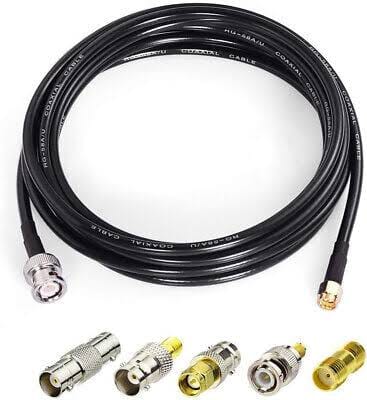
An sma to bnc coax cable on 50 ohm RG-58, built to the length your bench needs with crimp or solder terminations. One cable instead of a stack of adapters.
Last updated: 13 September 2026
Overview
An sma to bnc coax cable is the adapter cord every lab owns six of and can never find: instrument side is BNC, device side is SMA. Building it as one cable instead of stacking a barrel adapter on a BNC lead removes two mechanical joints, and every joint is a reflection you pay for at frequency. We build it on 50 ohm RG-58, in the length you actually need, with crimp or solder terminations to the connector maker’s strip geometry.
Key Specifications
| Connector A | SMA male, straight or right angle, 50 ohm |
|---|---|
| Connector B | BNC male, straight, 50 ohm |
| Cable | RG-58 class, 50 ohm, braided shield |
| Termination | Crimp or solder, to connector maker geometry |
| Length | 0.3 to 5 m typical, OEM build to order |
| Impedance | 50 ohm nominal, stated per order |
| Marking | Heat-shrink labels with your part number |
50 ohm or 75 ohm: the decision that comes first
Characteristic impedance is set by the ratio of inner conductor diameter to the inner diameter of the shield, so it is fixed by the cable geometry, not by the connector. Mixing the two is the single most common way to lose margin on a bench: every impedance step reflects part of the signal back toward the source.
| 50 ohm | 75 ohm | |
|---|---|---|
| Optimized for | Power handling and low loss across RF | Lowest signal attenuation |
| Typical use | Radio, test instruments, antenna feeds | Video, SDI, broadcast, CATV |
| Common cables | RG-58, RG-316, LMR-195 | RG-59, RG-6 |
| Connectors | SMA, N, TNC, BNC 50 | BNC 75, F, SMB |
| What happens if mixed | Reflection, standing waves, measurement error | Same — the mismatch is the problem |
The 50 ohm figure is an industry-general compromise: coaxial line has its lowest attenuation near 77 ohm and its highest power handling near 30 ohm, and 50 ohm sits between them. The coaxial cable family is defined around that value. What your assembly is built and verified to — return loss, insertion loss, velocity — is stated per order, measured on your build.
SMA and BNC: what each interface is built for
These two are not interchangeable in spirit even when you can screw an adapter between them. One is a precision threaded RF interface, the other is a quick bayonet that was never meant for 18 GHz.
| SMA | BNC | |
|---|---|---|
| Coupling | Threaded, 1/4-36 | Bayonet, quarter turn |
| Impedance versions | 50 ohm as standard | 50 ohm and 75 ohm versions exist |
| Usable frequency | Into the tens of GHz for precision grades | Low GHz; the bayonet limits repeatability |
| Mating cycles | Hundreds, thread dependent | Hundreds, quick to connect |
| Best at | Device and module ports, small form factor | Instruments, scopes, generators, patch panels |
| Watch out for | Thread wear, overtightening | Worn bayonet slots losing contact pressure |
Because the two ends are doing different jobs, the weak point is almost always the BNC: a bayonet that has been mated a few hundred times loses contact pressure, and a loose BNC shows up as intermittent signal long before anyone suspects the cable.
Where the loss shows up
Coaxial attenuation climbs with frequency, roughly with the square root of frequency, so doubling the run length does not double the loss in a way you can ignore — it compounds with frequency. That is why the two questions we ask first are the highest frequency you care about and the length you need. Give us both and we will quote the cable and the termination that holds the margin, with the measured figures stated per order rather than a generic datasheet claim.
Typical applications for this sma to bnc coax cable
- RF test benches — signal generator or analyzer to a device under test
- Antenna and radio front-end bring-out leads
- Telemetry and instrumentation links inside a rack
- Replacing stacks of adapters on a crowded bench
- Prototype and pre-compliance setups where the connection changes daily
How to specify your build
- Impedance — 50 ohm is the default for SMA; confirm the BNC side matches.
- Connector gender and angle on each end: SMA male straight or right angle, BNC male.
- Cable — RG-58 as standard; alternatives on request.
- Length and the highest frequency of interest.
- Termination method — crimp or solder.
- Marking — heat-shrink labels with your part number.
Workmanship and testing
Assembly and inspection follow IPC/WHMA-A-620 Class 3 workmanship criteria under our ISO 9001 quality management system, and every unit is 100% continuity and pinout tested before it is packed. Conductor range is 32 to 12 AWG. Strip dimensions and crimp heights are set from the connector maker’s geometry and checked on the first article. Where a standard sets a limit for the category, the connector interface or the jacket, that is the industry-general definition of the rating. The values your assembly is built and verified to are the ones stated on your drawing, per order.
Custom builds and ordering
Send the mating part numbers and we will confirm the interface before we cut cable. Prototype builds start from 5 pcs and ship in 3 working days; production orders start at MOQ 500 pcs and ship 14 working days after approval. New tooling adds about 10 working days, and we hold 100 sets of mold tooling in house. OEM and ODM builds ship under your part number and labeling, with material certificates and first-article reports on request. Factory audits and video line tours of our Longgang, Shenzhen plant can be arranged through Alan Kang.
Related RF and coax assemblies
- 12G-SDI Coax Cable Assembly, BNC to BNC
- SDI BNC Cable Assembly for Studios and OB Vans
- CoaXPress Machine Vision Cable Assembly
- USB3 Vision Camera Cable with Locking Screws
- Custom Shielded Ethernet Data Cable
- Mini-SAS HD Cable, SFF-8643 to SFF-8644
Full range: signal and data cable range.
Frequently Asked Questions
Can I use a 50 ohm BNC where a 75 ohm BNC is fitted?
They will often mate, and that is the problem — the mismatch reflects signal. Check the marking on the jack; 75 ohm BNCs usually have a thinner dielectric and are marked.
SMA or RP-SMA?
They are different. RP-SMA reverses the pin and socket, and using the wrong one means no contact at all. Send a photo if you are not sure.
How long can I go?
It depends on the frequency and the loss budget, not on a number we can quote generically. Give us the top frequency and we will build to the reach you state.
Do you measure return loss?
Where the order calls for it, yes, and the figures are stated for your build rather than quoted from a generic datasheet.
| Connector A | SMA male, straight or right angle, 50 ohm |
|---|---|
| Connector B | BNC male, straight, 50 ohm |
| Cable | RG-58 class, 50 ohm, braided shield |
| Termination | Crimp or solder, to connector maker geometry |
| Length | 0.3 to 5 m typical, OEM build to order |
| Marking | Heat-shrink labels with your part number |
| Impedance | 50 ohm nominal, stated per order |