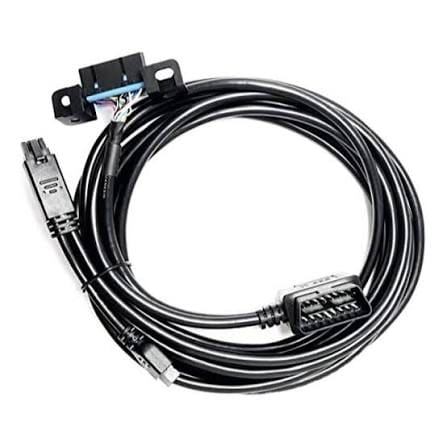
OBD2 Splitter USB Charger Cable, 16-Pin Pass-Through Y Lead
An obd2 splitter usb charger turns the single diagnostic port into a second 16-pin socket plus USB-A and USB-C outlets, so a dongle, a dash camera and a phone can all run at once. 16 pins pass through, inline resettable fuse.
Last updated: 13 September 2026
Overview
An obd2 splitter usb charger gives you a second 16-pin socket plus USB-A and USB-C charging outlets from the single diagnostic port under the dash. The two 16-pin sockets are wired straight through with no electronics in the path, so a fleet dongle and a scan tool both see the CAN bus as if they were the only thing plugged in, while a dash camera and a phone draw power from the same take-off. The charging branch is protected by an inline resettable fuse, so a shorted phone cable trips and recovers instead of taking out the vehicle circuit.
Key Specifications
| Connector A | J1962 16-pin plug |
|---|---|
| Connector B | J1962 16-pin socket plus USB-A and USB-C outlets |
| Pass-through | All 16 pins wired straight through |
| USB-A output | 5 V up to 3 A |
| USB-C output | 5 V up to 3 A, or 9 V at 2 A on negotiation |
| Input | 12 V / 24 V vehicle supply |
| Protection | Inline resettable 3 A fuse on the charging branch |
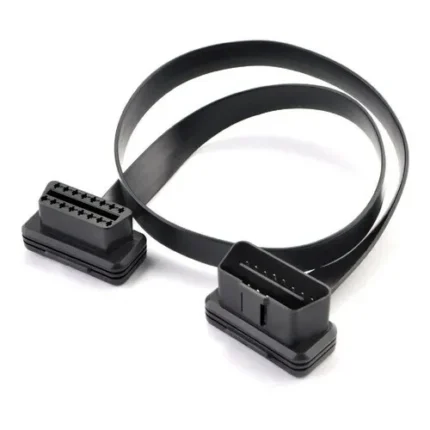
| Lead | Flat low-profile, 0.3 m |
One port, and a power budget that is not unlimited
The diagnostic port is usually the only permanently live connector in the cabin, which is why it gets asked to run everything. The thing to check before you order is how much you are taking and what the vehicle port is fused at.
| Item | What to check | Why it matters |
|---|---|---|
| Vehicle port fuse | Rating of the circuit feeding pin 16 | Sets the ceiling for everything downstream |
| Dongle draw | Steady-state current of the connected device | Continuous, day and night on a live port |
| Dash camera draw | Recording current, not the peak on the box | Runs for hours in parking mode |
| Phone or tablet draw | Fast-charge negotiation current | 9 V negotiation roughly doubles the power taken |
| Total | Sum of the above at 12 V | A truck left standing for a week will notice |
If the numbers are close, order the version with a switched supply, or fit a timer. A flat battery on a Monday morning costs more than the splitter.
Pass-through wiring: why grounds are not bundled
All 16 pins run straight through, pin for pin. That includes the grounds. On a 16-pin pass-through the temptation is to tie pin 4 and pin 5 together and save a conductor, and that is the usual reason one of two connected devices stops talking — some vehicle makers reference a signal to chassis and others to a dedicated signal ground, and joining them injects offset into the bus. We carry the pins separately and let the vehicle decide.
Charging outputs
- USB-A outlet at 5 V up to 3 A for cameras, dongles and older phones.
- USB-C outlet at 5 V up to 3 A, or 9 V at 2 A where the connected device negotiates it.
- Input taken from the vehicle 12 V or 24 V supply through the diagnostic connector, so the same part works in a van and in a truck.
- Inline resettable fuse at 3 A on the charging branch, which recovers once the fault is removed rather than needing a replacement fuse on the hard shoulder.
Physical layout
The lead is flat and low profile at roughly 0.3 m, which lets it run along the top of the footwell trim without standing proud where a boot catches it. The charging module is a small molded body rather than a bare board, because a loose board rattling behind a dash panel is a warranty claim waiting to happen — and it is also a heat source with nothing to sink into.
Typical applications for this obd2 splitter usb charger
- Insurance and fleet dongles that must stay connected while a phone and camera also need power
- Dash camera installations where the camera would otherwise need a second run to the lighter socket, paired with our OBD2 dashcam power cable with low-voltage cutoff and parking timer where parking mode is required
- Delivery and ride-share vehicles running a phone, a camera and a telematics unit at once
- Workshop loan cars where a diagnostic tool and a battery maintainer share the port, alongside our OBD2 extension flat cable
- Demonstration and training vehicles with several devices temporarily fitted
Before you buy
- What the two 16-pin devices actually draw, measured rather than guessed.
- What the vehicle port is fused at.
- Whether the port is permanently live or switched with the ignition.
- Whether 9 V negotiation on the USB-C outlet is needed for your devices.
- How long the vehicle stands between runs.
If standing time is long and the port is live, tell us and we will quote the switched or timed variant instead.
Workmanship and testing
Assembly and inspection follow IPC/WHMA-A-620 Class 3 workmanship criteria under our ISO 9001 quality management system, and every unit passes 100% continuity and pinout testing before it is packed. Conductor range is 32 to 12 AWG. Where an ingress rating is specified we can quote seal checking on the production batch.
Custom builds and ordering
Prototype builds start from 5 pcs and ship in 3 working days; production orders start at MOQ 500 pcs and ship 14 working days after approval. New overmold tooling adds about 10 working days. OEM and ODM builds ship under your part number and labeling, with material certificates and first-article reports available on request.
Related OBD power and splitter leads
- OBD2 extension flat cable, 16-pin male to female ribbon lead
- 16-pin OBDII Y splitter extension cable, heavy-duty male to female extender
- OBD2 dashcam power cable with low-voltage cutoff and parking timer
- OBD power cable for dash camera, OBD to USB Type-C adapter
- OBD2 Type B cable for medium-duty truck fleets
- USB-C PD charging cable, 240 W PD 3.1 EPR
Full range: automotive cable and wire harness assemblies.
Frequently Asked Questions
Will two devices on one port conflict on the bus?
No, provided the pass-through carries all 16 pins separately and the two devices are not both trying to drive the bus at once. Bundling grounds is the usual cause of the conflict, and we do not do it.
Does it work on 24 V trucks?
Yes. The input stage takes 12 V or 24 V and the outlets still present 5 V, or 9 V where the device negotiates it.
What happens if a phone cable shorts?
The inline resettable fuse on the charging branch trips, and recovers once the fault is removed. The vehicle circuit and the pass-through side are unaffected.
Will it flatten the battery?
Only if the port is permanently live and the total draw is high relative to how long the vehicle stands. Check the fuse rating and add up the draw, or order the switched variant.
| Connector A | J1962 16-pin plug |
|---|---|
| Connector B | J1962 16-pin socket plus USB-A and USB-C outlets |
| Pass-through | All 16 pins wired straight through |
| USB-A output | 5 V up to 3 A |
| USB-C output | 5 V up to 3 A, or 9 V at 2 A on negotiation |
| Input | 12 V / 24 V vehicle supply |
| Protection | Inline resettable 3 A fuse on the charging branch |
| Lead | Flat low-profile, 0.3 m |