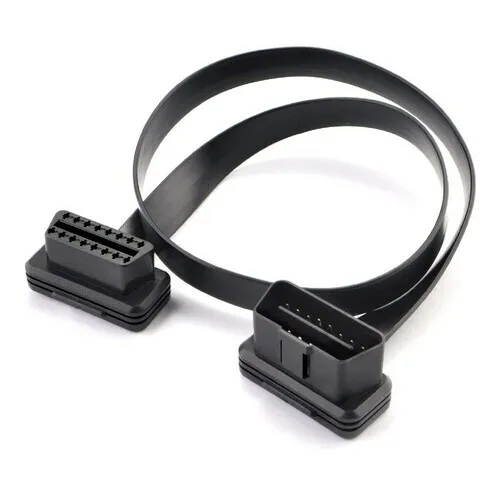
OBD2 Extension Flat Cable, 16-Pin Male to Female Ribbon Lead
An obd2 extension flat cable takes the wear off the vehicle diagnostic port: the tool plugs into the extension and the extension stays in the dash. All 16 pins wired straight through in a low-profile TPU ribbon, 0.3 to 5 m.
Last updated: 13 September 2026
Overview
An obd2 extension flat cable moves the wear off the vehicle diagnostic port. Rather than cycling the connector in the dash dozens of times a day, the tool plugs into the extension and the extension stays in the vehicle — and when it eventually wears out, you replace a cable instead of pulling the dash. All 16 pins are wired straight through, one to one, because which pins matter depends on the tool and the vehicle, and a lead that only carries the bus pins causes communication failures that look like vehicle faults. The ribbon is flat and low profile so it tucks along the sill and under the footwell trim without lifting anything.
Key Specifications
| Connector A | J1962 16-pin plug |
|---|---|
| Connector B | J1962 16-pin socket |
| Conductor | 22 AWG x 16, straight through one to one |
| Construction | Flat low-profile ribbon |
| Jacket | Flexible TPU |
| Lengths | 0.3 m / 0.6 m / 1 m / 2 m / 5 m |
| Cascading | Two or more leads may be joined; keep total run short |
| Function | Passive extension, no electronics |
What wears out first, and what it costs
| Failure point | What causes it | What the repair costs |
|---|---|---|
| Vehicle 16-pin socket contacts | Repeated insertion cycles, side load from a heavy dongle | Dash-out harness work, hours not minutes |
| Extension socket contacts | The same cycles, but on the cheap part | One cable |
| Cable at the strain relief | Being dragged across the sill or trapped in a door | One cable |
| Diagnostic tool connector | Plugging straight into a worn port | Tool repair or replacement |
That first row is the whole argument. The socket in the dash is not a service part in any practical sense, and the labor to reach it dwarfs the price of an extension.
Flat, not round
| Flat TPU ribbon (this cable) | Round 16-way bundle | |
|---|---|---|
| Profile | Lies under sill and footwell trim | Holds trim panels off their clips |
| Routing | Tucks along the sill and under carpet | Needs a gap or a channel |
| Coiling | Stays flexible, takes no permanent set | Stiffens where it has been coiled |
| Door shut line | Passes without lifting the seal | Can lift the seal and let in wind noise |
TPU rather than PVC because it stays flexible in a cold workshop and does not take a permanent set after a winter coiled in a drawer.
The four bus groups behind a 16-pin port
This is why carrying all 16 pins matters. An OBD-II port can present several different physical layers depending on the vehicle, and a tool that cannot see the one the vehicle uses reports a communication failure that reads exactly like a dead ECU.
| Pins | Signaling | Still found on |
|---|---|---|
| 2 and 10 | SAE J1850 PWM or VPW | Older North American and some Asian vehicles |
| 7 and 15 | ISO 9141-2 K and L line | Older European and Asian vehicles |
| 6 and 14 | ISO 15765 CAN | Most vehicles built since the mid-2000s |
| 1, 3, 8, 9, 11, 12, 13 | Manufacturer discretion | Proprietary and maker-specific lines |
| 4, 5 and 16 | Ground, signal ground and battery | Every vehicle |
A lead wired for CAN alone is fine until the day a tech plugs into something older, and then it is a wasted bay hour while someone works out that the cable is the problem.
Choosing a length
| Length | Suits | Note |
|---|---|---|
| 0.3 m | Keeping the tool clear of the pedal box | Shortest lead that keeps the plug off the driver footwell |
| 0.6 m and 1 m | General workshop use, tool on the seat or a trolley | The usual default |
| 2 m | Bay work where the analyzer sits alongside the vehicle | Still short enough for bus integrity |
| 5 m | Analyzer or laptop parked outside the bay | Useful for target-based ADAS calibration |
Leads can be cascaded, but keep the total run as short as the job allows. Each extension adds resistance and capacitance to bus lines that were specified for a short harness, and a long chain is a legitimate cause of an intermittent fault that vanishes the moment the extensions come out.
Typical applications for this obd2 extension flat cable
- Calibration and coding work where the same port is cycled dozens of times a day
- ADAS front and rear target setups where the tool cannot physically sit at the port
- Emission testing where the analyzer cart stays outside the bay, paired with our OBD2 splitter USB charger cable when a second device also needs the port
- Wheel alignment rigs and rolling road installations
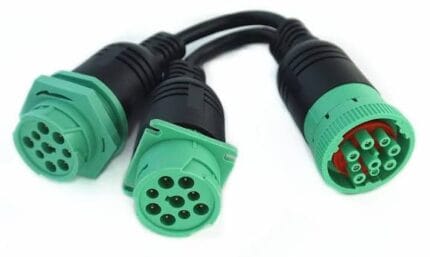
- Workshops that also run heavy vehicles, alongside our SAE J1939 OBD2 diagnostic cable
Build and ordering
Sixteen conductors at 22 AWG in a flat TPU ribbon, with J1962 plug and socket molded at the two ends and strain relief molded into both bodies. Custom lengths, right-angle shells and unshielded builds for cost-sensitive programs are all available.
From 5 pcs for a prototype, shipped in 3 working days, to 500 pcs and up for production at 14 working days after approval. Tooling we already hold costs no lead time; a new body adds roughly 10 working days. Private-label shipments carry your part number and labeling, and we can supply material certificates plus a first-article report.
Workmanship and testing
ISO 9001 governs the line and IPC/WHMA-A-620 Class 3 governs the workmanship. Terminations cover 32 to 12 AWG. No unit is packed before continuity and pinout have been verified, and where an ingress rating is specified we can quote seal checking on the production batch.
Related OBD leads
- OBD2 splitter USB charger cable, 16-pin pass-through Y lead
- SAE J1939 OBD2 diagnostic cable, Type 2 green 9-pin to 16-pin adapter
- OBD2 Type B cable for medium-duty truck fleets
- OBD-II 16-pin female to 3-pin diagnostic lead cable
- OBD2 dashcam power cable with low-voltage cutoff and parking timer
Full range: automotive cable and wire harness assemblies.
Frequently Asked Questions
Do all 16 pins really need wiring?
Yes, if the cable will meet more than one vehicle. Manufacturer-discretion pins carry proprietary diagnostic lines, and a tool that cannot see them reports a communication failure rather than a missing pin.
Can I join two extensions together?
You can, but keep the total run as short as the job allows. A long chain adds capacitance to bus lines and can produce faults that disappear when the extensions are removed.
Why TPU rather than PVC?
TPU stays flexible in the cold and does not take a permanent set after being coiled, which is what kills cheap PVC ribbons stored in a drawer over winter.
Is there a right-angle version?
Yes. A right-angle shell on the vehicle end keeps the cable flat against the dash where the footwell is shallow.
| Connector A | J1962 16-pin plug |
|---|---|
| Connector B | J1962 16-pin socket |
| Conductor | 22 AWG x 16, straight through one to one |
| Construction | Flat low-profile ribbon |
| Jacket | Flexible TPU |
| Lengths | 0.3 m / 0.6 m / 1 m / 2 m / 5 m |
| Cascading | Two or more leads may be joined; keep total run short |
| Function | Passive extension, no electronics |