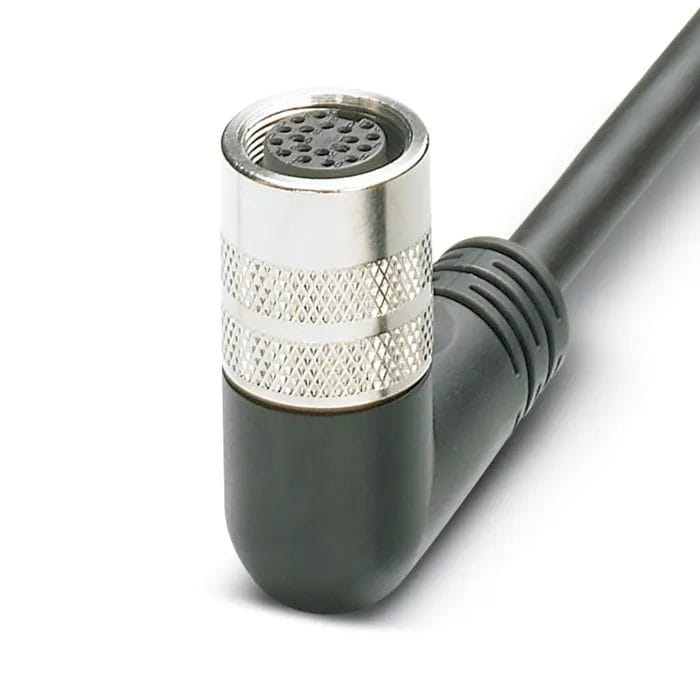
M16 Sensor Actuator Cordset, 2+3 to 14-Pin Hybrid
An M16 sensor actuator cordset is the size you reach for when M12 runs out of pins: an M16 x 0.75 screw-lock shell standardized in IEC 61076-2-106 that carries up to 14 contacts, or a true 300 V / 8 A power bundle, in a footprint still smaller than M23. Straight and right-angle, shielded or not.
Overview
An M16 sensor actuator cordset is the size you reach for when M12 runs out of pins: an M16 x 0.75 screw-lock shell standardized in IEC 61076-2-106 that carries up to 14 contacts, or a true 300 V / 8 A power bundle, in a footprint still smaller than M23. Straight and right-angle, shielded or not.
Key Specifications
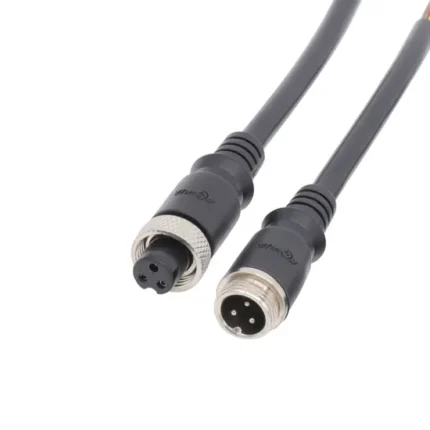
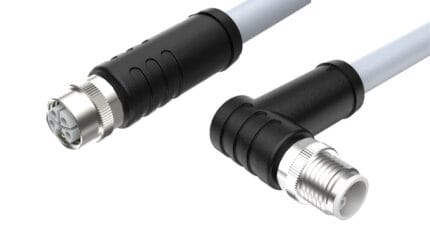
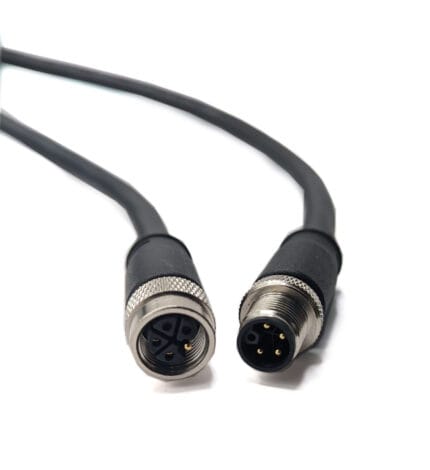
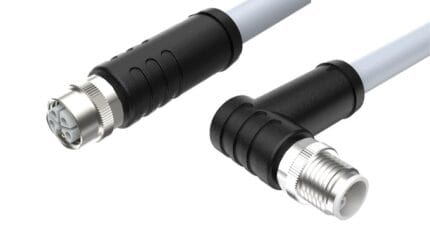
The table below lists the configuration shown in the product photo.
Choosing Between M12, M16 and M23
All three sizes are standardized screw-lock circular interfaces, and the choice between them is made by circuit count and current rather than by habit. M12 A-coding spans a very wide pin-count range and dominates general sensor work, but it tapers off in current capacity as position count rises, because more contacts in a twelve-millimeter shell means smaller contacts and less copper per position.
M16 sits above it. The extra thread diameter buys enough insert area to carry fourteen signal positions, or a genuinely power-rated bundle, without dropping to the fine contact sizes that limit high-density M12 builds. M23 is larger again and is where the heavy hybrid servo configurations live.
In practice: stay on M12 for single-sensor circuits, step to M16 when one connector has to carry a whole group, and reserve M23 for hybrid motor and feedback work.
The Coarse Thread That Refuses to Back Off
M16 has one quiet mechanical advantage nobody advertises: a coarser, deeper thread than M12. On telecom towers – the original mass-market home of this connector, where it drives remote electrical tilt antenna actuators – that thread is what keeps the coupling mated through years of wind-induced panel vibration. The same property makes it the default on servo valve packs and machine frames that resonate all shift.
Power Class and Signal Class in One Family
The detail specification supports two practical regimes. Power-oriented builds run 300 V at 8 A on 18 AWG (0.75 mm2) conductors – solenoid valve clusters, small drive auxiliaries, heater and lamp loads. Signal-oriented builds run 60 V at 3 A on 24 AWG (0.25 mm2) with a 360-degree shield for encoder and I/O bundles. Contact resistance is 10 milliohm or better, inserts are PA66 rated UL94 V-0, and sealed builds hold IP67 with a rated 500 mating cycles minimum.
Applications for This M16 Sensor Actuator Cordset
Machine builders buy this size wherever M12 density falls short: multi-axis motion controllers, dense I/O blocks on packaging and CNC machinery, and encoder or resolver bundles on compact drives. Telecom contractors use the sealed versions for antenna line devices and outdoor cameras that get hosed down. Solar trackers, wind-turbine pitch cabinets and irrigation controllers round out the sealed-build list.
Why Density Changes the Economics
The argument for a higher pin count is not the connector itself, it is everything around it. Every extra connector on a machine costs a panel cutout, a mating cycle at install, another sealing point to leak eventually, and another part number to stock. Consolidating sixteen circuits into one sealed shell removes several of each.
The counter-argument is service isolation: when one device on a high-density branch fails, everything sharing the connector comes off line with it. Designers usually resolve this by grouping circuits that logically belong together – one axis, one valve cluster, one device group – so a failure and a repair boundary coincide rather than spreading.
Hybrid Inserts Without a Second Cutout
The signature capability is the hybrid insert: tell us how many positions you want at power cross-section and how many at signal, and we lay out an insert that keeps the two groups apart with grounded positions between them. That separation is what stops a switching heater or valve coil from coupling transients into a quiet feedback line one millimeter away.
Getting the Insert Arrangement Right
The thread is universal; the pinout is not. A 12-pin A-coded shell from two suppliers may not share an arrangement, so send the receptacle part number or a pin-numbered face view and we will match it rather than assume. Right-angle molded versions – the style in the product photo – solve the classic clearance problem behind a valve manifold or inside a tower-top junction box.
Specifying Both Halves Together
A cordset only connects if the receptacle it is meant to mate with agrees. Because insert arrangements vary within the same shell size and pin count, the most common delay is discovering at install time that the cable on the bench and the receptacle on the shelf were built to different layouts.
Ordering both halves from one source removes the problem entirely. Give us the device part numbers, or a face view of each port, and we build the pair to match.
Panel and Cable-Mount Half Sets
Because we mold the cable side and supply the receptacle side, the pair arrives as a matched set: front- or rear-mount receptacles with solder or PCB contacts, sealed to the same rating as the cordset. Ordering both halves from one source removes the classic commissioning delay of discovering at install time that the receptacle on the shelf is a different insert arrangement.
Installation and Handling Notes
Keep the coupling finger-tight plus a firm final turn. The coarse thread grips well, and over-torquing distorts the sealing faces rather than improving retention.
Support the cable near the connector at both ends. Higher pin-count cables are heavier than their single-sensor equivalents, and their weight should not be carried by the joint.
Right-angle versions are clocked at build time, so decide which way the cable must leave before ordering.
Ordering, Packaging and Verification
Specify pin count, split, jacket, shielding, length and end treatment; lengths run from pigtails to long cabinet drops with no forced minimum. Cordsets ship bagged and labeled by part code, coiled rather than folded so the jacket never sets a kink. Every unit is continuity and hipot tested, gauge-mated and, on sealed builds, leak tested; 48-hour salt-spray samples and full test reports accompany the batch.
Every production run can ship with RoHS and REACH declarations and the electrical report agreed at quotation; see certifications and material declarations. UL styles and other named approvals are built to drawing: we source to the style you specify and document it, rather than asserting a listing we do not hold. This assembly is built on the four lines covered under cable assembly and wire harness production, with nothing in the build handed to an undisclosed subcontractor. The wider context is covered under what automation programs ask for. Tooling is quoted separately, cut in-house rather than brokered out, and owned by you.
Frequently Asked Questions
Should I use M16 instead of M12? Only where you need more positions or a genuinely power-rated bundle. Single-sensor circuits belong on M12.
Are pinouts standard across suppliers? The thread is; insert arrangements are not. Match the arrangement, not just the pin count.
Can one insert mix power and signal contacts? Yes. Hybrid layouts are a standard build for this series.
What does IP67 actually cover? The sealed, mated pair. An unmated half is not protected.
Related Cable Ranges
Compare with the rest of the Circular M-Series Cable Assemblies, the Panel Mount Cable range for panel feedthroughs, and Custom Wire Harnesses for multi-branch looms. The interface is defined by IEC 61076-2-106.
For smaller six-position circuits see the IP67 right-angle M8 sensor cable, and for hybrid servo work the IP67 right-angle M23 power cable.
| Connector series | M16 (IEC 61076-2-106 / IEC 60130-9) |
|---|---|
| Coupling thread | M16 x 0.75 |
| Pin count | 8 (image shows female right-angle), 5, 6, 10, 12, 14, 2+3 |
| Coding | A-coded |
| Rated voltage | 300 V (power builds), 125 V, 60 V (signal builds) |
| Jacket material | PVC, PUR, TPE |
| Shielding | Unshielded, 360-degree EMC shield |
| Ingress rating | IP67 when mated |
| Rated current | 8 A (0.75 mm2 power builds), 3 A (0.25 mm2 signal builds) |
| Wire gauge | 18 AWG (0.75 mm2), 24 AWG (0.25 mm2) |