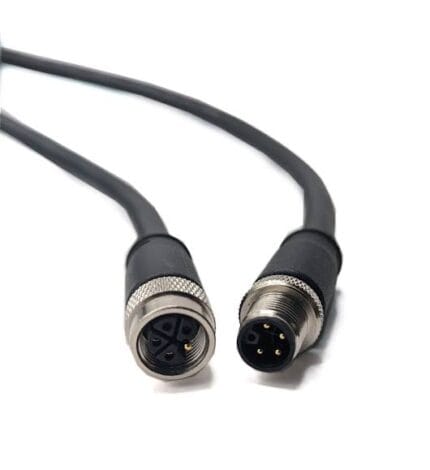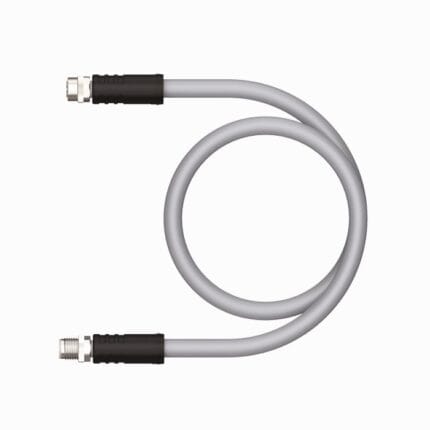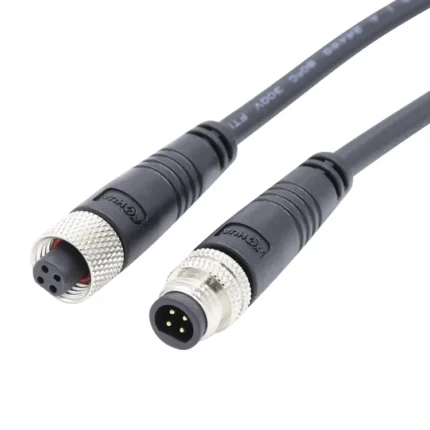
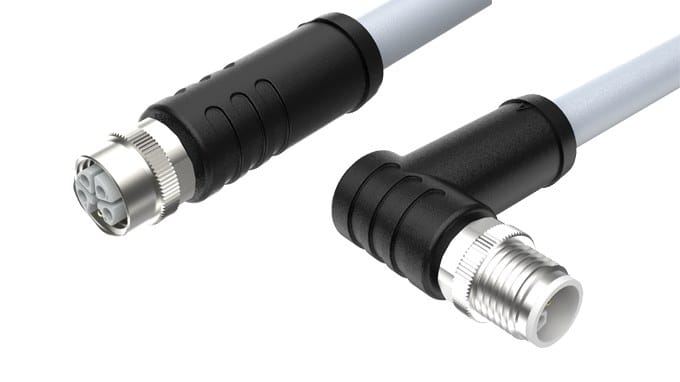
M12 L-Code 16A Cable for IO-Link Power and AGV Drives
An M12 L-code 16A cable feeds 24 V DC out to IO-Link masters, field I/O islands and AGV drives where an A-coded connector runs out of current. Five power contacts, halogen-free PUR jacket, sized to your run.
Overview
IO-Link masters, valve blocks and compact field I/O modules have moved the power demand out of the cabinet and onto the machine. A single master with eight ports can draw well past what a 4 A A-coded connector will carry, which is why the M12 L-code 16A cable exists: same thread, same panel cut-out, far more copper in the contacts. It suits daisy-chained 24 V distribution trunks, IP67 field I/O islands, drive power on AMRs and AGVs, and on-board 24 V distribution in vehicles.
Key Specifications
| Connector series | M12, L-coded, 5 positions (4 + FE) |
|---|---|
| Rated voltage | 63 V DC (pending supplier datasheet) |
| Rated current | 16 A at a stated ambient temperature (pending supplier datasheet) |
| Conductor cross-section | 5 x 2.5 mm2 (pending supplier datasheet) |
| Temperature range | -40 to +80 C (pending supplier datasheet) |
| Ingress rating | IP65 / IP67 / IP69K (pending supplier test report) |
| Jacket material | Halogen-free PUR |
| Contacts | Gold plated, plating thickness pending confirmation |
| Coupling nut | Nickel plated brass standard, stainless steel optional |
| Flex life | Bend and torsion cycle figures withheld pending test method and report |
| Typical loads | IO-Link master trunks, IP67 field I/O, AMR and AGV drives, 24 V vehicle distribution |
Why L-code carries 16 A
L-code uses five positions in a 4 + FE arrangement with contacts sized for power rather than signal. That sets it apart from K-coded and S-coded parts, which are the mains-voltage codings, and from the A-coded sensor connectors covered by IEC 61076-2-101. The practical consequence is that a 24 V distribution run needing two or three A-coded drops can be fed with one L-coded lead. The keying also stops an L-coded plug being forced into a signal receptacle, so a 16 A supply cannot be landed on a sensor input by mistake.
L is a DC power coding, keyed deliberately away from both the mains codings and the A-coded sensors. The whole family, K, S, T, L, M, P and the rest, is mapped in the coding reference in our download center.
L-code 5-position pin map
Two supply contacts and two returns, plus functional earth. The doubling is the point: it shares the current across more copper than a signal connector has.
| Pin | Function | Color | Note |
|---|---|---|---|
| 1 | +24 V DC | Brown | Supply contact A |
| 2 | 0 V | White | Return contact A |
| 3 | 0 V | Blue | Return contact B |
| 4 | +24 V DC | Black | Supply contact B |
| 5 | FE | Green/yellow | Functional earth |
Conductor size and voltage drop
On a 24 V trunk the connector is rarely what limits you – the copper is. Sixteen amps is a fine headline number and meaningless on its own: it is only valid at a stated ambient temperature with a stated conductor size, and the voltage that actually arrives at the last master on the trunk depends on the length and on the cross-section you chose.
| Decision | What governs it | What we need from you |
|---|---|---|
| Conductor cross-section | Current and routed length out and back | Load current and the length of the trunk |
| Number of drops on the trunk | Sum of the loads, not the count of connectors | Per-module current draw |
| Ambient temperature | Derating of the rating quoted for the coding | Where the run sits on the machine |
| Bend radius and flexing | Stranding choice and jacket life | Whether the run is fixed or moving |
Send us the load and the routed length and we will size the conductor.
The coding family, with the power codings together
L-code is one of four power codings, and mixing them up is the classic specification error in this part of the range.
| Code | Contacts | Job | Voltage class | Current class |
|---|---|---|---|---|
| L | 4+FE | DC power for field devices | 63 V DC | 16 A |
| T | 2 to 4 | DC power for drives | 63 V DC | 12-16 A |
| K | 4+PE | Three-phase AC power | 630 V AC | 12-16 A |
| S | 2+PE / 3+PE | Single-phase AC power | 630 V AC | 12-16 A |
| M | 5 to 6 | Servo power with brake | 630 V AC | 8 A |
| A | 3 to 12 | Sensors, actuators, IO-Link | 30-250 V | 1.5-4 A |
| C | 3 to 6 | AC sensors and actuators | 250 V AC | 2-4 A |
| D | 4 | 100 Mbit/s Ethernet | 60 V | 4 A |
| X | 8 | 10 Gbit/s Ethernet | 60 V DC | 0.5 A |
| B | 4 to 5 | PROFIBUS-DP | 60 V | 4 A |
| P | 4 | EtherCAT P | 60 V | 4 A |
| Y | 8 (4+4) | Power plus Fast Ethernet | 50 V | 6 A power / 0.5 A data |
Those voltage and current figures are the values published for the coding as an interface, including the 16 A shell rating for L-code. They are not a claim about our part: your assembly is manufactured and accepted to the nominal values on your drawing.
Where it gets installed
- Daisy-chained supply to several IO-Link masters along one trunk
- IP67 field I/O islands mounted directly on the machine frame
- Drive and traction power on AMRs, AGVs and other mobile platforms
- On-board 24 V distribution in commercial and special-purpose vehicles
On an automated guided vehicle the duty is the hard part: the conductor is sized on the peak rather than on the average.
Jacket, contacts and coupling nut
Continuous flexing is the normal condition for this kind of lead, so the standard jacket is halogen-free PUR, which holds up against oils and coolants. Contacts are gold plated to keep contact resistance stable across many mating cycles, and a stainless steel coupling nut is available where the connector sits in a washdown area or outdoors.
Flex life and torsion
Competitor literature for this class of cable quotes very high bend cycle counts. We are not publishing those numbers here. A cycle-life figure means nothing without the test method behind it. Send us the duty cycle and we will obtain the supplier test report written against a recognized method before any figure goes on a drawing.
Figures to confirm before you specify
These figures come from published competitor data rather than our own datasheet. IP69K in particular involves a high pressure, high temperature wash test that not every IP67 connector passes.
Typical applications for this M12 L-code 16A cable
- 24 V trunks feeding several IO-Link masters along one run
- IP67 field I/O islands mounted on the machine frame
- Traction and drive power on AMRs and AGVs
- On-board 24 V distribution in special-purpose vehicles
How to specify your build
- Load current, including the peak, not just the average.
- Routed length of the trunk out and back.
- Ambient temperature at the run.
- Coupling nut – nickel plated brass or stainless steel.
- Fixed or moving, with the duty cycle if it moves.
- Quantity, prototype or production.
Workmanship and testing
M12 L-Code 16A builds are made to IPC/WHMA-A-620 Class 3 workmanship inside an ISO 9001 system, over a 32 to 12 AWG range. continuity and pinout are verified on each M12 assembly before packing, and seal checking is quoted whenever an ingress rating is on the drawing.
Material declarations against RoHS and REACH are issued per project, alongside the dimensional and electrical reports agreed at quotation; see certifications, compliance and material declarations. Where your drawing names a UL style or another approval, the build follows your drawing and ships with the supporting document rather than a claim of our own. For continuous motion the stranding, lay length and jacket are built to the flex method described under continuous-flex construction and flex-life testing, with the cycle count defined in the test scope. More background: cable assemblies for industrial automation and robotics. Tooling for this build is cut in our own tool room and belongs to your program, so a repeat run years later starts from the same tool.
Custom builds and ordering
For M12 L-Code 16A builds, prototypes run from 1 to 50 pcs with a 3 working day turnaround; volume orders begin at 500 pcs and ship 14 working days after approval. Tooling not already held adds around 10 working days. OEM and ODM M12 work ships under your part number and labeling, and material certificates and first-article reports can be supplied.
Related M12 power assemblies
- M12 L-Code Power Splitter for Two IO-Link Masters
- M12 Power T-Code or L-Code DC Power Cable, 63 V DC
- M12 IO-Link Cable, Master to Device Drop for 3 and 4 Wire Ports
- M12 K-Coded Power Cable for 630 V AC Motor Feeds
- M12 S-Coded Power Cable for Single-Phase AC Loads
- M12 Drag Chain Cable, Continuous Flex Cordset for Cable Carriers
Full range: circular M8 and M12 cable assemblies.
Frequently Asked Questions
Is 16 A usable at any length?
No. Sixteen amps is a rating at a stated ambient temperature and conductor size. What limits you on a real trunk is the voltage drop over the routed length, so send us the load and the length.
Can I feed several IO-Link masters from one trunk?
Yes, that is the common use. Size the conductor on the sum of the loads plus the length, not on the number of connectors.
L-code or T-code?
Both are DC power codings. L-code is the 4 + FE arrangement used for PROFINET and IO-Link power; T-code is usually a smaller contact count for drives and distributed DC loads.
| Connector series | M12, L-coded, 5 positions (4 + FE) |
|---|---|
| Rated voltage | 63 V DC class |
| Rated current | 16 A at a stated ambient temperature class |
| Conductor cross-section | 5 x 2.5 mm2 class |
| Temperature range | -40 to +80 C class |
| Ingress rating | IP65 / IP67 / IP69K class |
| Jacket material | Halogen-free PUR |
| Contacts | Gold plated |
| Coupling nut | Nickel plated brass standard, stainless steel optional |
| Flex life | Bend and torsion cycle figures |
| Typical loads | IO-Link master trunks, IP67 field I/O, AMR and AGV drives, 24 V vehicle distribution |