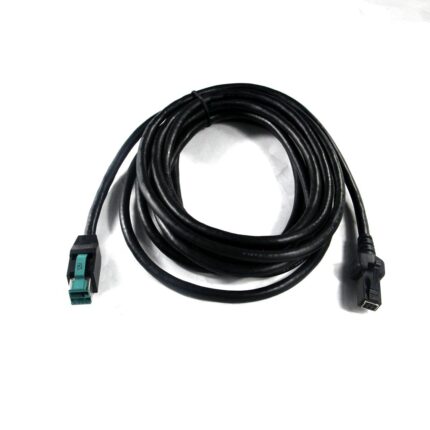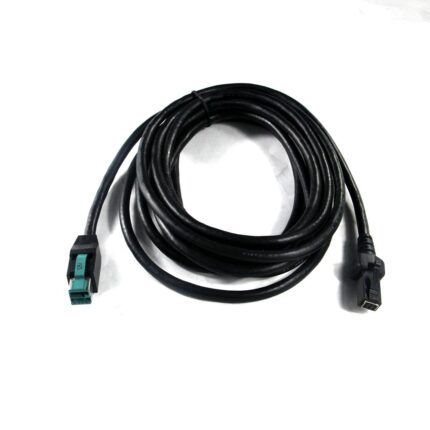
USB4 80Gbps Cable for Docks, 8K Displays and eGPU Enclosures
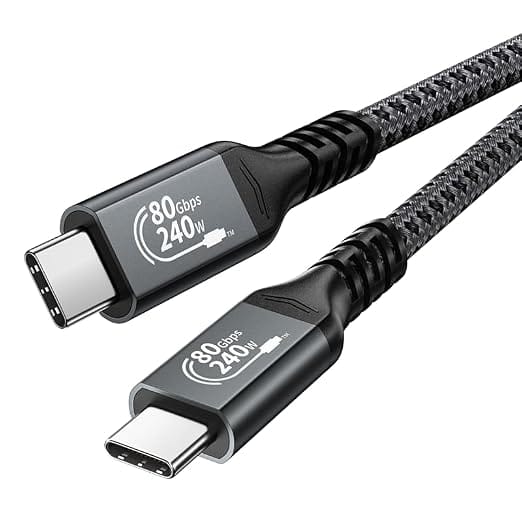
A USB4 80Gbps cable built for docks, 8K displays and external GPU enclosures, where the lead is part of the link budget rather than an accessory. E-Marker identified to the host, triple shielded, and offered in the shortest length that reaches.
Last updated: 13 September 2026
Overview
At 80 Gbps the cable stops being an accessory and becomes part of the link budget. That is why a USB4 80Gbps cable in this class is short, thick in conductor terms, heavily screened, and fitted with an E-Marker chip that tells the host what the assembly can actually carry before any power or data contract is negotiated. If the host cannot read the marker, it falls back to a safe default and the buyer never sees the rate they paid for.
Key Specifications
| Product type | USB4 high-speed data cable |
|---|---|
| Data rate | Quoted 80 Gbps bidirectional – to be confirmed |
| Boosted mode | Quoted up to 120 Gbps in one direction – to be confirmed |
| Power delivery | PD 3.1 extended power range, 240 W class – to be confirmed |
| Marker | E-Marker identified to the host |
| Construction | Quoted 28 AWG copper, triple shielding, braided jacket – to be confirmed |
| Length policy | Shortest run that reaches – rate and power fall with distance |
| Certification | No approval claim made; documentation pending supplier filing |
What the rating means in USB-IF naming
USB naming has been revised several times and the same physical port now appears under several labels. The terms below are the industry definitions used by USB-IF, quoted so you can match a dock or a display to the right lead. They are not our own measured results.
| Name | Defined signaling rate | What it is used for |
|---|---|---|
| USB 3.2 Gen 1 | 5 Gbps | Peripherals, external drives, basic docks |
| USB 3.2 Gen 2 | 10 Gbps | Fast storage, single 4K display docks |
| USB 3.2 Gen 2×2 | 20 Gbps over two lanes | High rate storage, dual display docks |
| USB4 | 20 or 40 Gbps | Docks, eGPU enclosures, high refresh displays |
| USB4 80Gbps | 80 Gbps bidirectional, or 120 Gbps one way with 40 Gbps back | 8K displays, eGPU, fast external storage arrays |
The 80 Gbps and 120 Gbps figures are the USB4 Version 2.0 definitions. The boosted mode is asymmetric on purpose: it favors the direction a display or a storage array actually needs, and it is negotiated rather than guaranteed by the cable alone.
What the assembly has to do
- Carry the full rate at the length offered, not only on a bench with a short sample.
- Identify itself to the host through an E-Marker so the port does not throttle to a safe default.
- Negotiate power without dropping out under load, which is a voltage drop problem as much as a protocol problem.
- Carry display traffic alongside data over the same connector, using the alternate mode the sink supports.
- Keep the high-speed pairs screened from the power conductors and from the outside world.
Power: PD 3.1 and where 240 W comes from
USB Power Delivery 3.1 defines two ranges. Standard power range covers up to 100 W at 20 V and 5 A. Extended power range, usually written EPR, adds higher voltages up to 48 V at 5 A, which is where the 240 W class figure comes from. Reaching EPR levels requires a cable that identifies itself as capable, which is exactly what the E-Marker does. The wattage on this page is a design target until the supplier datasheet and our own electrical results are in.
Where the standard requires it
| Scenario | What you actually need | What happens if you under-specify |
|---|---|---|
| 8K or high refresh dual display dock | 80 Gbps class lead, E-Marker fitted | Dock drops to a lower mode or refuses the second display |
| External GPU enclosure | Full rate both ways at the length used | Frame rate collapse and intermittent dropouts under load |
| Fast external storage array | Rate at length, plus stable power delivery | Drive disconnects during sustained write |
| Single 4K60 display and peripherals | 10 or 20 Gbps is usually enough | Paying for headroom the setup cannot use |
Length is the constraint
Buy the shortest run that reaches. Every number above degrades with distance, and the degradation shows up as a negotiated fallback rather than as an error message, which is why users rarely connect the symptom to the cable. If the run genuinely needs more than a passive copper lead can manage, an active optical assembly is the correct answer rather than a longer passive one.
Certification status
We make no certification claim on this page. Competitor pages in this class print a compliance ID; until our supplier files the corresponding documentation and test report for the production build, we describe capability rather than approval status. If you need a documented compliance trail for a corporate rollout, ask us and we will tell you exactly what is on file. The values your assembly is built and verified to are the ones stated on your order.
Typical applications for this USB4 80Gbps cable
- Workstation docks driving one or two high-resolution panels, alongside our USB-C to DisplayPort cable where a native display input is needed
- External GPU enclosures where the link rate sets the frame rate
- Fast external storage arrays on video workflows, with our USB4 screw lock cable where the run has to be retained mechanically
- Capture drives and reference monitors on the same chain
- Cabinet and rack passthroughs using a waterproof USB-C bulkhead cable where a panel port is required
These rates and modes are the USB4 industry definitions; what your assembly is verified to is measured on the finished build and stated per order.
Workmanship and testing
Assembly and inspection follow IPC/WHMA-A-620 Class 3 workmanship criteria under our ISO 9001 quality management system, and every unit passes 100% continuity and pinout testing before it is packed. Conductor range is 32 to 12 AWG. Where an ingress rating is specified we can quote seal checking on the production batch.
Custom builds and ordering
Prototype builds start from 5 pcs and ship in 3 working days; production orders start at MOQ 500 pcs and ship 14 working days after approval. New overmold tooling adds about 10 working days. OEM and ODM builds ship under your part number and labeling, with material certificates and first-article reports available on request.
Related assemblies
- USB4 Screw Lock Cable, 80Gbps Dual-Screw USB-C
- USB-C Active Optical Cable for Long-Reach USB4 Class Links
- USB-C Gen2 Data Cable, 10 Gbps, with 100 W Power Delivery
- USB-C to DisplayPort Cable for High Refresh Monitors
- Waterproof USB-C Bulkhead Cable for Panel Mount Enclosures
- Active Optical HDMI Cable for Boardrooms
Full range: signal and data cables.
Frequently Asked Questions
Why does my 80 Gbps dock only negotiate a lower mode?
Usually because the host cannot read an E-Marker, or because the run is too long to hold the rate. Shorten the lead first, then check the marker.
Is 240 W over USB-C actually available?
240 W is the PD 3.1 extended power range class at 48 V and 5 A. Reaching it requires a cable that identifies itself as capable; the figure on this page is a design target pending test confirmation.
Should I buy a longer lead for futureproofing?
No. Rate and power both fall with distance, and the fallback is silent. Buy the shortest run that reaches.
What is the minimum order?
Prototypes start from 5 pcs and ship in 3 working days. Production runs start at 500 pcs and ship 14 working days after approval.
| Product type | USB4 high-speed data cable |
|---|---|
| Data rate | Quoted 80 Gbps bidirectional – to be confirmed |
| Boosted mode | Quoted up to 120 Gbps in one direction – to be confirmed |
| Power delivery | PD 3.1 extended power range, 240 W class – to be confirmed |
| Marker | E-Marker identified to the host |
| Construction | Quoted 28 AWG copper, triple shielding, braided jacket – to be confirmed |
| Certification | No approval claim made |
| Length policy | Shortest run that reaches – rate and power fall with distance |