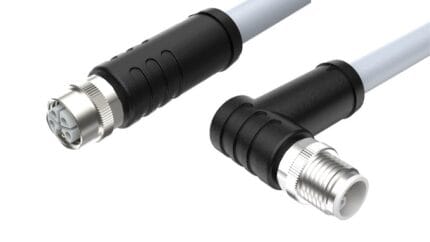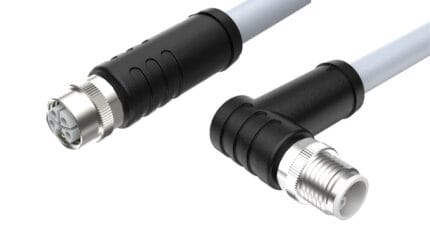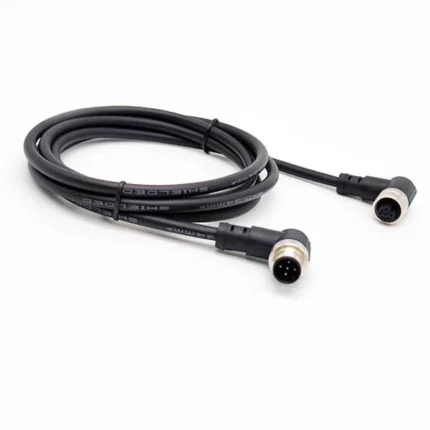
M12 Power T-Code or L-Code DC Power Cable, 63 V DC
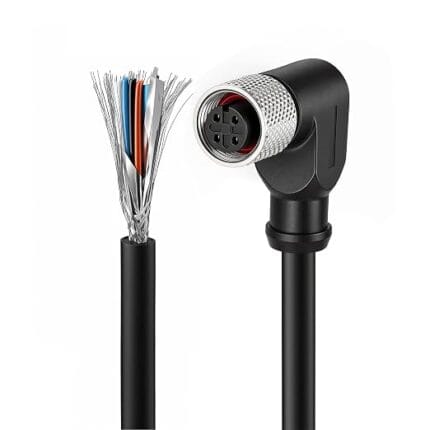
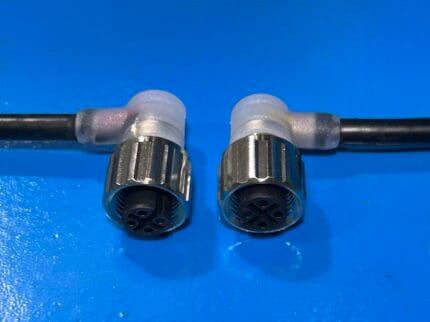
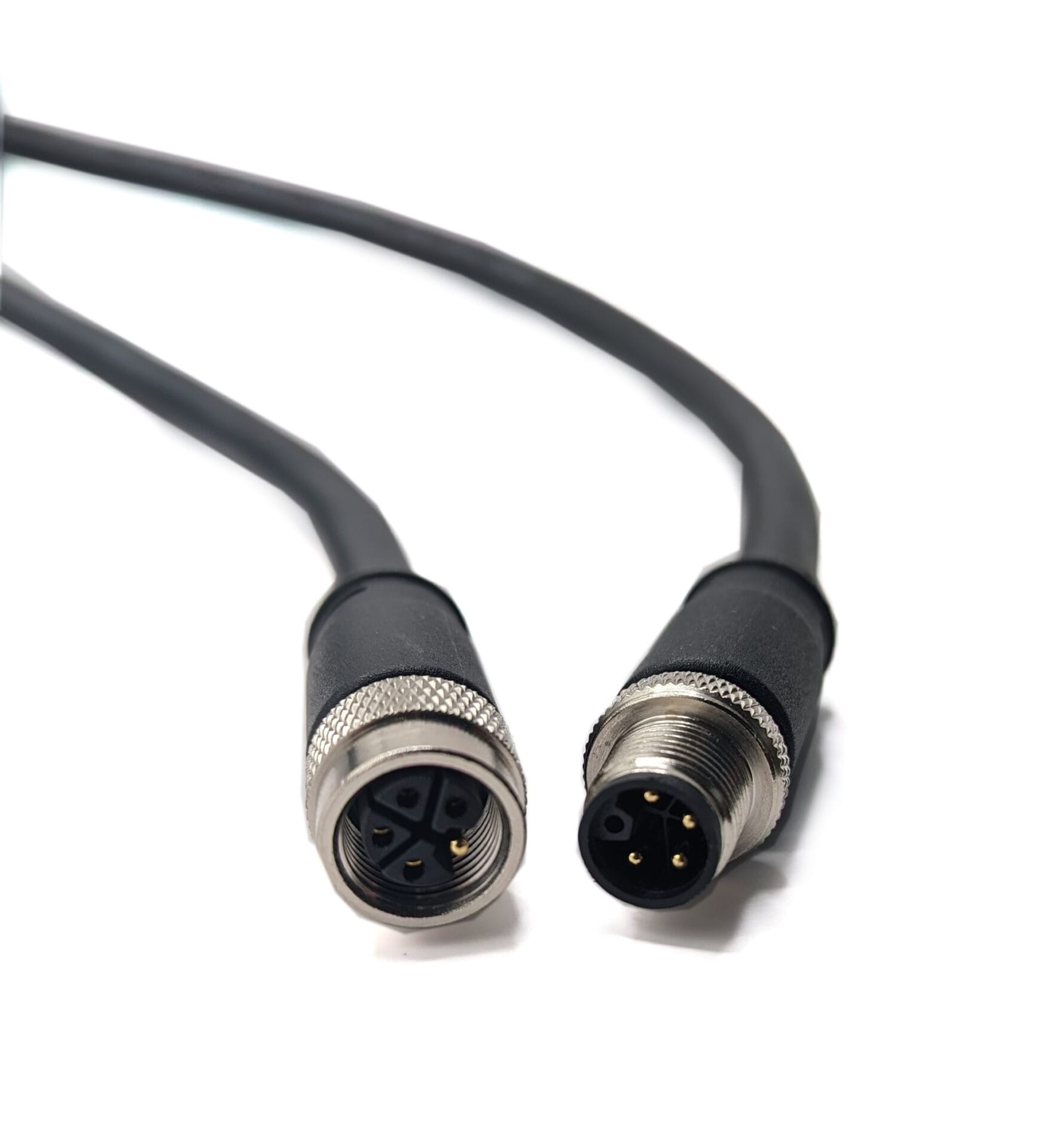
This M12 l code power cable carries 16 A at 63 V DC on five positions, or 12 A on four in the T-coded version, both per IEC 61076-2-111 and IP67 mated. 14 or 16 AWG, tamper-proof overmold, gold-plated contacts, built to your length.
Overview
An M12 L code power cable, like its T-coded sibling, belongs to the IEC 61076-2-111 family of DC power connectors that were deliberately keyed so nobody can cross-connect them. T-code carries four conductors at 12 A, L-code carries five at 16 A, both restricted to 63 V DC, and neither will mate with the other. That last property is the feature rather than the limitation: it stops a low power drive being plugged into a network segment designed for something else, and vice versa, without asking anyone to read a label.
Key Specifications
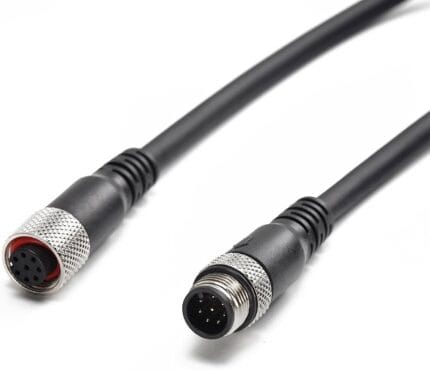
| Connector A | M12 T-coded 4-pin male or L-coded 5-pin (4+FE) male, shielded, IP67 |
|---|---|
| Connector B | M12 T-coded 4-pin female or L-coded 5-pin female, shielded, IP67 |
| Coding | T or L per IEC 61076-2-111 |
| Rated | T-coded 12 A / 63 V DC; L-coded 16 A / 63 V DC, DC only |
| Wire size | 16 AWG (1.5 mm2) T-coded; 14 AWG (2.5 mm2) L-coded |
| Jacket | PVC or PUR, black, drag chain capable on request |
| Temperature | -25 to +80 °C with PUR jacket |
| Overmold | Tamper-proof, cannot be removed from the cable in the field |
| Length | OEM build to required length |
T or L: choose by current, then check the socket
The coding is not a preference, it is a physical key, and the socket on your equipment decides it nine times out of ten. Where you have a free hand, current is the tie breaker.
| Attribute | T-coded | L-coded |
|---|---|---|
| Positions | 4 (3 power plus protective earth) | 5 (4 power plus functional earth) |
| Current class | 12 A | 16 A |
| Voltage | 63 V DC | 63 V DC |
| Conductor size | 16 AWG class (1.5 mm2) | 14 AWG class (2.5 mm2) |
| Typical loads | Small drives, field device islands, lighting runs | Medium DC drives, IO-Link power, AGV supplies |
| Intermateable with the other | No, intentionally | No, intentionally |
Current decides between T and L, though the socket already on the machine may decide for you. Both codings, and the rest of the family, are set out in the coding reference in the download center: pole counts, applications, and what will not mate.
Why 63 V DC is the line
This part of the family was defined for extra-low voltage DC distribution on the machine, not for mains. Above that boundary the same shell size has its own answer: K-coding covers three-phase AC and S-coding covers single-phase AC, both aiming at 630 V, and both are keyed differently again. Confusing a DC power run with an AC one is exactly the mistake the whole coding scheme exists to prevent.
| Family member | Rated for | Use it when | Not when |
|---|---|---|---|
| T-code | 12 A at 63 V DC | Small DC drives and distributed field power | Above 12 A or above 63 V |
| L-code | 16 A at 63 V DC | IO-Link power islands and medium DC loads | Any AC application |
| K-code | Three-phase AC power | Motor feeds and drives on mains voltage | Anything DC |
| S-code | Single-phase AC power | Heaters, pumps and single-phase loads | Anything DC |
Voltage drop usually decides the conductor
The stated current is a contact rating. What actually limits a DC power drop is how much voltage is left at the load, and that is a function of length, conductor size, how many conductors share the bundle and how warm the bundle runs. Voltage drop is also why a drive that works on the bench browns out once it is installed at the end of a long run.
| Input to the calculation | Effect | Where it comes from |
|---|---|---|
| Load current and inrush | Sets the baseline, multiple times steady state for motors cold | Device datasheet |
| Minimum acceptable voltage at the load | Often the real decider, not the current rating | Stated per your drawing |
| Routed one-way length | Drop scales with length, and the return path counts twice | Stated per your drawing |
| Number of loaded conductors together | Bundle heating derates each one | Confirm at order |
| Ambient temperature | Resistance rises with temperature | Confirm at order |
Give us current and length and we will quote 16 AWG or 14 AWG accordingly, or larger where the numbers do not stack up.
Shape small enough to fit but cannot be taken apart
Under continuous load, contact resistance is everything, so contacts here are gold-plated brass and the overmold is a tamper-proof body that cannot be pulled off the cable in the field. That last point matters on rental and mobile equipment: the assembly either gets properly made or gets replaced, rather than being repaired with a screwdriver and ending up with a hot joint.
Typical applications for this M12 L code power cable
- Compact 24 V and 48 V DC drives, stepper and small servo axes
- IO-Link power islands and DC-powered field I/O blocks
- AGV and AMR supply drops running 24 or 48 V DC distribution
- LED lighting runs and DC fans where routing space is tight
- Replacing multiple small cable runs with one coded power feeder
How to specify your build
- Coding – T or L, which usually follows the equipment socket.
- Current and inrush of the load, so conductors can be sized.
- Length along the route, plus minimum voltage at the load.
- Jacket – PUR for oil and flexing, PVC for dry static runs.
- Whether either end needs shielding, and how it is bonded.
- Quantity, prototype or production.
Workmanship and testing
IPC/WHMA-A-620 Class 3 is the workmanship bar for M12 Power T-Code builds, and ISO 9001 is the system behind the line, from 32 to 12 AWG. No M12 assembly is boxed before continuity and pinout are confirmed, and seal checking is quoted whenever an ingress rating is on the drawing.
Every production run can ship with RoHS and REACH declarations and the electrical report agreed at quotation; see certifications and material declarations. UL styles and other named approvals are built to drawing: we source to the style you specify and document it, rather than asserting a listing we do not hold. For continuous motion the stranding, lay length and jacket are built to the flex method described under continuous-flex design and testing, with the cycle count defined in the test scope. The wider context is covered under what automation programs ask for. Tooling is quoted separately, cut in-house rather than brokered out, and owned by you.
Custom builds and ordering
Five pieces is the prototype minimum for M12 Power T-Code builds, shipping in 3 working days. The production minimum is 500 pcs, delivered 14 working days after approval. Tooling not already held adds around 10 working days. M12 orders ship as OEM or ODM under your part number and labeling material certificates and first-article reports are available on request.
Related M8 and M12 assemblies
- M12 L-Code 16A Cable for IO-Link Power and AGV Drives
- M12 L-Code Power Splitter for Two IO-Link Masters
- M12 K-Coded Power Cable for 630 V AC Motor Feeds
- M12 S-Coded Power Cable for Single-Phase AC Loads
- M12 C-Coded AC Cable, Dual Keyway for AC Sensors
- M12 M-Coded Motor Cable with Integrated Brake Conductors
Full range: circular M8 and M12 cable assemblies.
Frequently Asked Questions
Can I plug a T-coded plug into an L-coded socket?
No, and that is intentional. The two codings are keyed apart so different current classes cannot be cross-connected on site.
Why is it limited to 63 V DC?
Because that is what this part of IEC 61076-2-111 is defined for. K-coding and S-coding cover AC power applications at much higher voltages.
What conductor size do I need?
Tell us the current and the routed length. The limiting factor is usually voltage drop at the load rather than the contact rating itself.
Does it work on an IO-Link power island?
Yes, L-coding at 16 A is a common choice for that duty, with the splitter variant feeding two masters from one drop.
Is the connector removable from the cable?
No. The overmold is tamper-proof by design, so a damaged assembly is replaced rather than field repaired into a hot joint.
| Connector A | M12 T-coded 4-pin male or L-coded 5-pin (4+FE) male, shielded, IP67 |
|---|---|
| Connector B | M12 T-coded 4-pin female or L-coded 5-pin female, shielded, IP67 |
| Coding | T or L per IEC 61076-2-111 |
| Rated | T-coded 12 A / 63 V DC; L-coded 16 A / 63 V DC (DC only) |
| Wire Size | 16 AWG (1.5 mm2) for T-coded; 14 AWG (2.5 mm2) for L-coded |
| Jacket | PVC or PUR, black, drag-chain rated on request |
| Temperature | -25 to +80 deg C (PUR jacket) |
| Length | OEM build to required length |