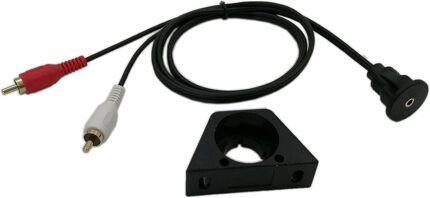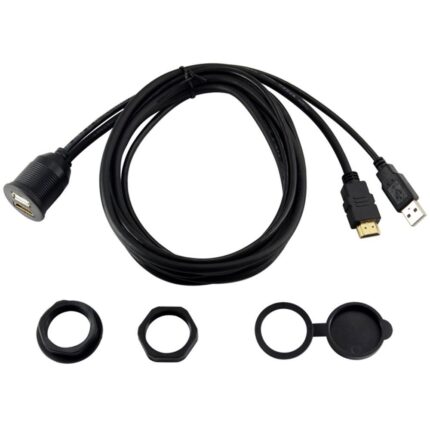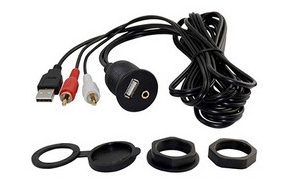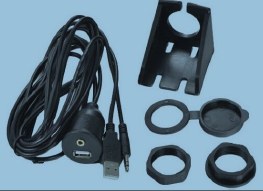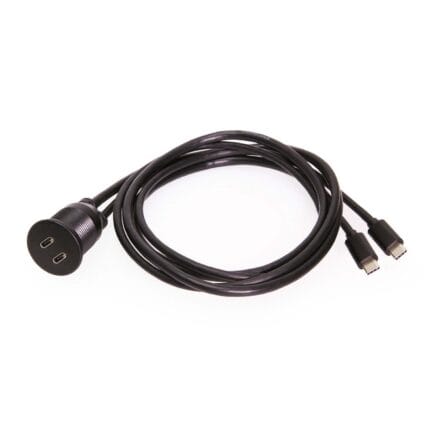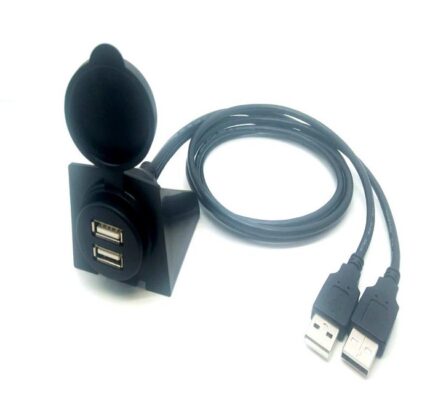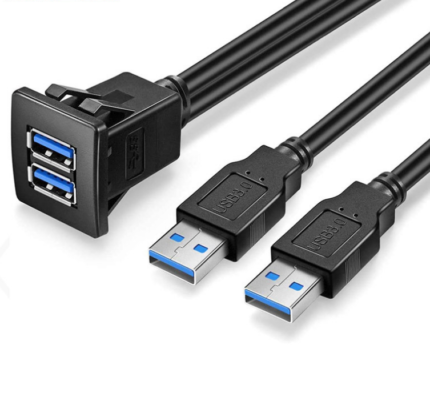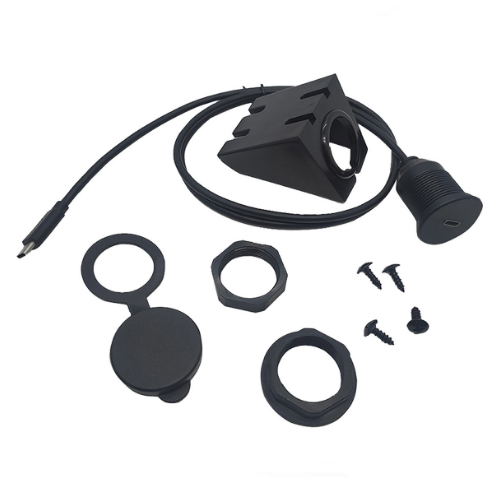
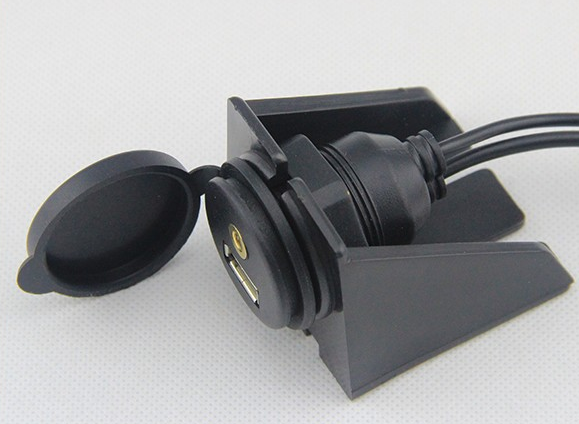
Single USB-C Female Car Dashboard Flush Mount Extension Cable with Bracket
A single usb c dashboard cable puts one USB-C socket on a flush dash bracket with 60 W or 100 W Power Delivery, so a phone, tablet or laptop charges at full rate. 32-26 AWG, black PVC or TPE jacket, 1 m / 2 m / 3 m.
Overview
A single usb c dashboard cable is the modern replacement for the legacy 5 V dash socket: one USB-C female in a flush 28-30 mm bracket, carrying Power Delivery at 60 W (20 V at 3 A) or, on the e-marked build, 100 W at 20 V and 5 A. That covers fast phone charging, tablets, and a laptop that would simply refuse to charge from an older port. Conductors are 32-26 AWG, the jacket is black PVC with TPE available, and stock lengths are 1 m, 2 m and 3 m. It is also the version to choose when the port has to carry data at 5 or 10 Gbps rather than just power. Two caveats worth reading before you order: the source has to be able to deliver what the panel is rated for, and above 3 A the cable has to carry an e-marker.
Key Specifications
| Connector A | USB-C Male |
|---|---|
| Connector B | USB-C Female, panel mount |
| USB specification | USB 2.0 480 Mbps; USB 3.1 Gen1 5 Gbps; USB 3.1 Gen2 10 Gbps |
| Power | 60 W (20 V / 3 A); 100 W (20 V / 5 A, e-marker) |
| Conductor | 32-26 AWG |
| Jacket material | Black PVC; black TPE on request |
| Cable length | 1 m / 2 m / 3 m |
| Mounting | Flush mount bracket, 28-30 mm cut-out, screw and cap |
| Cut-out diameter | 28-30 mm round |
| Application | Car, marine and motorcycle dashboards; phone, tablet and laptop charge and data |
USB 2.0, 5 Gbps or 10 Gbps: what changes in the cable
The connector looks identical at every speed, which is why this trips people up. A USB 2.0 Type-C build uses one differential pair plus power and configuration; a 5 Gbps build adds a second pair and more shielding; a 10 Gbps build is more demanding again on pair geometry and on the conductor construction. Below about a meter, USB 2.0 panel extensions are cheap and trouble-free. Once the run gets long and the port is expected to move data, the higher-speed construction is what keeps the link from negotiating down.
| Specification | Signaling rate | Typical panel use | Cable demand |
|---|---|---|---|
| USB 2.0 | 480 Mbps | Charging, sync, diagnostics | Low – the easiest build to route |
| USB 3.1 Gen1 | 5 Gbps | Media transfer, phone offload | Moderate – extra pairs and shielding |
| USB 3.1 Gen2 | 10 Gbps | Fast external drives, video | Higher – geometry and shielding matter |
| Thunderbolt-class | 20 to 40 Gbps | Not offered on this build | Active electronics required |
Power Delivery in one paragraph
Power Delivery is a negotiation, not a rating printed on the cable. Source and sink exchange capabilities over the configuration channel and settle on a contract – a voltage and a current that both can live with. Three practical consequences. A 100 W panel on a 30 W adapter delivers 30 W. A phone that only wants 15 W will take 15 W from a 100 W source and nothing you do to the cable changes that. And the e-marker is what tells the source the cable can carry 5 A, so an unmarked build is silently limited to 3 A no matter what the sockets look like. The USB-C connector and cable specifications are published by the USB Implementers Forum and they are the definitions we work to.
Single or twin port: the mechanical argument
A single-port bracket is narrower, takes less depth behind the panel, and puts less load on the cut-out, which matters on thin dashboards and on motorcycle fairings where there is nothing stiff behind the trim. A twin-port bracket gives a second socket for one hole, at the cost of a wider body and a longer moment arm when someone plugs into the outer port. If only one device ever charges, take the single – it is easier to fit and it is the part less likely to crack the trim.
| Single port | Twin port | |
|---|---|---|
| Bracket width | Narrower | Wider – check the panel |
| Depth behind panel | Less | More |
| Load on the cut-out | Lower | Higher – consider a backing plate |
| Best on | Thin trim, fairings, motorcycle panels | Flat dashboards and consoles |
| Power per port | Full budget to one device | Shared across the source capability |
Where a single usb c dashboard cable is the right call
- Driver phone charging on cars, vans and trucks where one device is the norm
- Motorcycle and marine panels where there is no room for a twin bracket
- Laptop and tablet charging on RV and sleeper-cab installs
- Diagnostics and media ports where the socket also carries data, see the Car USB-C Data Cable with Right Angle Plug
- Fleet vehicles standardising on USB-C, alongside the Dual Port USB Panel Mount with USB-C 100 W
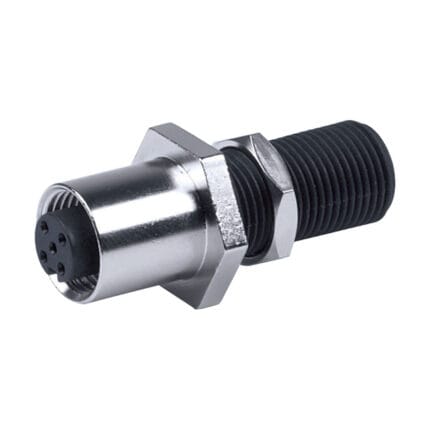
- Installs that want a threaded metal body rather than a bracket, compare the Flush Mount USB-C Receptacle
- Exposed panels where the sealed version is the right part, see the Waterproof USB-C Panel Pigtail
- Cabinet service ports, see the Control Cabinet Service Interface
Failure modes on USB-C dash panels
Slow charging is nearly always the source or the e-marker, not the socket. After that, the two that matter are mechanical: a bracket nut that was never tightened lets the socket rotate until the solder joints go, and a cut-out that is marginally oversize lets the whole body rock on a thin trim panel until the flange cracks. The environmental one is lint – a USB-C socket in a vehicle cabin collects pocket debris, and a plug that will not seat fully gives intermittent charging that looks like a cable fault.
What we treat as a target rather than a claim
What is listed here for Single USB-C Female Car builds is the industry-standard definition, not a measurement we took on a finished part. What your assembly is built and verified to is what your drawing states, confirmed against the supplier datasheet before a quote goes out.
How to specify your build
- Power – 60 W, or 100 W with an e-marker.
- Data rate – USB 2.0, 5 Gbps or 10 Gbps.
- Length – 1 m, 2 m or 3 m, or your measured route length.
- Bracket – single as standard; twin on request.
- Source – what will feed it, and what it can deliver.
- Jacket – black PVC as standard, TPE where flexibility matters.
- Quantity and whether this is a prototype or a production order.
Workmanship and testing
Single USB-C Female Car builds are assembled and inspected to IPC/WHMA-A-620 Class 3 criteria, with ISO 9001 as the quality system over 32 to 12 AWG work. continuity and pinout are verified on each Single assembly before packing, and seal checking is quoted whenever an ingress rating is on the drawing.
Material declarations against RoHS and REACH are issued per project, alongside the dimensional and electrical reports agreed at quotation; see certifications, compliance and material declarations. Where your drawing names a UL style or another approval, the build follows your drawing and ships with the supporting document rather than a claim of our own. This assembly is built on the four lines covered under the assembly lines behind this build, with nothing in the build handed to an undisclosed subcontractor. Related reading: our engineering review process. Tooling for this build is cut in our own tool room and belongs to your program, so a repeat run years later starts from the same tool.
Custom builds and ordering
Single USB-C Female Car prototype builds start from 1 to 50 pcs and are out in 3 working days; production is quoted from 500 pcs at 14 working days after sample approval. Your part number and labeling go on OEM and ODM Single shipments, and material certificates and first-article reports are available on request. We hold 100 sets of mold tooling in house, so a standard body needs no tooling time and a new one adds about 10 working days.
Related panel and USB-C hardware
- Flush Mount USB-C Receptacle, Threaded M21 Body
- Waterproof USB-C Panel Pigtail, 10 Gbps
- Dual Port USB Panel Mount with USB-C 100 W
- Car USB-C Data Cable with Right Angle Plug
- Circular USB-C Screw Cable with Metal M12 Style Shell
Full ranges: panel mount cable, signal and data cables and screw-lock molded cable.
Frequently Asked Questions
Why is my laptop charging slowly from a 100 W panel?
Check the source first. Power Delivery is a negotiation, so a 100 W panel on a 60 W adapter delivers 60 W, and a laptop that wants less will take less regardless.
Do I need the e-marker for 60 W?
Not at 3 A. At 5 A – the 100 W build – the source expects the cable to identify itself, so the e-marker is required for the port to deliver its full rating.
Can the socket carry data as well as charge?
Yes, at 480 Mbps, 5 Gbps or 10 Gbps depending on the build. Tell us which, because it changes the conductor construction.
Will it fit where my old USB-A socket was?
Usually. The bracket takes the same 28-30 mm round cut-out, so a USB-C socket is often a direct swap for an existing flush bracket.
| Connector A | USB-C Male |
|---|---|
| Connector B | USB-C Female, panel mount |
| Cable length | 1 m / 2 m / 3 m |
| USB specification | USB 2.0 480 Mbps; USB 3.1 Gen1 5 Gbps; USB 3.1 Gen2 10 Gbps |
| Power | 60 W (20 V / 3 A); 100 W (20 V / 5 A, e-marker) |
| Conductor | 32-26 AWG |
| Jacket material | Black PVC; black TPE on request |
| Mounting | Flush mount bracket, 28-30 mm cut-out, screw and cap |
| Cut-out diameter | 28-30 mm round |
| Application | Car, marine and motorcycle dashboards; phone, tablet and laptop charge and data |