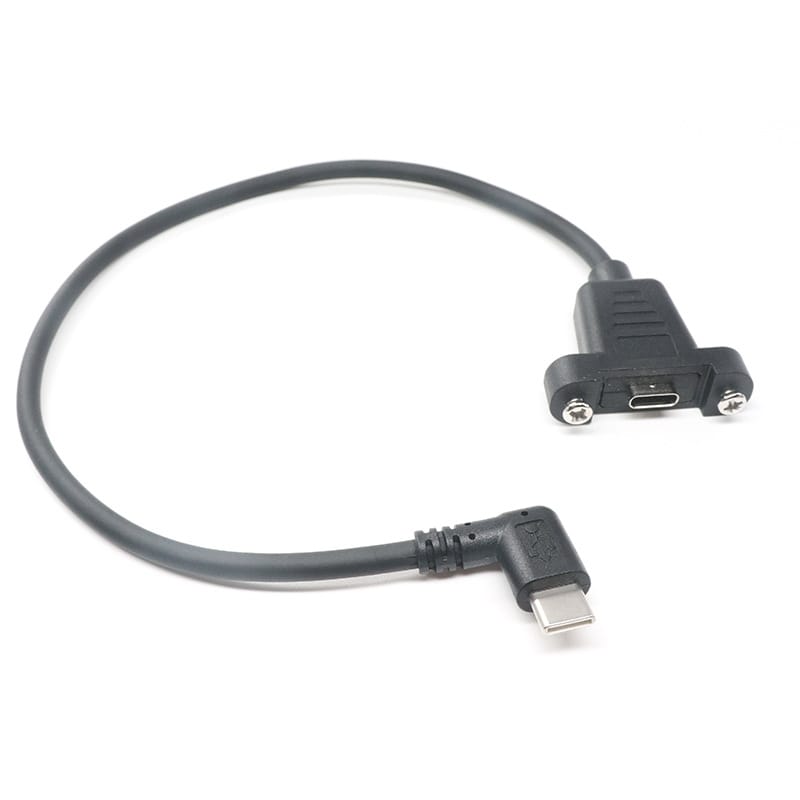
Right Angle Type C male USB Cable to Femal socket with screw-lock
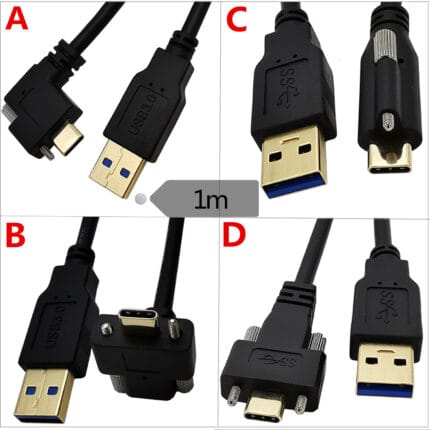
A right angle type c cable with a screw-lock panel socket turns an enclosure wall into a USB-C feedthrough. The 90-degree host plug saves depth; dual M2 thumbscrews hold the panel end.
Overview
A right angle type c cable solves two problems that industrial enclosures always have at the same time. The first is depth: a straight USB-C plug plus its bend radius needs room behind the device that a shallow cabinet does not have, so the 90-degree plug on the host end turns the cable sideways and saves the clearance. The second is retention: the panel end is a Type-C receptacle held to the enclosure wall by two M2 thumbscrews, so the port is part of the panel rather than a socket dangling inside it. The result is a feedthrough that a technician can plug into from outside without opening the box, and that stays put when the cabinet is moved, racked or shipped.
Key Specifications
| Connector A | USB Type-C male, right-angle 90 deg |
|---|---|
| Connector B | USB Type-C female panel-mount with dual M2 thumbscrews |
| Lock | Dual M2 thumbscrews on the panel-mount end |
| Orientation | Right-angle on the host end, straight on the panel end |
| Mounting | Front or rear panel mounting |
| Sealing | Optional gasket where an ingress rating is required |
| Strain Relief | Molded PVC |
| Jacket | Black PVC |
| Application | Cabinet and enclosure USB feedthrough, tight-clearance installs |
What the elbow actually saves you
The saving is not just the plug body. It is the plug body plus the bend radius the cable would otherwise need, and in a shallow enclosure those two together are usually more than the gap available. Forcing a straight plug into that gap does not work: the cable takes a hard bend right at the strain relief, the conductors work harden at that point, and the joint fails weeks or months later rather than immediately, which makes it harder to diagnose.
| Installation | Straight plug | 90-degree plug | Comment |
|---|---|---|---|
| Shallow cabinet behind a door | Forces a hard bend at the relief | Cable exits sideways and flat | The elbow is usually the only option that closes the door |
| Rack shelf with a rear rail | Protrudes past the rail | Runs along the rail | Check the exit direction against the rail position |
| Open bench or wide enclosure | Fine | Fine, with no advantage | Straight is cheaper and easier to stock |
| Moving axis or vehicle | Lever arm on the receptacle | Lower profile, less leverage | Combine with a screw-lock panel end for the best result |
The catch with an elbow is that it only exits one way. Specify the direction the cable must run in the installed position – up, down, left or right – because the plug is molded for that direction and cannot be reoriented afterwards.
M2 on the panel, and what to watch when you tighten it
M2 hardware is small, and small fasteners are easy to over-torque. Two M2 screws on a panel flange are there to stop the receptacle from moving relative to the panel, not to clamp it like a pipe fitting. Over-tightening distorts the flange, can crack a thin panel, and strips the thread in aluminum or plastic. Under-tightening lets the receptacle work against the panel under vibration, which frets the mounting face and eventually loosens the joint.
- Tighten by hand until the flange is seated, then a little more. A driver is not needed.
- Use washers on thin or soft panels so the load spreads.
- Check the panel thickness range against the screw length before ordering.
- On painted or anodized panels, mask the contact area if the shield is meant to continue into the enclosure.
Vibration: why the panel end matters more than the plug end
In a cabinet installation the plug that gets mated and unmated is the service connection; the one that never gets touched is the one inside. A Type-C friction fit inside a vibrating enclosure is the classic intermittent fault, because it fails slowly: the contacts fret, the resistance rises, and the link starts retraining or dropping before it stops working. Fixing the internal connection to a panel receptacle removes that class of fault entirely and turns the internal wiring into a fixed harness that is strain-relieved once, properly.
If the enclosure is washed down or mounted outdoors, add the gasket option. An ingress rating is quoted for the mated and correctly seated condition, so an open receptacle with no cap is not a sealed port.
Where a right angle type c cable gets specified
- Control cabinets and enclosures that need a USB-C service port on the outside
- Medical devices and carts where the port is used many times a day
- Communication racks and telecom shelves with no rear clearance
- Automotive and on-board systems where the harness runs along a panel
- Kiosks and self-service terminals with a user-facing service connection
- Robotics and moving equipment, alongside our Hybrid Robot Torsion Cable where the cable itself has to flex continuously
What to send with the inquiry
- Panel thickness at the mounting point, and what the panel is made of.
- Mounting direction – front or rear – and which side the gasket has to sit on.
- Exit direction of the right-angle plug in the installed position.
- Data and power requirement – USB 2.0, USB 3.x, and the charging current.
- Cable length from the panel to the host end.
- Whether a gasket or cap is needed for the environment.
- Quantity, and whether this is a prototype or a production order.
Workmanship and testing
ISO 9001 covers the system and IPC/WHMA-A-620 Class 3 covers the work on Right Angle Type C builds, across 32 to 12 AWG. No Right unit is packed until continuity and pinout check out, and seal checking is quoted whenever an ingress rating is on the drawing.
Material declarations against RoHS and REACH are issued per project, alongside the dimensional and electrical reports agreed at quotation; see certifications, compliance and material declarations. Where your drawing names a UL style or another approval, the build follows your drawing and ships with the supporting document rather than a claim of our own. The 90-degree exit is formed in the tool itself; the exit options and their clearances are set out under right-angle overmold tooling options. The wider context is covered under our build-to-print process. Tooling for this build is cut in our own tool room and belongs to your program, so a repeat run years later starts from the same tool.
Custom builds and ordering
Right Angle Type C lots run from 1 to 50 pcs, out in 3 working days; volume starts at MOQ 500 pcs shipping 14 working days after approval. Tooling not already held adds around 10 working days. Right orders go out under your part number and labeling, OEM or ODM, and material certificates with first-article reports are available.
Treat the numbers on this page as the industry-standard definitions for Right Angle Type C builds rather than measured data from our line. The values your build is made and verified to are the ones on your drawing, checked against the supplier datasheet before we quote.
Related locking USB-C and panel builds
- USB-C Screw Locking Cable, Side or Top 10Gbps
- Right-Angle USB Type-C Male to Male Screw-Lock
- Circular USB-C Screw Cable with M12-Style Metal Shell
- IP67 Waterproof USB-C Screw Cable, USB 3.2 Gen 2
- USB 3.1 Type-A Male to Type-C Female Screw-Lock Adapter
- IP67 RJ45 Screw-Lock Bulkhead Cable
Full ranges: screw-lock molded cable and custom wire harnesses.
Frequently Asked Questions
Which end is right-angle?
The host end carries the 90-degree plug as standard and the panel end is straight. If you need it the other way round, or elbows on both ends, say so and we will quote it.
Can it be mounted from inside the enclosure?
Yes. Front and rear mounting are both supported; tell us which so the flange and the gasket land on the correct faces.
Is the port sealed?
Not as standard. Add the gasket option where the enclosure is washed down or mounted outdoors, and keep a cap on an unused port.
What current can the panel receptacle carry?
That is set by the receptacle and the cable, and it is stated per your drawing. Tell us the charging current you need and we will build to it.
| Connector A | USB Type-C male, right-angle 90 deg |
|---|---|
| Connector B | USB Type-C female panel-mount with dual M2 thumbscrews |
| Lock | Dual M2 thumbscrews on the panel-mount end |
| Orientation | Right-angle on the host end, straight on the panel end |
| Strain Relief | Molded PVC |
| Jacket | Black PVC |
| Application | Cabinet and enclosure USB feedthrough, tight-clearance installs |
| Mounting | Front or rear panel mounting |
| Sealing | Optional gasket where an ingress rating is required |