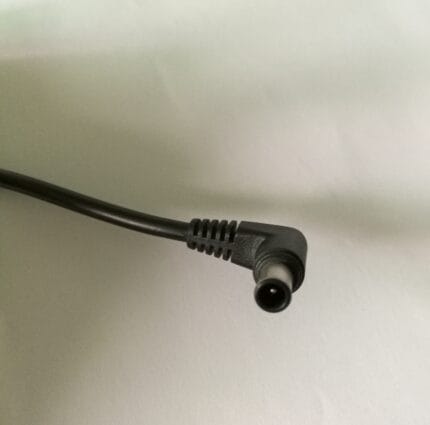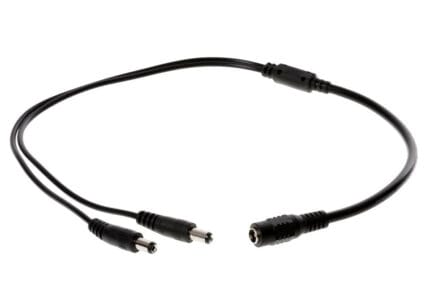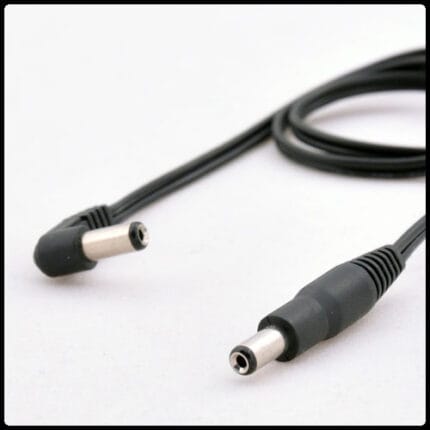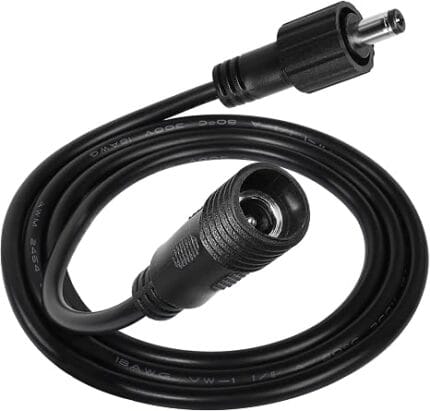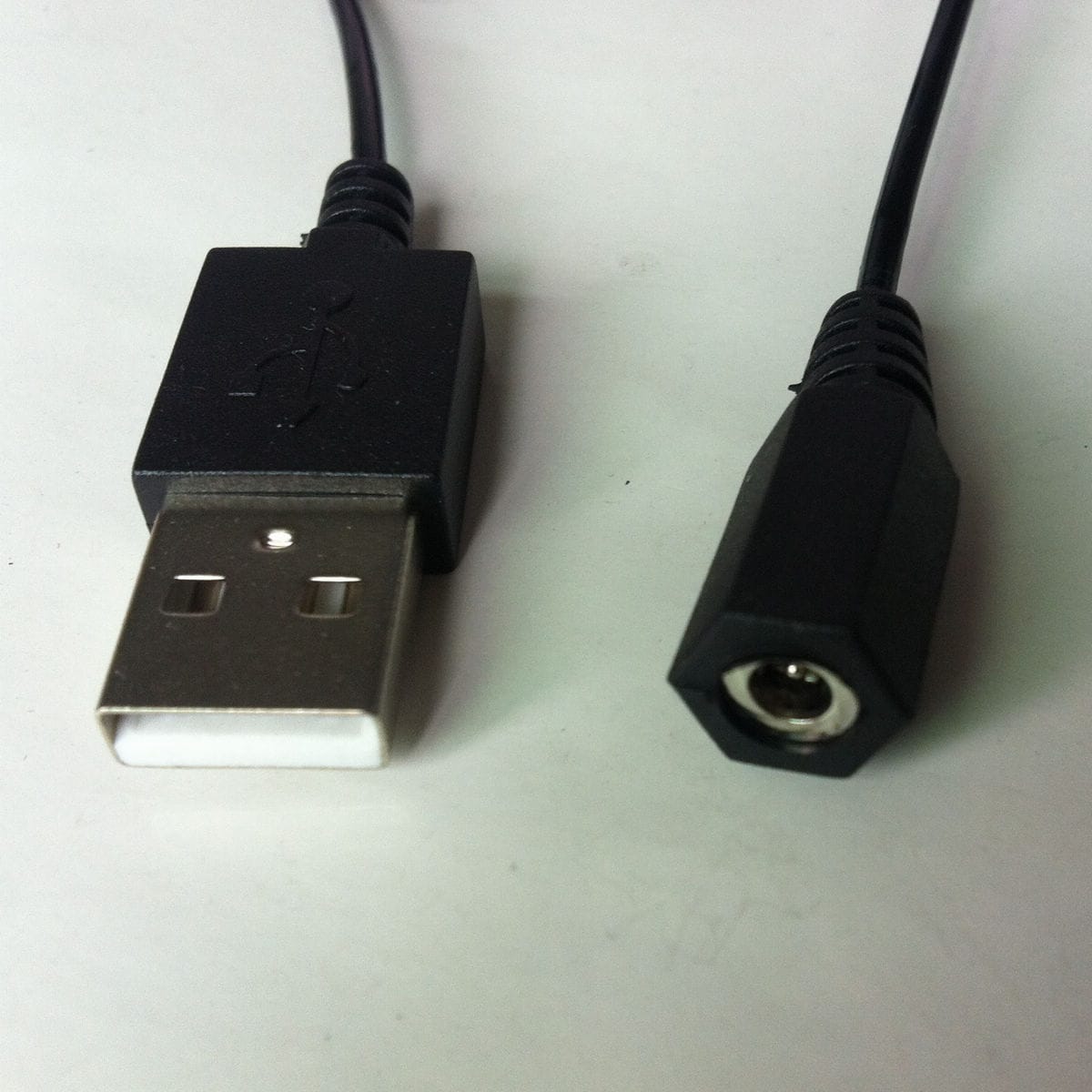
USB A to DC 5521 Female Adapter Cable
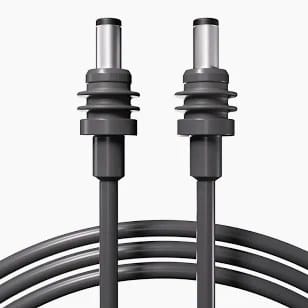
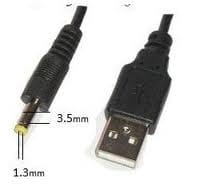
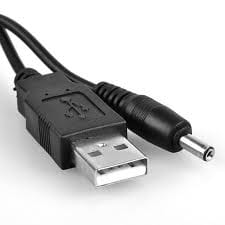
A 5521 adapter cable turns a USB Type-A port into a 5.5 x 2.1 mm DC barrel socket, so 5 V devices with a coaxial jack can run from a charger or power bank. Molded plugs, black PVC jacket.
Overview
A 5521 adapter cable is the short answer to a mismatch that shows up constantly on the bench: the device has a 5.5 x 2.1 mm coaxial power jack and the only source available is a USB port. One end is a USB Type-A plug, the other is a standard 5.5 x 2.1 mm female barrel socket, wired so VBUS and GND land on the barrel correctly with center positive polarity. There is no conversion electronics in the lead, so the voltage at the socket is whatever the host presents, nominally 5 V. The USB-A plug and the barrel socket are both molded with strain relief, and the jacket is black PVC.
Key Specifications
| Connector A | USB Type-A male |
|---|---|
| Connector B | DC 5.5 x 2.1 mm female socket |
| Jacket | Black PVC |
| Color | Black |
| Wiring | VBUS and GND from the USB-A plug to the barrel socket |
| Polarity | Center positive on the barrel socket |
| Output Voltage | 5 V nominal, as presented by the host port |
| Current | Limited by the host port or charger, stated per your drawing |
| Application | Power-tap for routers, LED controllers, fans |
How much current can the host port really give?
This is the question that decides whether the build works, and it is set by the source, not by the cable. The figures below are the industry-standard definitions for USB downstream-port and battery-charging current limits, quoted so you can budget; they are not a claim about any particular port. In practice a cheap charger or a laptop hub that is already loaded will deliver less than its label.
| Source | Standard current definition | What it means for your load |
|---|---|---|
| USB 2.0 downstream port | Up to 500 mA per the base specification | Fine for a sensor board or a small fan; not for a router with a radio |
| USB 3.x downstream port | Up to 900 mA per the base specification | Covers most single-board computers that are not driving peripherals |
| Dedicated charging port, BC 1.2 | Up to 1.5 A under the battery-charging specification | The realistic choice for routers, LED controllers and small displays |
| Power bank or wall charger | Whatever the label states, verified by measurement | Check the label and measure under load; derate if the unit gets hot |
Measure, do not assume. Put a USB load meter in line, run the device at full load for ten minutes, and read both the current and the voltage at the socket. If the voltage sags below what the device needs, the source is the constraint and a heavier cable will not help. For a load that needs a negotiated voltage above 5 V, use a trigger or PD lead instead – our USB-C PD Trigger Cable to DC 5.5×2.1mm covers that case.
Why 5 V at the source is often 4.7 V at the device
Two losses sit between the port and the jack. The first is the cable: thin conductors over a meter or two drop voltage in proportion to current, and the cheapest adapter leads use the thinnest wire the mold will accept. The second is the barrel contact itself, which adds resistance that climbs as the spring in the socket relaxes. The combination is why a device that works on a 30 cm lead fails on a 2 m one, and why the fix is copper rather than a bigger charger.
- Keep the run as short as the installation allows.
- State the current you measured and let us size the conductor for it.
- If the load is near the port limit, move up to a source with headroom instead of sitting at 100%.
Which barrel size does your device take?
The socket on this lead is 5.5 x 2.1 mm, which mates with the plug on the device power supply, not with the jack on the device. Get that backwards and you will order the wrong gender. If your device cable ends in a male plug, this female socket is correct. If it ends in a bare socket, you need a male plug version instead. The plug on most consumer gear is 5.5 x 2.1 mm, but 5.5 x 2.5 mm and 4.0 x 1.7 mm exist and are close enough in appearance to cause mistakes.
| Callout | Measures | Fit with this socket |
|---|---|---|
| 5.5 x 2.1 mm plug | 5.5 mm sleeve, 2.1 mm bore | Correct – the intended mate |
| 5.5 x 2.5 mm plug | 5.5 mm sleeve, 2.5 mm bore | Fits loosely on a 2.1 mm pin; not recommended |
| 4.0 x 1.7 mm plug | 4.0 mm sleeve, 1.7 mm bore | Will not mate |
| 3.5 x 1.35 mm plug | 3.5 mm sleeve, 1.35 mm bore | Will not mate |
If you are unsure, the DC Plug Adapter Set covers the common sizes and removes the guesswork on a one-off job.
Where a 5521 adapter cable is the right call
- Single-board computers and sensor boards with a barrel jack but only USB available
- Small desk fans, LED controllers and strip drivers running off a USB charger
- Routers and IoT gateways in a temporary or demo setup
- Field service kits where one power bank runs several 5 V devices
- Retrofit of a device whose original adapter has gone missing, paired with our USB A to DC 5521 Male Power Cable where the device end needs a plug rather than a socket
- Bench work, where a coiled version such as our USB A Coiled to DC 5521 Female Cable keeps the workspace clear
Workmanship and testing
USB A builds are made to IPC/WHMA-A-620 Class 3 workmanship inside an ISO 9001 system, over a 32 to 12 AWG range. continuity and pinout are verified on each USB assembly before packing, and seal checking is quoted whenever an ingress rating is on the drawing.
Material declarations against RoHS and REACH are issued per project, alongside the dimensional and electrical reports agreed at quotation; see certifications, compliance and material declarations. Where your drawing names a UL style or another approval, the build follows your drawing and ships with the supporting document rather than a claim of our own. Where this build needs an overmold, the tool is designed, cut and maintained in our own shop under overmold tooling cut in our own tool room, and it is never used for another customer’s program. The wider context is covered under our marine and outdoor work.
Custom builds and ordering
For USB A builds, prototypes run from 1 to 50 pcs with a 3 working day turnaround. Volume orders begin at 500 pcs and ship 14 working days after approval. Tooling not already held adds around 10 working days. OEM and ODM USB work ships under your part number and labeling, and material certificates with first-article reports are available.
Ratings shown here are the industry-standard description of what the USB A interface family is defined to do, not test results from a part of ours. Your assembly is built and verified to the values on your drawing, which we check against the supplier datasheet before quoting.
Related USB and DC power leads
- USB A to 3513 Barrel Power Cable
- USB A to 2-5mm Barrel Power Cable
- USB A to 3-5mm DC Female Cable
- USB-C PD Charging Cable 240 W PD 3.1 EPR
- Mini UPS Splitter Cable DC 5.5×2.1mm
- DC Barrel Adapter Kit – 5521 / 5525 / 4017 / 3513
Full ranges: DC plug power cable and signal and data cables.
Frequently Asked Questions
Does this cable change the voltage?
No. It is a passive lead. The socket presents the same voltage the USB source provides, nominally 5 V, minus the drop along the cable. For 9 V, 12 V or other negotiated voltages you need a PD source and a trigger cable.
Can it carry data as well as power?
This build routes VBUS and GND only. If you need data over the barrel connection, that is a different assembly and we would need to know the pinout you expect.
Will it run a 12 V device?
No. A standard USB-A port presents 5 V. A 12 V load needs a 12 V supply or a PD trigger that negotiates the higher voltage from a capable source.
Why does my device restart under load?
Almost always voltage drop or a source at its current limit. Measure at the barrel under load; if the voltage is collapsing, shorten the lead, increase conductor size, or move to a source with more headroom.
| Connector A | USB Type-A male |
|---|---|
| Connector B | DC 5.5 x 2.1 mm female socket |
| Jacket | Black PVC |
| Color | Black |
| Application | Power-tap for routers, LED controllers, fans |
| Wiring | VBUS and GND from the USB-A plug to the barrel socket |
| Polarity | Center positive on the barrel socket |
| Output Voltage | 5 V nominal, as presented by the host port |
| Current | Limited by the host port or charger, stated per your drawing |