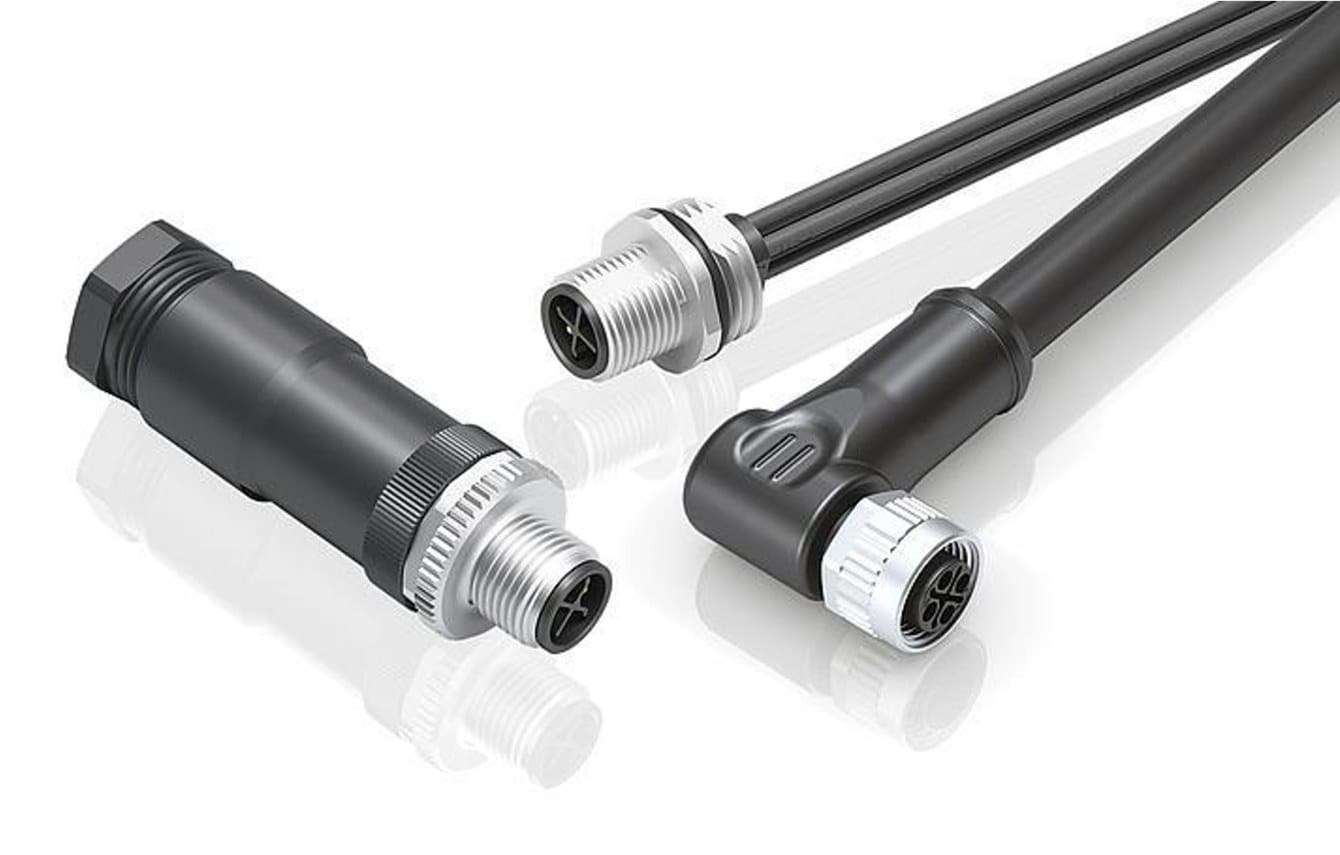
M12 P-Coded EtherCAT Cable, Power and Data in One Cordset
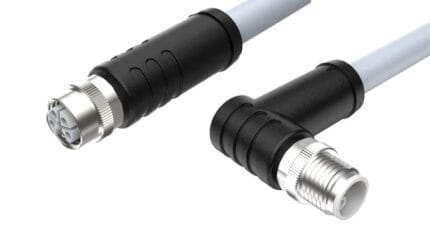
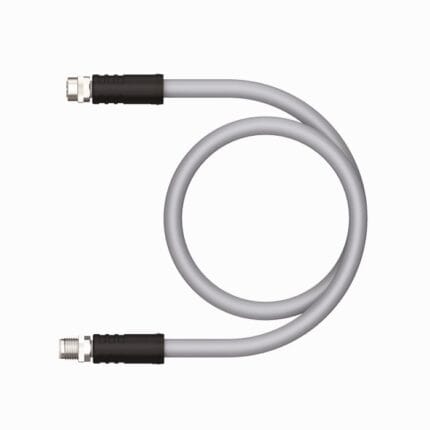
An M12 P-coded EtherCAT cable that carries 24 V supply and data in one connector, halving the ports and the sealing points on a distributed device. Supply contacts grouped away from the data pairs, braid bonded to the coupling nut at both ends.
Last updated: 13 September 2026
Overview
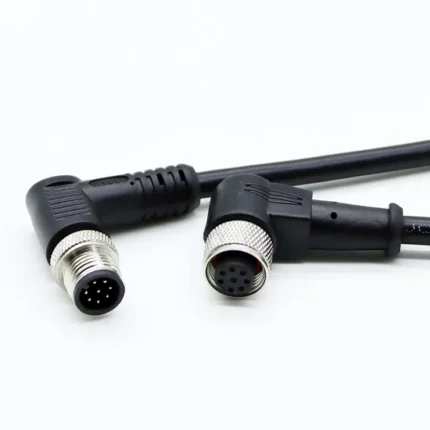
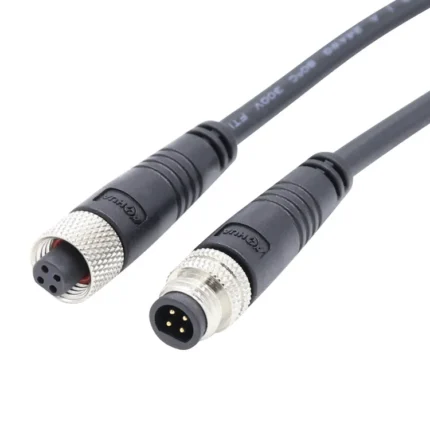
An M12 P-coded EtherCAT cable carries data and 24 V supply in one connector, which is the whole reason the coding exists. A distributed I/O block, a compact servo drive or a remote valve terminal normally needs two connections – one for the network and one for power. Running both through a single P-coded shell halves the port count on the device, halves the number of sealing points that can leak, and cuts wiring time on a machine build. We build it to the contact assignment on your device drawing.
Key Specifications
| Coding | P-code, single-cable power plus data |
|---|---|
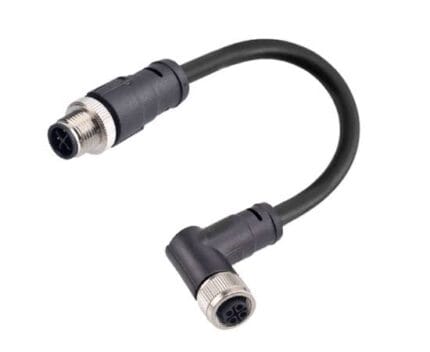
| Connector A | M12 P-coded with protective earth, straight or right-angle |
| Connector B | M12 P-coded, or open leads for a cabinet |
| Data conductors | Two shielded pairs, 100 Mbit/s class – confirm per build |
| Supply conductors | 24 V DC system feed – confirm per build |
| Jacket | PUR for oil and coolant, PVC for dry cabinets |
| Shielding | Braid bonded to the coupling nut at both ends |
| Ingress rating | IP67 when mated – confirm per build |
P-code versus the two codings it replaces
The decision is rarely “P or nothing” – it is “P, or a D-coded data cable plus a separate power feed”. The table below is how we frame it with customers.
| Coding | What it carries | When it is the right answer |
|---|---|---|
| D | Two data pairs only, 100 Mbit/s | Device drops where the supply comes from a separate cable |
| P | Data pairs plus 24 V DC supply in one shell | Distributed I/O, compact drives, valve terminals, single-cable machine designs |
| L / T | DC power only | Power feed where data runs on its own cable |
| Y | Hybrid power plus Fast Ethernet | Maker-specific hybrid installations where the device specifies it |
P-coded contact reference
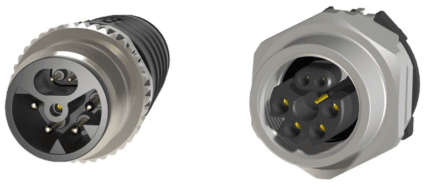
The assignment below is the arrangement we build to on a five-position P-coded shell. P-code contact assignment is fixed by the device maker’s implementation rather than by a single universal chart, so treat this as the template and confirm it against the port datasheet – we terminate to the pinout you send, not to a guess.
| Contact | Typical function | What we check before building |
|---|---|---|
| 1 | 24 V DC supply | Device current, run length, voltage drop |
| 2 | 0 V supply return | Return path sized to match the supply conductors |
| 3 | Data pair 1 | Differential pair, kept twisted to the contact |
| 4 | Data pair 2 | Differential pair, kept twisted to the contact |
| 5 | Protective earth | Extended first-make contact, bonded to the shell |
The design point that matters most is separation: the supply contacts are grouped away from the data pairs so switching noise from the load does not couple into the signal. That separation, plus continuous shielding, is what makes a single-cable installation stable.
How P-code sits in the M12 coding family
P-code is one of the power codings defined with the group, but unlike K, L, M, S and T it also carries data pairs. The full map below shows what every code is for and how many positions it normally uses.
| Code | Positions | Carries | Typical use |
|---|---|---|---|
| A | 3 / 4 / 5 / 8 / 12 | DC sensor supply and signals, IO-Link | Proximity switches, photoelectric sensors, valve plugs |
| B | 5 | PROFIBUS-DP fieldbus | Legacy drives, remote I/O racks, weigh scales |
| C | 3 to 6 | AC power, dual keyway, extended earth | AC sensors, solenoid coils, legacy actuator blocks |
| D | 4 | 100 Mbit/s Ethernet over two pairs | PROFINET, EtherNet/IP, EtherCAT device drops |
| K | 4 + PE | Three-phase AC power | Motor feeds, power distribution blocks |
| L | 4 + PE | DC power | IO-Link power, AGV and drive supplies |
| M | 5 + PE | Three-phase motor plus brake pair | Servo and geared motors with holding brake |
| P | 4 + PE | Data pairs plus 24 V DC supply | Single-cable EtherCAT and remote I/O blocks |
| S | 3 + PE | Single-phase AC power | Field I/O blocks, cabinet heaters, pumps, fans |
| T | 4 | DC power, two circuits | Low-voltage DC distribution |
| X | 8 | Up to 10 Gbit/s Ethernet over four pairs | Machine vision, M12 to RJ45 10G links |
| Y | 6 + PE / 8 | Hybrid power plus Fast Ethernet | Valve islands, hybrid power and data drops |
A, B, C and D are defined in IEC 61076-2-101, X in IEC 61076-2-109 and the power codings, including P, in IEC 61076-2-111. Y is a de-facto hybrid arrangement rather than an IEC-defined code. These are industry-standard descriptions of purpose; the data rate, current and voltage figures your assembly is built and verified to are the ones stated on your drawing.
Shielding is not optional here
Because power and data share a body, screen continuity is the thing that decides whether the link is stable. We bond the braid to the coupling nut at both ends so the shield path runs through the connector instead of being interrupted by it, and we keep the drain wire termination short. On a drive-heavy machine this is the difference between a link that runs for years and one that throws intermittent errors that never repeat on the bench.
The EtherCAT physical layer runs over standard Ethernet pairs, which is why the cable construction is ordinary and the assembly quality is not. Pairs are kept twisted to the contact, the braid is landed on the metal shell at both ends, and the drain is terminated short.
Build options
- P-code straight or right-angle on one or both ends
- P-code to P-code trunk leads, or P-code to open leads for a cabinet
- PUR jacket for oil and coolant, PVC for dry cabinets
- Braid bonded to the metal coupling nut at both ends
- Made-to-order length, with jacket printing on request
Typical applications for this M12 P-coded EtherCAT cable
- Distributed I/O blocks on conveyor and assembly lines
- Compact servo drives and machine-mounted inverters
- Remote valve terminals where one cable replaces two
- AGV and AMR platforms where every connector saved is weight and a leak path saved
- Retrofits that replace a D-code plus power pair with one cordset – see our M12 D-code PROFINET industrial Ethernet cable for the two-cable approach
- Hybrid alternatives using M12 Y-coded hybrid cable
Before you order
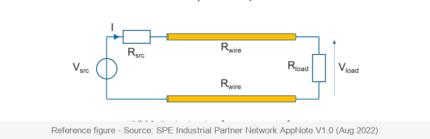
Tell us the total current the device draws, the length of the run, and whether the cable is fixed or moving. Voltage drop over a long thin run is the most common reason a single-cable installation misbehaves, and it is far cheaper to size the conductors correctly up front than to replace a machine full of cordsets later.
Workmanship and testing
ISO 9001 governs the line and IPC/WHMA-A-620 Class 3 governs the workmanship. Terminations cover 32 to 12 AWG. No unit is packed before continuity and pinout have been verified, and where an ingress rating is specified we can quote seal checking on the production batch.
Custom builds and ordering
From 5 pcs for a prototype, shipped in 3 working days, to 500 pcs and up for production at 14 working days after approval. Tooling we already hold costs no lead time; a new body adds roughly 10 working days. Private-label shipments carry your part number and labeling, and we can supply material certificates plus a first-article report.
Related single-cable and M12 assemblies
- M12 Y-coded hybrid cable for power and Fast Ethernet
- M12 Hybrid SPE cable for actuators and valve islands
- M12 K-coded power cable for three-phase motor feeds
- M12 L-code 16 A cable for DC power
- M12 X-code Cat6A to RJ45 industrial Ethernet cable
- M12 drag chain cable for continuous flexing
Full range: Circular M8 and M12 cable assemblies.
Frequently Asked Questions
Can P-code replace both my data and power cables?
That is the point of it, provided the device presents a P-coded port and the current draw fits the supply contacts. Give us the load and the run length and we will confirm.
Is P-code interchangeable with D-code?
No. The keyways differ deliberately so a data-only cable cannot be plugged into a single-cable port and silently leave a device unpowered.
What usually goes wrong on a single-cable install?
Voltage drop over an undersized supply pair, and a screen that is not bonded at both ends. Both are preventable at specification stage.
Do you build P-code to open leads?
Yes, for cabinet terminations. We can also supply the matching panel receptacle with flying leads.
| Connector A | M12 P-coded with protective earth, straight or right-angle |
|---|---|
| Connector B | M12 P-coded, or open leads for a cabinet |
| Coding | P-code, single-cable power plus data |
| Jacket | PUR for oil and coolant, PVC for dry cabinets |
| Shielding | Braid bonded to the coupling nut at both ends |
| Ingress rating | IP67 when mated – confirm per build |
| Data conductors | Two shielded pairs, 100 Mbit/s class – confirm per build |
| Supply conductors | 24 V DC system feed – confirm per build |