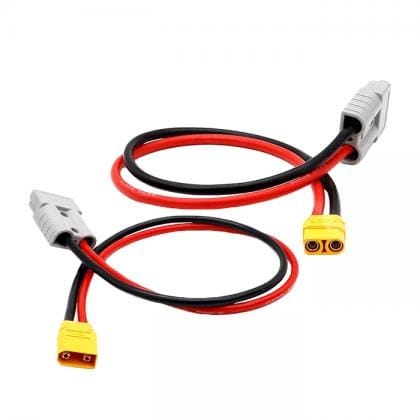
DC Plug XT60 Cable 5.5×2.1mm with Anderson SB50 Option, 14 AWG Silicone
A dc plug xt60 cable bridges a battery or power station on an XT60 or Anderson SB50 shell to equipment on a 5.5×2.1mm barrel. 14 AWG silicone, 150 to 300 mm, in either direction. The barrel limit is printed on the label rather than the battery-side figure.
Last updated: 13 September 2026
Overview
A dc plug xt60 cable joins two power worlds that were never designed to meet: the XT60 and Anderson shells used on battery packs and portable stations, and the 5.5×2.1mm barrel used on cameras, routers, monitors, LED drivers and portable gear. The assembly carries two very different current figures on its two ends, and the lower one governs the whole cable. We build it to the connectors you name and print the governing figure on the label.
Key Specifications
| Connector A | DC barrel plug 5.5×2.1mm, center positive, marked |
|---|---|
| Connector B | XT60 plug; Anderson SB50 version available |
| Conductor | 14 AWG red / black silicone |
| Length | 150 to 300 mm |
| SB50 side rating | 50 A quoted from public listings, pending verification |
| Barrel side rating | 5 A quoted from public listings, printed on the label |
| Polarity | Center positive on the barrel end |
| Applications | Powering 5.5×2.1mm gear from XT60 or Anderson sources, and back-feeding station inputs |
| Termination | Crimped contacts, pull-tested; solder option on request |
| Jacket | Silicone, stays flexible cold, tolerates heat near a converter |
Two ratings, one assembly
This is the part that catches people out. The battery end can pass far more current than the barrel end can, and the assembly is only as good as its weakest interface. Contact area at the barrel sets the ceiling there, not the conductor – putting 14 AWG behind a 5.5×2.1mm plug does not raise the plug limit by one amp.
| Interface | Where it sits | Retention | What sets the limit |
|---|---|---|---|
| XT60 | Battery pack, e-bike pack, power station | Friction fit with a positive housing latch | Contact area and the solder cup joint |
| Anderson SB50 | Larger stations, battery boxes, solar banks | Sprung latch on the shell, audible click | Contact rating and crimp quality at the terminal |
| DC barrel 5.5×2.1mm | Load side: camera, router, monitor, driver | Friction only, unless a threaded collar is specified | Contact area at the pin – governs the assembly |
The figures quoted for these shells come from public listings and are recorded as leads rather than as verified ratings. The current your assembly is built and verified to is the one stated on your drawing, and that is the number we print.
Latch versus friction
The two battery-side shells behave differently in service, and it is worth choosing on that basis rather than on habit. An XT60 housing holds on a close-tolerance friction fit with a latch you can feel, and it stays put in a bag or a vehicle. An SB50 shell carries a sprung latch that clicks and takes far more abuse; it is the one to specify where the connection gets knocked, or where the mating half lives on a piece of equipment that gets moved daily. A plain barrel has neither, which is why a barrel on a vibrating installation is usually the wrong answer – use our threaded locking DC pigtail there instead.
What actually limits a high-current terminal
On the battery side the terminal does not fail because the conductor was too thin. It fails at the joint between conductor and contact. Three things decide whether that joint holds up:
- Crimp geometry. The crimp has to compress the strands into a solid mass without cutting any of them. Too loose and you get a high-resistance joint that heats; too tight and you shear strands and reduce the cross-section.
- Full strand capture. Every strand has to be inside the barrel. A few strands left outside carry no current and, worse, work loose over time.
- Stranding and flex. Silicone-jacketed fine strand stays flexible at the exit; stiff conductor puts the bending stress straight into the crimp.
Every terminal on these builds is pull-tested, and crimp height is checked on a cut section at setup and at intervals through the run. Where a build is going into a product that will be handled daily, we can add a pull-test report on the production batch.
Temperature rise: what to measure, and when
Terminal temperature is the honest test of a high-current assembly, and it is not a number we invent. The practical method is simple: run the assembly at the current stated on your drawing until the temperature stops climbing, then measure at the contact and 25 mm back along the conductor. A joint that runs noticeably hotter than the cable feeding it has a problem, whatever its rating claims. We can run that check on samples and report the measured values against the limits in your specification; the pass figure is stated per your drawing, not assumed from a listing.
Which direction you are powering
Feeding a barrel-input device from a battery is the common case and is straightforward. Feeding a station input from a barrel supply also works, but station inputs have a voltage window and sometimes a current limit, and a source outside that window is either rejected or charges slowly. In both directions the barrel is center positive and is marked on the overmold – check the marking against the symbol on the device before connecting, because reverse polarity at a station input is a service call, not a reset.
Where the load is on a DC connector size that is close but not identical, measure the socket pin with a caliper rather than trusting the outer shell. A 2.1 mm pin in a 2.5 mm socket feels fine and fails intermittently.
Typical applications for this dc plug xt60 cable
- Running 5.5×2.1mm cameras, routers and monitors from an XT60 battery pack
- Field kits where one battery has to feed mixed barrel-input equipment
- Power stations and battery boxes feeding a DC barrel pigtail distribution point
- Back-feeding a station input from a regulated barrel supply inside its stated window
- Test benches where the source is a bench pack and the load is barrel-input gear
How to specify your build
- Battery-side shell – XT60 or SB50, and male or female.
- Barrel size and polarity – measure the socket pin; center positive is standard, center negative is a different build.
- Direction of power flow, and the voltage window of the destination.
- Current the assembly has to carry, stated per your drawing.
- Length – short by preference; this is an adapter, not a run.
- Label text, including the figure you want printed as the limit.
- Quantity, prototype or production.
Workmanship and testing
Every build is assembled and inspected to IPC/WHMA-A-620 Class 3 workmanship under our ISO 9001 system. We terminate conductors from 32 to 12 AWG. Each unit is checked for continuity and pinout before packing, and where the build carries an ingress rating we can add seal checking on the production run.
Custom builds and ordering
Prototypes are quoted from 5 pcs and ship within 3 working days. Volume production starts at 500 pcs with a 14 working day lead time after approval, and about 10 working days more when a new tool is needed. Private labeling carries your part number, and material certificates with first-article reports are available on request.
Related DC assemblies
- 14 AWG DC Barrel Pigtail Cable to Bare Wire or Ring Terminals
- Solar MC4 Adapter Cable to XT60, Anderson and DC7909
- IP67 Waterproof DC Extension Cable 5.5×2.1mm
- IP65 Waterproof DC 5521 Extension Cable
- IP67 DC to USB-C Cable, 5.5×2.1mm Barrel Power Lead
- Threaded Locking DC Pigtail 5.5×2.1mm, Shielded Right-Angle
Full range: DC plug power cable assemblies.
Frequently Asked Questions
Which rating applies to the cable?
The lower one. The barrel end sets the ceiling for the assembly, which is why that figure is printed on the label rather than the battery-side shell figure.
XT60 or SB50 – which should I pick?
Match the shell already on your battery or station. Where you are specifying both halves, pick SB50 for kit that gets knocked about and XT60 where the connection lives in a bag.
Can I have a longer lead?
Not usefully. This is an adapter, and extra length here is voltage lost and slack to stow. Use a proper extension on the side that needs the distance.
Do you stock the connectors or do I supply them?
We source them, and can build with customer-supplied shells if your product already uses a specific brand. Either way the crimp setup is qualified before the run starts.
Is the barrel center positive?
Yes as standard, and it is marked on the overmold. Center negative is a separate build – say so on the order.
| Connector A | DC barrel plug 5.5×2.1mm, center positive, marked |
|---|---|
| Connector B | XT60 plug; Anderson SB50 version available |
| Conductor | 14 AWG red / black silicone |
| Length | 150 to 300 mm |
| SB50 side rating | 50 A class |
| Barrel side rating | 5 A, printed on the label |
| Polarity | Center positive on the barrel end |
| Applications | Powering 5.5×2.1mm gear from XT60 or Anderson sources, and back-feeding station inputs |
| Termination | Crimped contacts, pull-tested; solder option on request |
| Jacket | Silicone, stays flexible cold, tolerates heat near a converter |
Related products
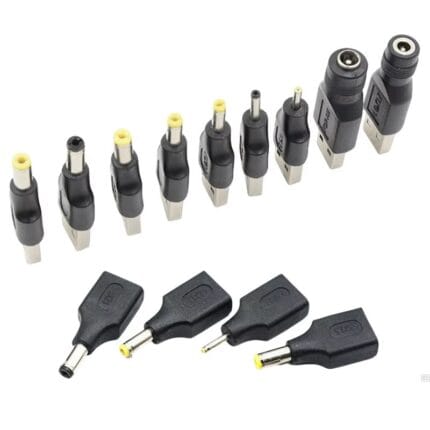
DC Barrel Adapter Kit – 5521 / 5525 / 4017 / 3513 / 1.35mm / 2.5mm, 6-Piece
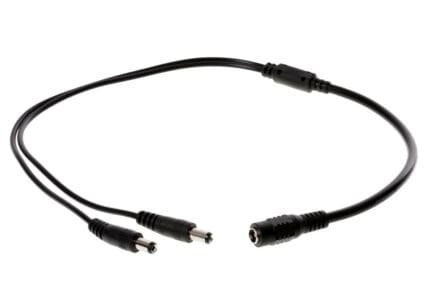
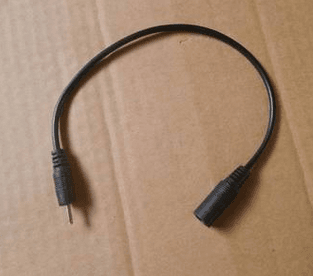
A dc barrel adapter kit covering 5.5x2.1, 5.5x2.5, 4.0x1.7, 3.5x1.35 and 2.5 mm in six molded female-to-male adapters, so one supply covers a mixed estate. Center positive throughout, with nickel-plated brass contacts. Measure the socket pin with a caliper before ordering: the outer shell is identical across three of these five sizes. Bagged with a size card, or boxed with a printed insert.