DC 5521 Daisy Chain Cable 1 Female 5 Way
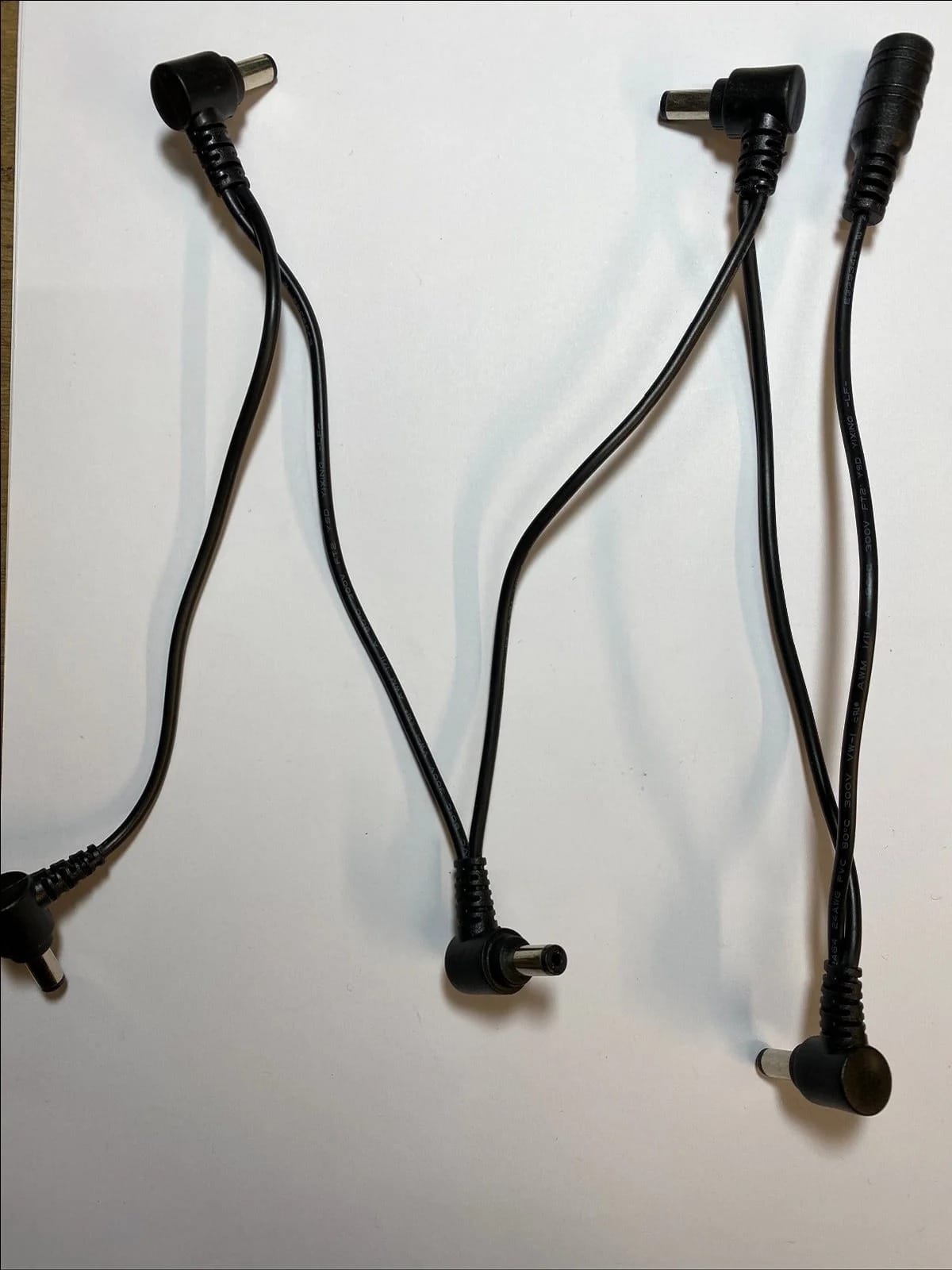
A dc 5521 daisy chain cable splits one 5.5 x 2.1 mm female feed into five right-angle male leads for CCTV rows, LED strings and 12 V distribution. Leg length, polarity and conductor size are built to your drawing.
Overview
A dc 5521 daisy chain cable takes one 5.5 x 2.1 mm DC feed and spreads it over five right-angle male plugs, so one supply serves a camera row, a run of LED fixtures or a low-voltage DC bus instead of five separate adapters. The input is a female barrel socket; the output is five legs, each ending in an L-shaped plug that lies parallel to the mounting surface. That geometry is the reason the part exists: in a shallow enclosure a straight plug plus its bend radius needs clearance the box does not have, and the cable ends up kinked against the wall where it will eventually work harden and fail. Leg length, conductor size, jacket color and polarity are set from your drawing.
Key Specifications
| Connector A | DC 5.5 x 2.1 mm female socket (1x) |
|---|---|
| Connector B | DC 5.5 x 2.1 mm male plug (5x, right-angle) |
| Splitter Type | 1 female to 5 male (5 way daisy chain) |
| Cable Length | Custom |
| Jacket | Black PVC |
| Polarity | Center positive (standard) |
| Conductor | Stranded copper, size stated per your drawing |
| Junction | Molded PVC splitter body with strain-relief boots |
| Voltage | Low-voltage DC bus, per your drawing |
| Application | CCTV chain, multi-LED string, low-voltage DC bus |
Is this really a daisy chain or a star splitter?
The trade name is misleading and it is worth settling before you order. In this build all five legs are wired in parallel across the single input, not looped one into the next. That distinction matters: one load failing does not interrupt the other four, and the current in the input leg is the sum of all five outputs, which is what sizes the feed conductor. If you want the loads protected independently, ask for the fused version instead.
Which barrel size are you actually mating to?
Every leg on this assembly is 5.5 x 2.1 mm, the most common coaxial power size in security and LED work, but not the only one. The callout is outer diameter by inner diameter of the plug bore, and the families below are close enough that a plug will sometimes go in far enough to look seated without making reliable contact.
| Callout | Outer / inner diameter | Where you meet it | Mating note |
|---|---|---|---|
| 5.5 x 2.1 mm | 5.5 mm sleeve, 2.1 mm center pin | CCTV cameras, LED strips, routers, NVRs | The reference size for this build |
| 5.5 x 2.5 mm | 5.5 mm sleeve, 2.5 mm center pin | Some laptop adapters and older consumer gear | A 2.5 mm bore accepts a 2.1 mm pin but the fit is loose; measure before you assume |
| 4.0 x 1.7 mm | 4.0 mm sleeve, 1.7 mm pin | Compact consumer electronics, some mini PCs | Will not mate with 5.5 mm hardware |
| 3.5 x 1.35 mm | 3.5 mm sleeve, 1.35 mm pin | Small handheld devices and USB hubs | Will not mate with 5.5 mm hardware |
Calipers settle it in ten seconds: sleeve 5.5 mm and pin 2.1 mm means this is the right family. If either number differs, take the DC Barrel Adapter Kit or specify what you measured. The coaxial power connector family has no single governing standard, which is why the physical check beats a part number search.
Build the current budget before you order
A five-way splitter fails in a predictable way: the input leg and the junction carry the sum of all five loads, and nobody sized them for it. The voltage at the far leg sags below what the camera needs. Add up the nameplate draw of every device first, then leave headroom on top.
| Check | Why it decides the build | What we need from you |
|---|---|---|
| Total draw of all five loads | Sets the input conductor and the contact rating at the junction | Nameplate current of each device, or a measured figure |
| Longest leg length | Voltage drop is proportional to length; the far leg governs | Hub-to-plug distance for the longest run |
| Conductor cross-section | The only real cure for drop is more copper, not a bigger supply | Stated per your drawing, or tell us the drop you can tolerate |
| Supply headroom | A supply run at 100% of rating has no margin for inrush or summer heat | Supply rating, or let us size it with you |
| Polarity of each load | One reversed device on a shared bus is a short across the supply | Center positive unless you tell us otherwise |
If a device in your list uses inverted polarity, do not solve it by forcing the plug. Put it on its own leg built with reverse polarity, or feed it from a separate supply – we build those assemblies for exactly that case.
Why right-angle heads on all five legs
A right-angle plug removes the plug body and the cable bend radius from the depth budget behind a device. For a camera on a soffit or a driver in a channel, that is the difference between a door that closes and one that does not. It also changes how the joint takes strain: with the cable leaving sideways, a pull loads the plug body in shear against the panel instead of levering it out of the jack. The trade-off is orientation: an L-shaped plug only exits one way, so tell us which way the cable should leave in the installed position and we will set the mold to match.
Where a dc 5521 daisy chain cable earns its keep
- Camera rows along a loading bay or a shopfront where one supply feeds four or five heads
- Under-cabinet and cove LED runs where the drivers sit in a shared channel
- Test benches and burn-in racks where several low-power units share a bench supply
- Retrofit jobs where mains outlets do not exist at each device position, paired with our Mini UPS Splitter Cable
- Any job that would otherwise need a multi-output distribution box
What to send with the inquiry
- Number of legs and their length – measured from the junction body to the plug tip.
- Total current you expect to draw, and the current of the heaviest single load.
- Conductor size, or the voltage drop you can accept at the far leg.
- Exit direction of each right-angle plug in the installed position.
- Polarity – center positive unless specified, and flag any reversed load.
- Quantity, and whether this is a prototype or a production order.
Workmanship and testing
DC 5521 Daisy Chain builds are assembled and inspected to IPC/WHMA-A-620 Class 3 criteria, with ISO 9001 as the quality system over 32 to 12 AWG work. continuity and pinout are verified on each DC assembly before packing, and seal checking is quoted whenever an ingress rating is on the drawing.
RoHS and REACH declarations are provided per project together with the agreed test reports; the documentation scope is listed under certifications and compliance. If your drawing specifies a UL style, we build to that drawing and supply the UL reference with the shipment instead of substituting an equivalent. Overmold material is selected for how it bonds to the jacket, following the method set out under overmold materials and injection parameters. The wider context is covered under our marine and outdoor work. Any tooling we cut for this part stays yours, maintained in our own tool room under your part reference.
Custom builds and ordering
DC 5521 Daisy Chain prototype builds start from 1 to 50 pcs and are out in 3 working days. Production is quoted from 500 pcs at 14 working days after sample approval. Your part number and labeling go on OEM and ODM DC shipments, and material certificates and first-article reports come with them on request. We hold 100 sets of mold tooling in house, so a standard body needs no tooling time and a new one adds about 10 working days.
Related DC power hardware
- DC 5521 Power Splitter 1 Female 2 Way
- COB LED Power Injection Cable DC 5.5×2.1mm
- 14 AWG DC Barrel Pigtail Cable 5.5×2.1mm to Bare Wire
- IP67 Waterproof DC Extension Cable 5.5×2.1mm
- Fused 12V Distribution Harness
- Threaded Locking DC Pigtail 5.5×2.1mm
Full ranges: DC plug power cable and custom wire harnesses.
Frequently Asked Questions
Can each leg be a different length?
Yes, and it is common. Give us each leg length measured from the junction body and we cut them individually rather than shipping five equal legs that have to be coiled up.
What happens if one load shorts?
On an unfused splitter the whole bus goes down and the supply goes into protection. If that risk is real in your installation, order the fused version so a faulted leg drops itself instead of the row.
Will this plug fit a 5.5 x 2.5 mm jack?
A 2.1 mm pin will enter a 2.5 mm bore, but the contact is loose and it will heat under load. Size the plug to the jack, or add an adapter, rather than relying on the slop.
Can you put a switch or an LED on the junction body?
Yes. The junction is a molded body we tool ourselves, so a power indicator or a rocker switch can be incorporated. That adds tooling time on a first build.
| Connector A | DC 5.5 x 2.1 mm female socket (1x) |
|---|---|
| Connector B | DC 5.5 x 2.1 mm male plug (5x, right-angle) |
| Splitter Type | 1 female to 5 male (5 way daisy chain) |
| Cable Length | Custom |
| Jacket | Black PVC |
| Polarity | Center positive (standard) |
| Application | CCTV chain, multi-LED string, low-voltage DC bus |
| Conductor | Stranded copper, size stated per your drawing |
| Junction | Molded PVC splitter body with strain-relief boots |
| Voltage | Low-voltage DC bus, per your drawing |