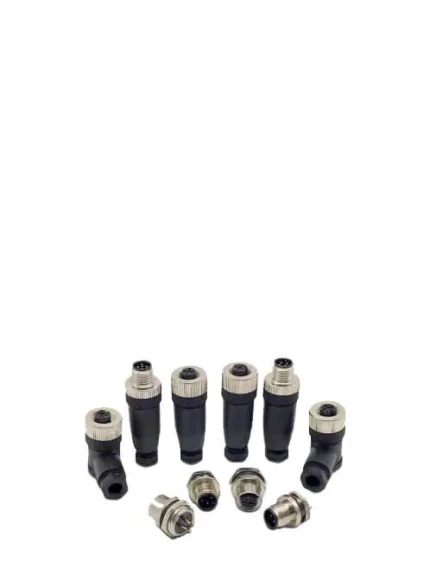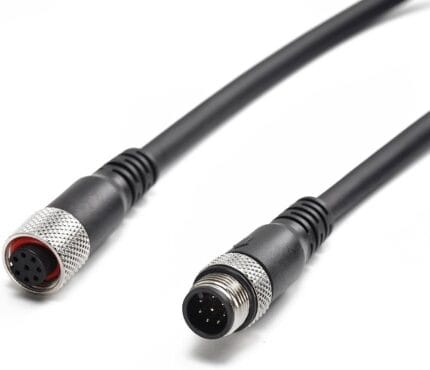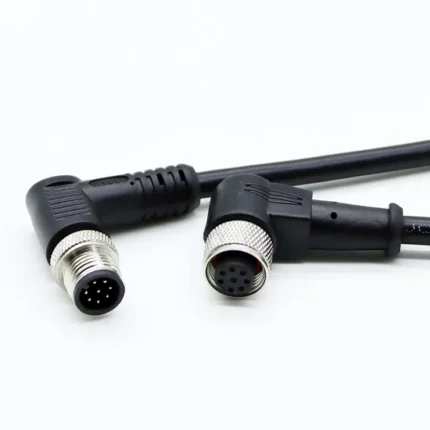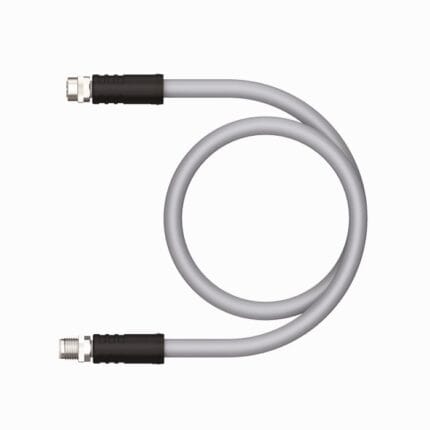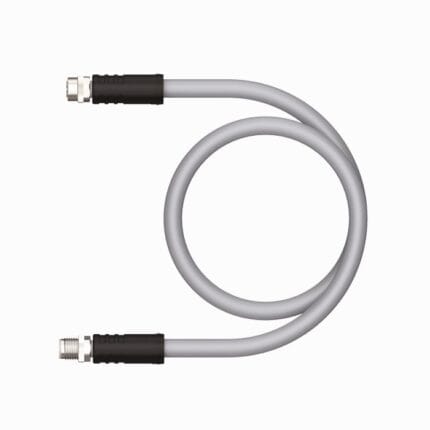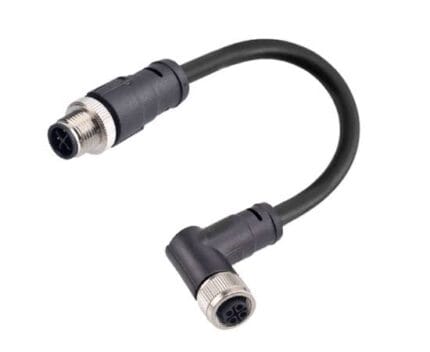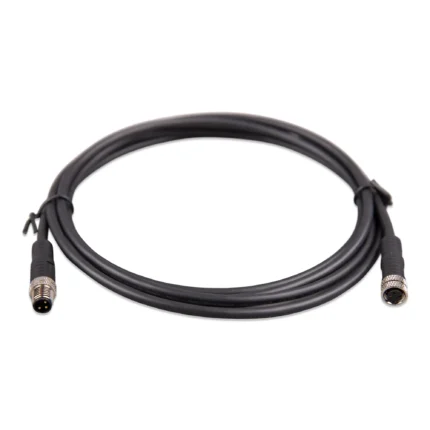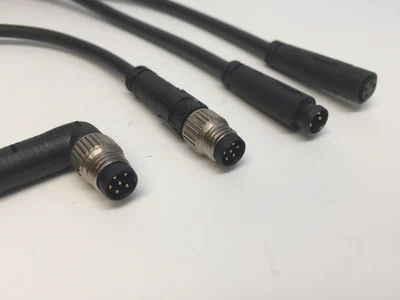
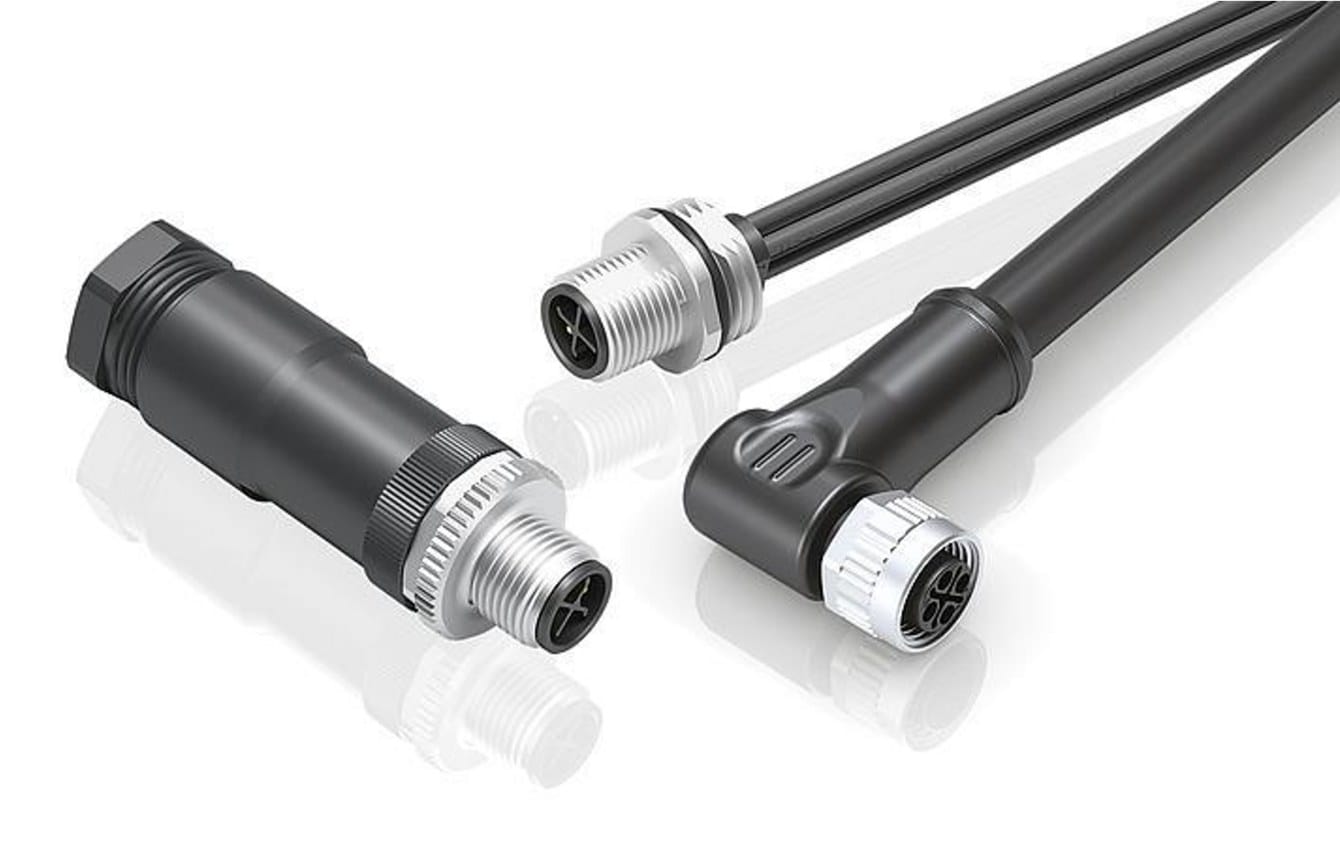
M12 C-Coded AC Cable, Dual Keyway for AC Sensors and Actuators
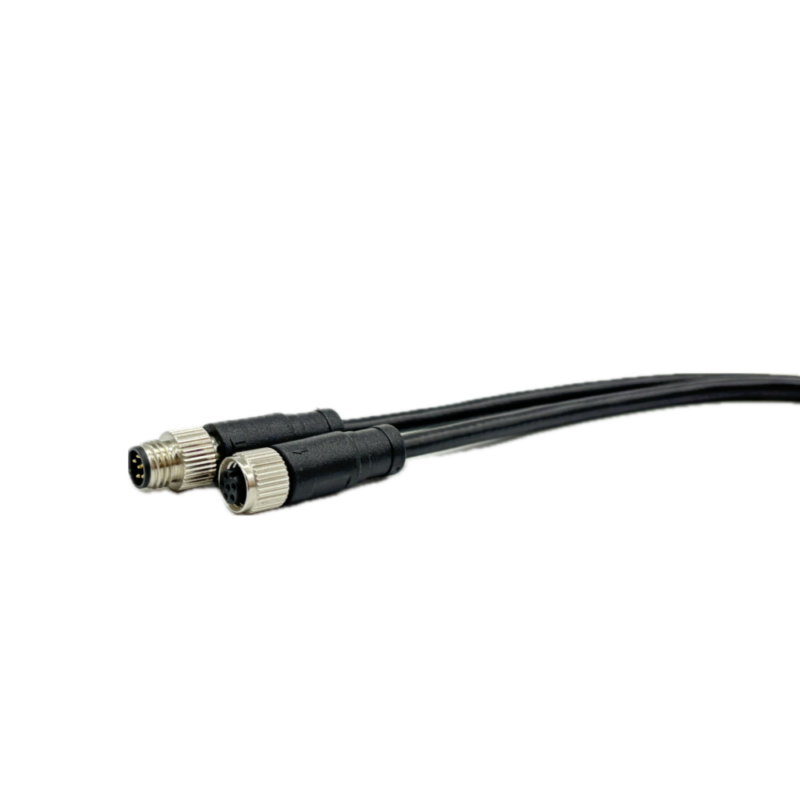
An M12 C-coded AC cable for the mains-voltage branch of a machine: dual keyway that refuses an A-coded plug, and an extended protective earth contact that makes first and breaks last. 3 to 6 poles, mains-rated jacket, made to your length.
Last updated: 13 September 2026
Overview
An M12 C-coded AC cable is the mains-voltage branch of the M12 family: a dual keyway that will not accept an A-coded sensor plug, and an extended protective earth contact that makes first and breaks last. It exists for the slice of the installed base that runs on mains rather than 24 V – AC solenoid coils, AC proximity switches left over from older panels, small single-phase fan and pump motors, and legacy actuator blocks. We build it to the pole count, phase arrangement and length on your drawing.
Key Specifications
| Coding | C-code, AC power, dual keyway |
|---|---|
| Poles | 3, 4, 5 or 6 positions |
| Earth contact | Extended protective earth, first-make / last-break |
| Connector A | M12 C-coded, straight or right-angle |
| Connector B | M12 C-coded, or open leads for a terminal box |
| Jacket | Mains-rated PUR or PVC, voltage marked on the cable |
| Conductors | Sized to the load current and run length |
| Ingress rating | IP67 when mated – confirm per build |
What separates C-code from the A-code everyone knows
Most M12 wiring on a machine is 24 V DC, which is why A-code is the default and why the mistake is easy to make. Two features separate the two: the dual keyway, which physically refuses an A-coded plug, and the extended earth contact, which is longer than the phase contacts so it mates first and separates last. Contact spacing and the insulating body are dimensioned for mains working rather than for a signal. Reaching for an A-coded cordset in this position is exactly the error the coding system was invented to prevent.
The extended contact is the protective earth, and on a mains connector it is the contact that should never be the last one made.
If you mate the wrong one
The physical keyway is the first line of defense, but maintenance Departments are inventive. Forcing a signal cordset into a mains receptacle, or wiring a mains circuit onto a signal insert, puts mains across contacts and insulation specified for a sensor circuit. The result is not an intermittent fault – it is a failed insert, a damaged device, and in the worst case a safety incident. Where a panel carries both 24 V and mains, do not standardize on one coding across every outlet. Keep the mains outlets C-coded or S-coded and the signal outlets A-coded, and label them.
C-code contact reference
Position numbering below is the arrangement most makers follow for mains M12. The earth position is the one to check on your device drawing: it is always the first-make contact, but its number is not the same on every manufacturer’s datasheet.
| Position | 3-pole | 4-pole | 5-pole | 6-pole |
|---|---|---|---|---|
| 1 | L | L1 | L1 | L1 |
| 2 | N | L2 | L2 | L2 |
| 3 | PE (first-make) | L3 | L3 | L3 |
| 4 | – | PE (first-make) | N | N |
| 5 | – | – | PE (first-make) | PE (first-make) |
| 6 | – | – | – | Auxiliary or spare |
Where C-code sits in the M12 coding family
C-code is the older AC answer and S-code is the newer one, and knowing which situation you are in saves a lot of rework. The map below covers every coding in the family, including the power codes that have largely taken over on new builds.
| Code | Positions | Carries | Typical use |
|---|---|---|---|
| A | 3 / 4 / 5 / 8 / 12 | DC sensor supply and signals, IO-Link | Proximity switches, photoelectric sensors, valve plugs |
| B | 5 | PROFIBUS-DP fieldbus | Legacy drives, remote I/O racks, weigh scales |
| C | 3 to 6 | AC power, dual keyway, extended earth | AC sensors, solenoid coils, legacy actuator blocks |
| D | 4 | 100 Mbit/s Ethernet over two pairs | PROFINET, EtherNet/IP, EtherCAT device drops |
| K | 4 + PE | Three-phase AC power | Motor feeds, power distribution blocks |
| L | 4 + PE | DC power | IO-Link power, AGV and drive supplies |
| M | 5 + PE | Three-phase motor plus brake pair | Servo and geared motors with holding brake |
| P | 4 + PE | Data pairs plus 24 V DC supply | Single-cable EtherCAT and remote I/O blocks |
| S | 3 + PE | Single-phase AC power | Field I/O blocks, cabinet heaters, pumps, fans |
| T | 4 | DC power, two circuits | Low-voltage DC distribution |
| X | 8 | Up to 10 Gbit/s Ethernet over four pairs | Machine vision, M12 to RJ45 10G links |
| Y | 6 + PE / 8 | Hybrid power plus Fast Ethernet | Valve islands, hybrid power and data drops |
The signal codings A, B, C and D are defined in IEC 61076-2-101, X in IEC 61076-2-109, and the power codings K, L, M, S and T in IEC 61076-2-111. Y is a de-facto hybrid arrangement rather than an IEC-defined code. These are industry-standard descriptions of purpose; the voltage, current and creepage values your assembly is built and verified to are the ones stated on your drawing.
Maintaining an existing machine versus building a new one
On maintenance work the answer is nearly always “replace like with like”: read the code off the old connector, count the poles, and send a photo of the connector face if there is no part number. On a new build the industry has moved these circuits onto S-code, which covers AC power with a modern contact layout. If you are designing a new panel, look at our M12 S-coded power cable before you commit to C-code, and if the load is three-phase, at our M12 K-coded power cable.
Build options
- Straight or right-angle overmolded heads, male or female
- Mains-rated PUR or PVC jacket, with the voltage marking printed on the cable
- C-code to C-code, or C-code to open leads for a terminal box
- Color-coded cores with the earth clearly identified
- Made-to-order length, with or without jacket printing
Typical applications for this M12 C-coded AC cable
- AC proximity switches and AC solenoid coils on legacy panels
- Small single-phase fan and pump motors
- Legacy actuator blocks and valve terminals wired for mains
- Replacement cordsets on machines where the original part is no longer listed
- Mains feeds on older packaging and converting equipment
What we need from you
- Number of poles and the phase arrangement
- Working voltage and load current
- Length, and whether the run is fixed or moving
- Jacket preference and any oil, UV or coolant exposure
- A photo of the existing connector face if you are replacing a part
Workmanship and testing
The line works to IPC/WHMA-A-620 Class 3 under ISO 9001, terminating 32 to 12 AWG. Every unit gets a continuity and pinout test before it is packed. Seal checking on the production batch is available when an ingress rating is in the specification.
Custom builds and ordering
Prototype quantity starts at 5 pcs with a 3 working day turnaround, and production starts at MOQ 500 pcs shipping 14 working days after approval. Where a new tool is needed, allow about 10 working days. We ship OEM and ODM builds under your part number and labeling, and can provide material certificates and first-article reports.
Related M12 power and signal assemblies
- M12 S-coded power cable for single-phase AC loads
- M12 K-coded power cable for three-phase motor feeds
- M12 L-code 16 A cable for IO-Link power
- M12 power T-code or L-code DC power cable
- M12 8-pin A-coded IP67 waterproof extension cable
- M12 3-pin A-coded sensor / actuator extension cable
Full range: Circular M8 and M12 cable assemblies.
Frequently Asked Questions
How do I tell C-code from A-code on an unmarked connector?
Look at the keyway on the insert face. C-code uses a dual keyway and the earth contact sits proud of the others. A photo of the connector face is usually enough for us to identify it.
Can I use a C-coded cable on a 24 V circuit?
You can, but there is no reason to, and it invites the reverse mistake later. Keep the signal circuits on A-code.
Should a new design use C-code or S-code?
S-code, in most cases. C-code is the right answer for maintaining existing machines and the wrong answer for a new panel.
Do you mark the voltage on the jacket?
Yes, where the build is for mains working we print the rating on the cable so the next person servicing the machine can see what they are handling.
| Connector A | M12 C-coded, straight or right-angle |
|---|---|
| Connector B | M12 C-coded, or open leads for a terminal box |
| Coding | C-code, AC power, dual keyway |
| Jacket | Mains-rated PUR or PVC, voltage marked on the cable |
| Ingress rating | IP67 when mated – confirm per build |
| Poles | 3, 4, 5 or 6 positions |
| Earth contact | Extended protective earth, first-make / last-break |
| Conductors | Sized to the load current and run length |