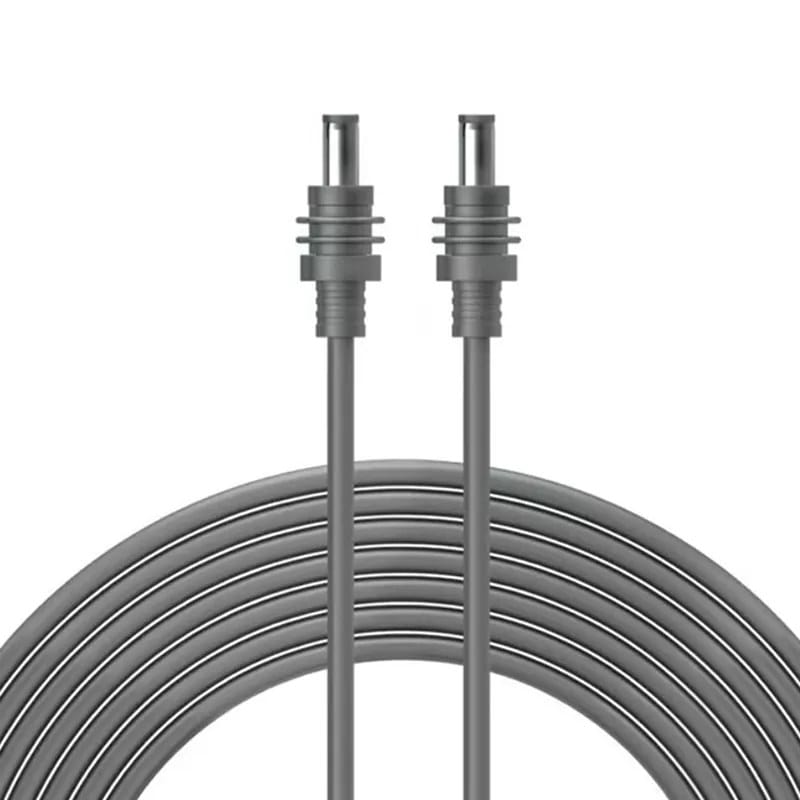
12V/24V Cigarette Lighter Power Cable with Waterproof 5.5×2.1mm DC Plug
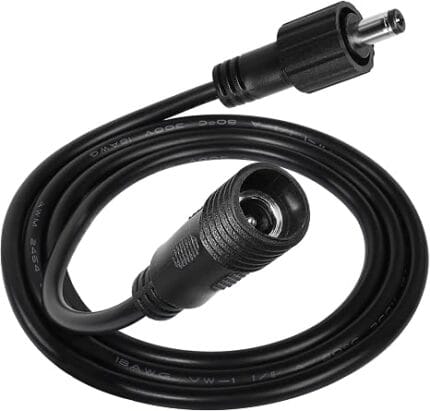
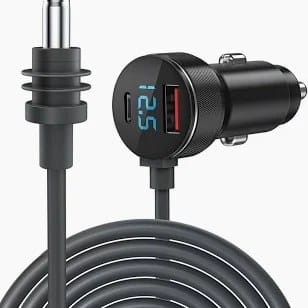
A cigarette lighter power cable takes 12 V or 24 V from a vehicle socket to a sealed 5.5×2.1mm DC plug. Center positive, replaceable blade fuse in the plug, 18 or 16 AWG tinned copper, waterproof cap on the barrel.
Overview
A cigarette lighter power cable is the shortest path between a vehicle socket and a compact DC terminal, and it removes the inverter from the chain entirely. This build runs from a fused lighter plug to a 5.5×2.1mm barrel with a sealing gasket at the mating face and a cap for the plug when it is not connected. Polarity is center positive and is printed on the overmold, so an installer can check it before plugging in rather than after.
Key Specifications
| Connector A | Cigarette lighter plug, 12V/24V, with replaceable blade fuse |
|---|---|
| Connector B | DC barrel plug 5.5×2.1mm, center positive, with sealing gasket |
| Conductor | 18 AWG tinned copper; 16 AWG on the 10 m version |
| Lengths | 3 m / 5 m / 10 m |
| Jacket | Flexible PVC, -40 to +105 C rated |
| Polarity | Center positive, marked on the overmold |
| Options | LED power indicator, right-angle barrel plug, custom length |
| Fitment | Mini terminal only; not for Gen 2 / Gen 3 / Flat HP |
| Waterproof cap | Gasket at the mating face; cap supplied for the unmated plug |
| Fuse | Replaceable blade fuse, value set per build |
What a “12 V” or “24 V” socket really delivers
The number on the socket is a system nominal, not a measurement. A 12 V vehicle system sits near the battery rest voltage with the engine off, rises while the alternator is charging, and sags hard for a second or two during cranking. A 24 V truck system sits at roughly twice those figures. Anything you plug in has to tolerate that whole span, which is why the rated input range on your device – not the label on the socket – is the number to check.
| System | Condition | Typical span seen at the socket |
|---|---|---|
| 12 V | Engine off, battery at rest | Around 12 V, lower on a discharged battery |
| 12 V | Engine running, charging | Up to the mid 14 V region |
| 12 V | Cranking | Dips well below nominal for a second or two |
| 24 V | Truck system, running | Roughly double the 12 V figures |
These are general characteristics of vehicle electrical systems, not figures for a specific vehicle. The rated input range your equipment is built and verified to is stated on your drawing.
Polarity: the one thing to check first
The barrel on this build is center positive, meaning the inner pin carries the positive and the outer sleeve is return. Most compact DC terminals and small network devices are wired this way, but not all of them, and the usual way to find out is expensive. The symbol printed on the device – a dot inside a circle with plus and minus arms – settles it in a second. Where a device is center negative, the answer is a dedicated build rather than an adapter: our reverse polarity DC 5521 power cable exists for exactly that case.
The DC connector family has no universal wiring convention across sizes either, which is why the polarity is marked on the overmold of every plug we ship.
The fuse: what it protects and where it sits
The blade fuse lives inside the barrel of the lighter plug, and it is there to protect the vehicle harness, not the load. That distinction matters when you choose the value: the fuse in the plug has to sit below the fuse protecting the socket circuit, so that a fault in your cable blows your fuse and not the vehicle one. It is also the first thing to check when a terminal stops powering up, and blade fuses are stocked by any automotive parts shop, so a field swap takes seconds.
- Find the fuse value protecting the socket – it is printed next to the socket or in the handbook.
- Choose the plug fuse below that value and above the steady draw of the load.
- Remember the fuse protects the cable first and the device second.
- A fuse that blows repeatedly is a symptom, not a problem to solve with a bigger fuse.
The waterproof cap, and what it does not cover
Two separate things keep water out of this assembly, and buyers often conflate them. The gasket at the mating face seals the joint when the plug is connected to the device. The cap seals the plug when it is not. Neither one makes an unsealed device inlet waterproof, and neither one is a substitute for routing the run so it does not sit in a bilge.
Ingress ratings are defined in IEC 60529, where the first digit covers solid ingress and the second covers liquid. That is an industry-standard classification, not a claim we make about this assembly. Where you specify an ingress rating on a build, the value is stated per your drawing and we can quote seal checking on the production batch. For a fully sealed run end to end, look at the IP67 waterproof DC extension cable instead.
Gauge, length and the temperature span
| Length | Conductor | Typical install |
|---|---|---|
| 3 m | 18 AWG tinned copper | Dashboard or front-seat mount |
| 5 m | 18 AWG tinned copper | Roof or rack mount in a van |
| 10 m | 16 AWG tinned copper | Cabin-to-cockpit run on a boat |
The jacket is specified across a wide span, so the cable stays workable in a cold cab and does not go soft on a sun-loaded dashboard. Tinned stranding is standard, because bare copper in a marine installation wicks corrosion up under the jacket and fails years later at a point nobody can see.
Typical applications for this cigarette lighter power cable
- Compact satellite terminals in cars, trucks, RVs and boats
- Small network devices and routers on a 12 V or 24 V rail
- Mobile office and field service setups running off the vehicle
- Open-deck marine installations, alongside our Starlink Mini car charger cable
- Devices with a barrel input fed through a DC to USB-C cable
- Backup power via a mini UPS splitter cable between the socket and the load
How to specify your build
- Device inlet – barrel size and polarity, read off the label.
- System voltage – 12 V, 24 V, or a build that sees both.
- Run length, along the route the cable will actually take.
- Socket fuse value, so the plug fuse is sized below it.
- Plug angle – straight or right-angle.
- Options – LED indicator, cap, print on the jacket.
- Quantity, sample or production.
Workmanship and testing
ISO 9001 covers the system and IPC/WHMA-A-620 Class 3 covers the work on 12V/24V Cigarette Lighter Power builds, across 32 to 12 AWG. Every 12V/24V build gets a continuity and pinout check before it is boxed, and seal checking is quoted whenever an ingress rating is on the drawing.
Material declarations against RoHS and REACH are issued per project, alongside the dimensional and electrical reports agreed at quotation; see certifications, compliance and material declarations. Where your drawing names a UL style or another approval, the build follows your drawing and ships with the supporting document rather than a claim of our own. The ingress rating is built into the joint, following the sealing structures set out in IP67 and IP68 sealing structures and validated against IEC 60529 before release. More background: cable assemblies for marine and outdoor equipment. Tooling for this build is cut in our own tool room and belongs to your program, so a repeat run years later starts from the same tool.
Custom builds and ordering
12V/24V Cigarette Lighter Power lots run from 1 to 50 pcs, out in 3 working days; volume starts at MOQ 500 pcs shipping 14 working days after approval. Tooling not already held adds around 10 working days. Your part number and labeling go on 12V/24V shipments, and material certificates and first-article reports come with them on request.
Related DC assemblies
- Starlink Mini Car Charger Cable, 12/24V Lighter to DC 5.5×2.1mm
- IP67 Waterproof DC Extension Cable 5.5×2.1mm
- IP67 DC to USB-C Cable, 5.5×2.1mm Barrel Power Lead
- Reverse Polarity DC 5521 Power Cable
- IP65 Waterproof DC 5521 Extension Cable
- DC Barrel Adapter Kit, 5521 / 5525 / 4017 / 3513 / 2.5 mm
- DC Waterproof Push-Pull Quick-Lock Cable
Full range: DC plug power cable assemblies and automotive cable and wire harness.
Frequently Asked Questions
Is the plug center positive?
Yes, and it is marked on the overmold. Check the symbol on your device before connecting – a center-negative device needs a different build.
What does the fuse protect?
Primarily the vehicle harness and the cable. Size it below the fuse protecting the socket circuit and above the steady draw of the load.
Does the waterproof cap make the whole run waterproof?
No. The gasket seals the mated joint and the cap seals the unmated plug. Neither seals a device inlet that was not sealed to begin with.
Which terminal does this fit?
It is built for the Mini form-factor terminal with a 5.5×2.1mm center-positive inlet. It is not intended for the Gen 2, Gen 3 or Flat HP versions, which use different inlets.
Can I have a right-angle plug?
Yes. A right-angle barrel is a standard option where the plug sits against a panel or in a shallow enclosure.
| Connector A | Cigarette lighter plug, 12V/24V, with replaceable blade fuse |
|---|---|
| Connector B | DC barrel plug 5.5×2.1mm, center positive, with sealing gasket |
| Conductor | 18 AWG tinned copper; 16 AWG on the 10 m version |
| Lengths | 3 m / 5 m / 10 m |
| Jacket | Flexible PVC, -40 to +105 C rated |
| Polarity | Center positive, marked on the overmold |
| Options | LED power indicator, right-angle barrel plug, custom length |
| Fitment | Mini terminal only; not for Gen 2 / Gen 3 / Flat HP |
| Waterproof cap | Gasket at the mating face; cap supplied for the unmated plug |
| Fuse | Replaceable blade fuse, value set per build |
Related products
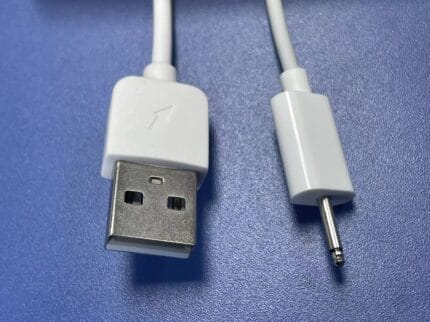
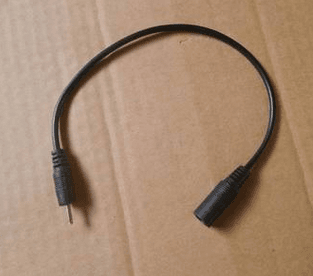
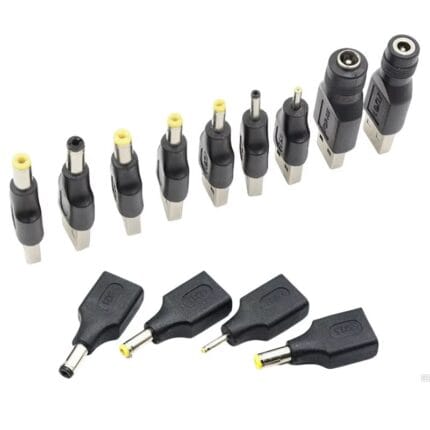
DC Barrel Adapter Kit – 5521 / 5525 / 4017 / 3513 / 1.35mm / 2.5mm, 6-Piece
A dc barrel adapter kit covering 5.5x2.1, 5.5x2.5, 4.0x1.7, 3.5x1.35 and 2.5 mm in six molded female-to-male adapters, so one supply covers a mixed estate. Center positive throughout, with nickel-plated brass contacts. Measure the socket pin with a caliper before ordering: the outer shell is identical across three of these five sizes. Bagged with a size card, or boxed with a printed insert.