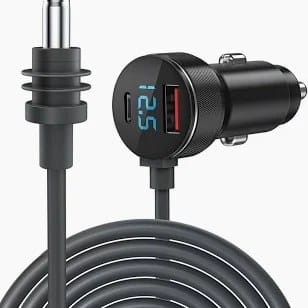
Starlink Mini Car Charger Cable – 12/24V Cigarette Lighter to DC 5.5×2.1mm
A starlink mini car charger cable takes 12 V or 24 V from a vehicle lighter socket straight to the dish DC 5.5×2.1mm input, with no inverter in the chain. Fused plug, 18 or 16 AWG tinned copper, built to the run length you name.
Overview
A starlink mini car charger cable takes the inverter out of a vehicle installation. The dish runs on DC, the vehicle already has DC at the lighter socket, and every volt you push up to mains and back down again is lost as heat in the converter. This lead carries the 12 V or 24 V already present at the socket straight to the DC 5.5×2.1mm barrel input, with a replaceable blade fuse inside the plug tip.
Key Specifications
| Cable type | DC power cable assembly |
|---|---|
| Input connector | Automotive cigarette lighter plug, fused |
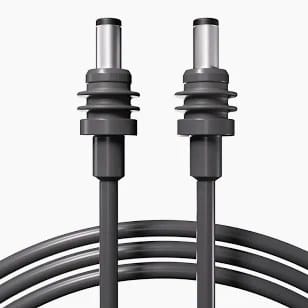
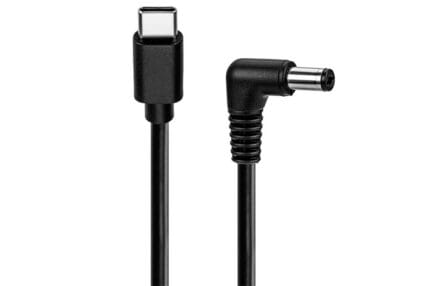
| Output connector | DC barrel 5.5 x 2.1 mm, center positive |
| Conductor | 18 AWG tinned copper (16 AWG on 10 m) |
| Voltage range | 12 / 24 V DC |
| Fuse | Replaceable blade fuse, 10-15 A |
| Jacket | PVC, -40 to +105 C |
| Length | 3 m / 5 m / 10 m, custom on request |
| Polarity | Center positive, marked on the overmold |
| Options | LED power indicator, right-angle barrel, custom print |
Which dish this fits
Fitment is settled by the power port, not by the name on the box. The cable is built to the connectors you name, so the check is a physical one: if the power inlet on your unit is a round barrel and the rating label calls for a DC input, this is the build to quote. The larger rectangular and kickstand dishes use a different, proprietary inlet and a different voltage range, and they are a separate job.
| Dish form | Power inlet | This cable |
|---|---|---|
| Mini / portable DC unit | Round DC barrel, 5.5 x 2.1 mm | Yes – built to this inlet |
| Gen 2 rectangular dish | Proprietary plug, not a barrel | No |
| Gen 3 kickstand dish | Proprietary plug, not a barrel | No |
| Flat High Performance | Proprietary plug, higher draw | No |
Send a photo of the inlet and the rating label if there is any doubt. Two photos settle the question faster than a part number search does.
What the socket can actually deliver
A socket described as 12 V does not sit at 12 V. On a passenger car it is closer to the battery rest voltage with the engine off and rises once the alternator is charging; a truck described as 24 V sits roughly twice as high. On top of that, vehicle sockets are commonly fused somewhere between 10 A and 20 A, and a long, thin lead to a rear cargo socket drops more voltage than a short one on the dash. Those three things together are why the same dish works perfectly in one vehicle and reboots in another.
- Read the fuse value printed next to the socket, or in the handbook – it is the ceiling for the whole circuit, not just for this cable.
- Measure the socket voltage with the dish running, not with it idle. The loaded number is the one that matters.
- If the measured drop along the run is more than you can afford, the answer is a heavier conductor, not a bigger fuse.
Why a generic car charger drops the link
The failure mode people report is not a dead dish, it is a dish that reboots at random. Three mechanisms cause it, and all three are voltage at the far end of the lead.
First is voltage drop in the cable. A thin lead carrying several amps over five meters loses voltage proportional to length and current, and the dish sees the remainder. Second is contact resistance at the lighter plug: the spring contacts in a cheap plug warm up, the plastic softens, the grip relaxes, and the resistance climbs further. Third is the converter itself – a small mains inverter or a multi-output charger with a shared budget will brown out before the vehicle does.
A dedicated DC lead removes the second and third causes outright and lets us size the first one: tell us the run length and the current you measured, and the conductor is chosen to hold the drop inside the window your equipment needs.
Choosing length and conductor
| Stock length | Conductor | Typical install |
|---|---|---|
| 3 m | 18 AWG tinned copper | Dash or front-seat mount, dish on the windscreen or dash |
| 5 m | 18 AWG tinned copper | Van or RV, dish on the roof or a rack, socket at the front |
| 10 m | 16 AWG tinned copper | Cabin-to-cockpit run on a boat, or a rear cargo socket in a truck |
Tinned stranding is standard rather than an upgrade. Bare copper that lives in a marine or high-humidity installation wicks corrosion up under the jacket, and the joint fails years later at a point nobody can see. Tinned stranding costs a little more and removes that failure mode. If the dish is being mounted permanently, most customers move to a hardwired pigtail on the fuse box rather than a socket plug, and we build both.
Typical applications for this starlink mini car charger cable
- Passenger cars and pickup trucks running the dish from a dash or console socket
- RV and camper van 12 V systems where the inverter would run all day
- Long-haul truck cabs, alongside our 12V/24V cigarette lighter power cable
- Boat and marine 12 V panels, where the tinned conductor earns its keep
- Field and emergency vehicles that need the link up before the engine starts
- Installations with a backup battery, fed through a mini UPS splitter cable
How to specify your build
- Dish inlet – a photo of the power port and the rating label.
- Run length, measured along the route the cable will actually take.
- Measured current at the dish input, or the figure off the label.
- Socket fuse value in the vehicle, so the fuse in the plug is sized below it.
- Jacket and color, and any print you want on the cable.
- Plug body – straight or right-angle, with or without the LED.
- Quantity, and whether this is a sample or a production run.
Workmanship and testing
Workmanship on Starlink Mini Car Charger builds follows IPC/WHMA-A-620 Class 3, the line is run under ISO 9001, and the termination range is 32 to 12 AWG. No Starlink assembly is boxed before continuity and pinout are confirmed, and seal checking is quoted whenever an ingress rating is on the drawing.
Every production run can ship with RoHS and REACH declarations and the electrical report agreed at quotation; see certifications and material declarations. UL styles and other named approvals are built to drawing: we source to the style you specify and document it, rather than asserting a listing we do not hold. Termination, molding and verification happen in-house see cable assembly and wire harness production so the process that made your sample is the process that runs the order. Related reading: what outdoor duty does to a jacket. Tooling is quoted separately, cut in-house rather than brokered out, and owned by you.
Custom builds and ordering
Quote Starlink Mini Car Charger builds from 1 to 50 pcs and they ship in 3 working days; at volume the minimum is 500 pcs with 14 working days after approval. Tooling not already held adds around 10 working days. OEM and ODM Starlink runs go out under your part number and labeling and material certificates with first-article reports are available.
Related DC assemblies
- Starlink Mini DC Extension Cable, 5.5×2.1mm male to male
- 12V/24V Cigarette Lighter Power Cable with Waterproof 5.5×2.1mm DC Plug
- IP67 Waterproof DC Extension Cable 5.5×2.1mm
- Mini UPS Splitter Cable DC 5.5×2.1mm, 1-to-2 and 1-to-4
- 14 AWG DC Barrel Pigtail Cable to Bare Wire or Ring Terminals
- Threaded Locking DC Pigtail 5.5×2.1mm, Shielded Right-Angle
Full range: DC plug power cable assemblies, or the wider automotive cable and wire harness range.
Frequently Asked Questions
Will this work with the larger rectangular dish?
No. That inlet is not a barrel and the voltage range is different. This build is for the Mini form factor with a round DC input, and we build to the connectors you name.
Why does my dish reboot when the engine starts?
Cranking pulls the vehicle rail down hard for a second or two. If the dish is already close to its lower limit because of drop in the lead, that dip is enough to reset it. Measure the loaded voltage at the dish and size the conductor from that number.
Can I get a right-angle barrel for a tight mount?
Yes. The overmold bodies are tooled in house, so a right-angle barrel or a different strain relief is a tooling change rather than a new supplier.
What fuse is in the plug?
A replaceable blade fuse in the 10 to 15 A range as standard. The value is set per build so it sits below the socket fuse in your vehicle – tell us that value and we match to it.
Do you make a hardwired version for permanent installs?
Yes. Where the dish is mounted permanently, a fused pigtail straight to the fuse box is the tidier answer and avoids the socket contact entirely.
| Cable type | DC power cable assembly |
|---|---|
| Input connector | Automotive cigarette lighter plug, fused |
| Output connector | DC barrel 5.5 x 2.1 mm, center positive |
| Conductor | 18 AWG tinned copper (16 AWG on 10 m) |
| Voltage range | 12 / 24 V DC |
| Fuse | Replaceable blade fuse, 10-15 A |
| Jacket | PVC, -40 to +105 C |
| Length | 3 m / 5 m / 10 m, custom on request |
| Polarity | Center positive, marked on the overmold |
| Options | LED power indicator, right-angle barrel, custom print |
Related products
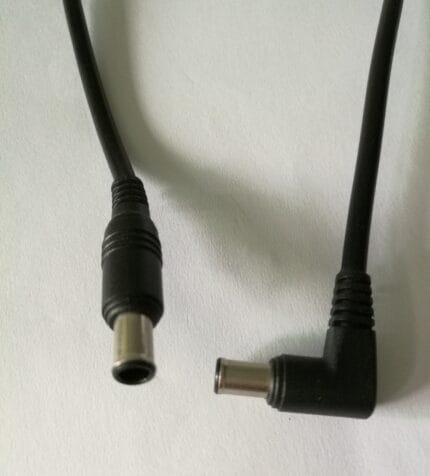
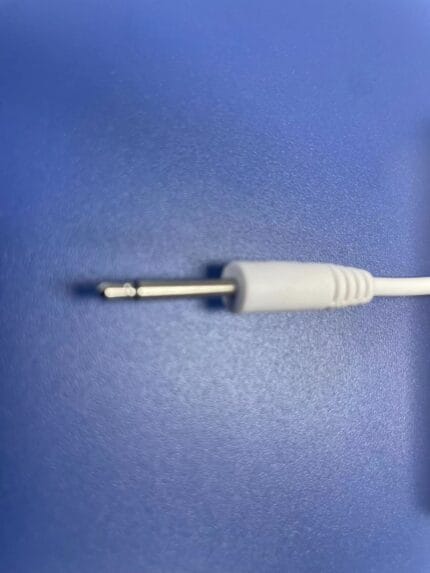
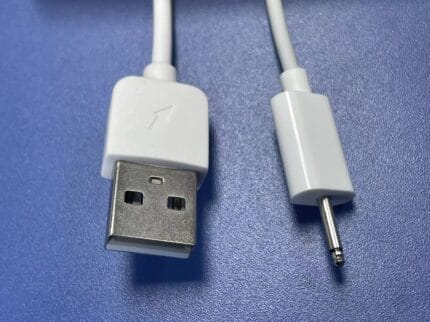
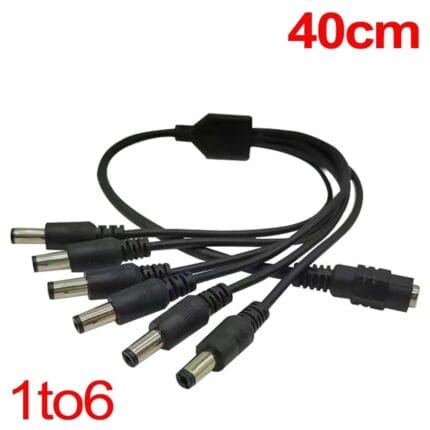
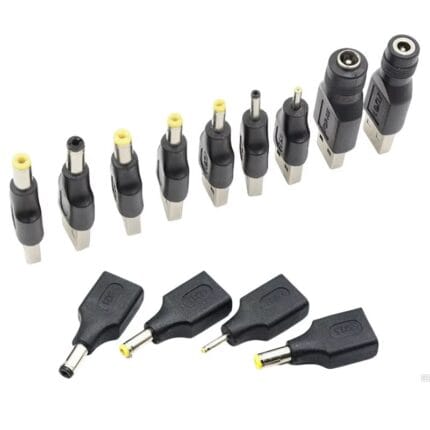
DC Barrel Adapter Kit – 5521 / 5525 / 4017 / 3513 / 1.35mm / 2.5mm, 6-Piece
A dc barrel adapter kit covering 5.5x2.1, 5.5x2.5, 4.0x1.7, 3.5x1.35 and 2.5 mm in six molded female-to-male adapters, so one supply covers a mixed estate. Center positive throughout, with nickel-plated brass contacts. Measure the socket pin with a caliper before ordering: the outer shell is identical across three of these five sizes. Bagged with a size card, or boxed with a printed insert.