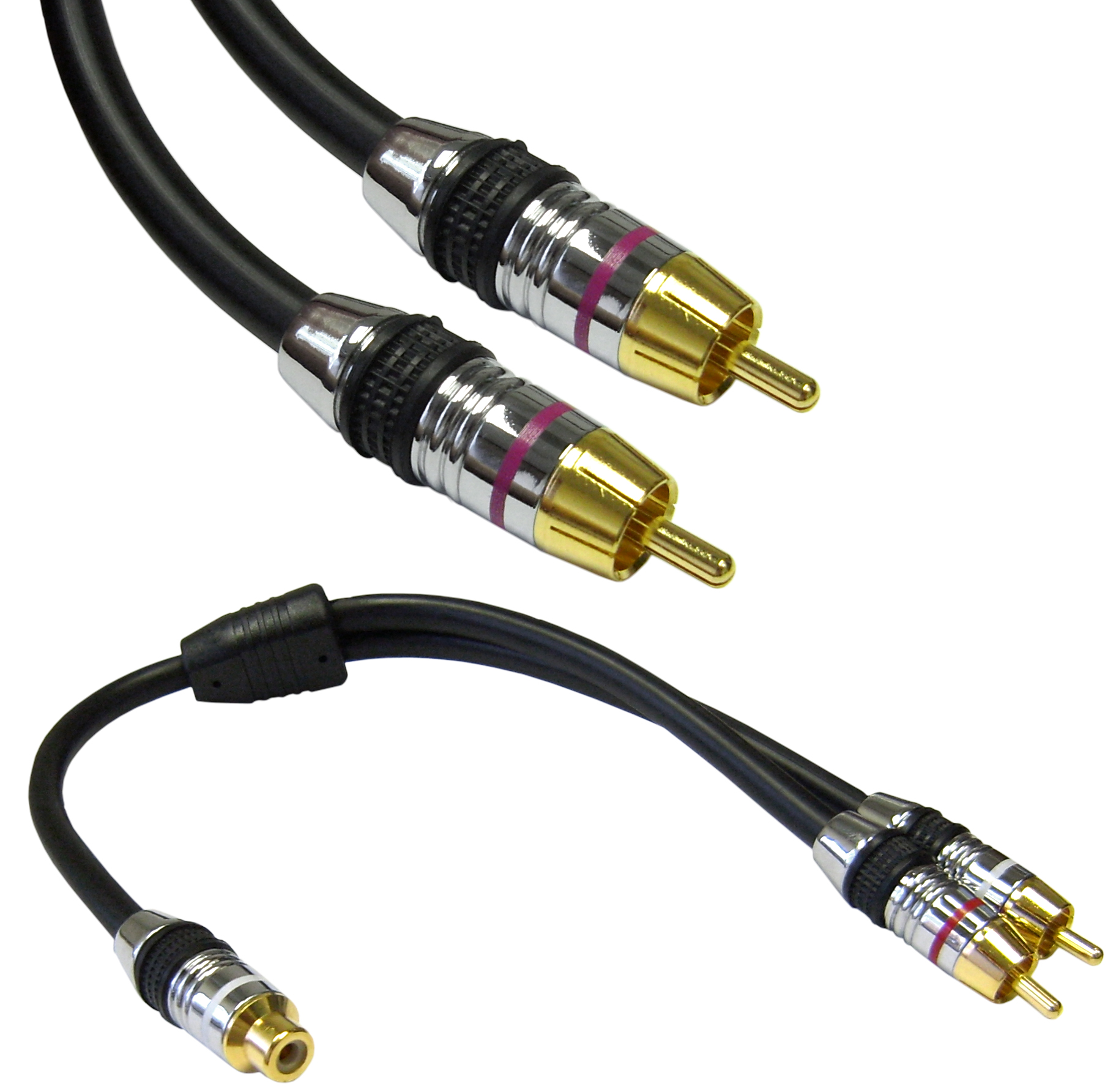
RCA Premium Subwoofer Y Splitter
An rca premium subwoofer splitter taking one LFE output to two powered subwoofers or two amplifier channels. Gold-plated metal shells with pink ID bands, screened, passive 1-to-2, leg lengths to your room.
Overview
An rca premium subwoofer splitter takes the single subwoofer or LFE
output on an AV receiver and feeds two destinations: two powered subwoofers, or two channels of a
subwoofer amplifier. A single RCA female socket goes on the source end and two RCA male plugs come off
the other. All three connectors carry a pink marker band, which sounds cosmetic until you have traced
leads behind a rack in the dark and found the two black RCA cables at the back of the cabinet are not
the ones you thought. Metal housings, gold-plated contacts and a proper strain relief at the fork are
what make this the build worth buying rather than the cheapest one on the shelf.
Key Specifications
| Connector A | RCA female, gold-plated, metal housing with pink band |
|---|---|
| Connector B | RCA male x 2, gold-plated, metal housings with pink band |
| Cable Length | Custom on request (typical 0.3-1 m) |
| Jacket | Black PVC |
| Application | Subwoofer mono feed split into two subs or two amplifiers |
| Signal | Mono line-level subwoofer / LFE output |
| Center conductor | Stranded copper |
| Identification | Pink marker band on all three connectors |
| Split type | Passive 1-to-2, no active buffer |
| Build | Leg lengths, jacket and band color per your drawing |
Why two subwoofers instead of one bigger one?
One subwoofer in a room gives you one set of room modes: places where a low note booms and others
where it disappears. Put a second cabinet somewhere else and the two excite the room differently, so
the peaks and nulls no longer line up and the bass is far more even from seat to seat. That is why one
output split to two cabinets often beats one larger cabinet in the corner, even though nothing was
added to the signal. Low frequencies are also hard to localize by ear, which is what makes the trick
work at all: the listener hears one bass range rather than
two subwoofers
playing from two places.
What the passive split costs you, and what it does not
Splitting one output into two inputs is the friendliest case in audio. At line level the destination
impedance is high compared with the source, so the signal level barely moves, and unlike splitting a
headphone output there is no meaningful level loss to plan around. Five things still deserve a check
before the room is signed off.
| Check | Why it matters | What to do |
|---|---|---|
| Gain on each cabinet | Two cabinets sum acoustically, so the pair plays louder than one at the same setting | Start each gain lower than you would for a single subwoofer, then trim |
| Room correction on the receiver | Automatic setup expects one cabinet on that output | Run calibration with both connected and re-check the level afterwards |
| Placement | Two cabinets in the same corner gain you almost nothing | Separate them – opposite walls or opposite corners is the usual start |
| Leg length | Unbalanced RCA runs pick up hum as they get longer | Keep the legs sensible and route them away from mains cords |
| Polarity | Two cabinets out of phase cancel each other | If bass gets thinner when the second is connected, check polarity first |
Shielding matters more here than people expect
The LFE channel is low frequency, so the assumption is that the cable does not matter. Two things
argue the other way. First, an unbalanced RCA connection has no common-mode rejection: whatever the
screen picks up arrives at the amplifier input and is amplified along with everything else. Second, the
subwoofer run is usually the longest unbalanced cable in the system, and it normally lies alongside
mains cords behind a cabinet. A foil screen plus a decent coverage braid, bonded properly at the plug,
is the difference between silence in the quiet passages and a low hum you cannot locate. Where a long
run is unavoidable, convert to a balanced link at the source with
a 6.35 mm TRS to XLR lead and back
again at the cabinet.
Why the pink band and the metal shell earn their keep
Two details justify the word premium, and both are practical. The pink band marks this lead as the
subwoofer feed at a glance, on the source end and on both legs, which ends the guessing game in a
cabinet full of black RCA cables. The metal housings do two jobs: they screen the connector body right
up to the shell of the socket, and they survive being pulled out of a tight rack by the plug rather
than by the cable. Gold plating keeps contact resistance stable over years of sitting in one place,
which is mostly what these leads do. The fork where one jacket becomes two is molded rather than
taped, which is where the cheaper versions fail.
Typical applications for this rca premium subwoofer splitter
- One receiver LFE output feeding two powered subwoofers for even room coverage
- Feeding a subwoofer signal into two channels of a subwoofer amplifier
- Duplicating any mono RCA line-level feed to two downstream devices
- Home cinema and media room builds, racked next to the
tonearm lead on the same
shelf - Car audio installs, feeding a trunk amplifier from a
dashboard
mounted RCA outlet
How to specify your build
- Leg lengths – the two legs rarely end up the same; measure both.
- Band color – pink as standard, or your own color code across the range.
- Connector finish – gold plated contacts and metal housings as standard.
- Jacket color, if any of the run is visible in the room.
- Quantity, and whether you need retail packing for resale.
For RCA Premium Subwoofer Y builds the line runs to IPC/WHMA-A-620 Class 3 under ISO 9001, terminating 32 to 12 AWG. 100% continuity and pinout are tested on each RCA unit before it is packed, and seal checking is quoted whenever an ingress rating is on the drawing.
Custom builds and ordering
RCA Premium Subwoofer Y prototype lots start from 1 to 50 pcs and ship in 3 working days. Production requires 500 pcs and runs 14 working days after sample approval. Your part number and labeling go on OEM and ODM RCA shipments, and material certificates and first-article reports can be supplied. We hold 100 sets of mold tooling in house, so a standard body needs no tooling time and a new one adds about 10 working days.
Material declarations against RoHS and REACH are issued per project, alongside the dimensional and electrical reports agreed at quotation; see certifications, compliance and material declarations. Where your drawing names a UL style or another approval, the build follows your drawing and ships with the supporting document rather than a claim of our own. Overmold tooling for this part is designed and cut in our own tool room under overmold tooling cut in our own tool room, so the tool belongs to your program and a revision is a machining job rather than a new negotiation. More background: cable assemblies for broadcast and pro AV.
Related audio assemblies
- Turntable Tonearm Cable with DIN and Dual RCA
- 6 in Mini-DIN6 PS/2 Male to 2 Female Y Splitter
- XLR Microphone Cable, Balanced Three Pin
- 1/4 TRS to XLR Cable 6.35 mm Balanced Lead
- 3.5 mm AUX Female to 2 RCA Male Car Dashboard
- Car Dashboard Flush Mount USB-A + 2 RCA Audio
Full range: audio and video cable assemblies.
Frequently Asked Questions
Will splitting the output make it quieter?
Not meaningfully at line level. Amplifier and powered-subwoofer inputs are high impedance, so the
source sees almost no extra load.
The bass got weaker when I connected the second subwoofer. Why?
Out of phase. Two cabinets cancelling each other is the classic symptom – check polarity and
position before changing anything else.
Can I use it in reverse, to combine two outputs into one input?
No. Combining sources needs a mixer. Wired backwards, each output drives into the other.
Does cable length matter for a subwoofer?
Not for tone, but it matters for hum. Keep unbalanced RCA runs short and away from mains.
| Connector A | RCA female, gold-plated, metal housing with pink band |
|---|---|
| Connector B | RCA male x 2, gold-plated, metal housings with pink band |
| Cable Length | Custom on request (typical 0.3-1 m) |
| Jacket | Black PVC |
| Application | Subwoofer mono feed split into two subs or two amplifiers |
| Signal | Mono line-level subwoofer / LFE output |
| Center conductor | Stranded copper |
| Identification | Pink marker band on all three connectors |
| Split type | Passive 1-to-2, no active buffer |
| Build | Leg lengths, jacket and band color per your drawing |
Related products