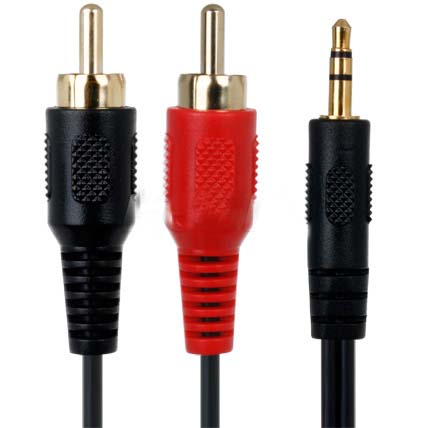
3-5mm TRS to 2x RCA Cable
A trs 2x rca cable splitting a 3.5 mm stereo output into red and white RCA plugs for an amplifier, soundbar, TV or powered monitors. Screened pair, gold-plated contacts, length and leg split to your layout.
Overview
This trs 2x rca cable takes the 3.5 mm headphone or line output of a
phone, tablet, laptop or portable player and breaks it into the two RCA plugs a home amplifier,
soundbar, powered monitor or television expects: white for left, red for right. It is the most common
cable in consumer audio and one of the most misunderstood, because the plug fits in three kinds of
socket and only one of them gives you the right level. Most of the complaints about these leads –
too quiet, distorted, humming – are level and grounding problems rather than cable problems, and all
three are avoidable at the specification stage.
Key Specifications
| Connector A | 3.5 mm TRS male, straight, black housing |
|---|---|
| Connector B | RCA male x 2 (red + white, gold-plated) |
| Cable Length | Custom on request (typical 1-3 m) |
| Jacket | Black PVC |
| Application | Phone / tablet / laptop to stereo amplifier or TV analog input |
| Wiring | Tip to right, ring to left, sleeve common to both RCA shells |
| Conductor | Stranded copper |
| Shielding | Screen carried through to both RCA shells |
| Signal type | Unbalanced stereo, consumer line or headphone level |
| Build | Length, jacket color and leg length per your drawing |
Levels: what a trs 2x rca cable is really matching
Audio equipment agrees on signal levels by convention rather than by law, and the conventions differ
between a headphone output, a consumer line output and a professional line input. Connecting between
them is where the trouble starts. These figures are the ones generally quoted for each class; treat
them as the starting point and check your own equipment.
| Class | Commonly quoted nominal level | Plugging it into a consumer line input |
|---|---|---|
| Microphone level | Far below line, tens of millivolts | Too quiet; needs a preamplifier |
| Consumer line level | -10 dBV nominal | Correct match |
| Headphone output | Roughly line level, with current drive for a low impedance load | Works, but watch the volume setting |
| Professional line level | +4 dBu nominal | Too hot; will overdrive a consumer input |
| Speaker level | Amplified, tens of volts | Never connect this to a line input |
The practical rule for the usual case, a phone into an amplifier: set the phone close to full and
use the amplifier’s volume control. Running the phone low and the amplifier high amplifies the phone’s
noise floor along with the music. Running both high distorts the input. The nominal levels above are
industry conventions, and the values your build is verified to are the ones on your drawing; see the
line level
conventions for the background.
The two faults that get blamed on the cable
Hum. A phone on a charger and an amplifier on mains power are two pieces of
equipment with two ground references, and an unbalanced connection carries the difference straight into
the input. It usually appears when the charger is plugged in and disappears when it is not, which is
the diagnostic. Fixes, in order: run the source on battery, move the charger to the same outlet strip
as the amplifier, or use a ground-loop isolator on the audio path.
Distortion. Almost always a hot source into a sensitive input, or two volume
controls both set high. Drop the source to about three quarters and bring the level up on the
amplifier. If it still distorts, the source output may be a headphone driver into an unexpectedly low
input impedance, and a resistive pad is the answer rather than a different cable.
What this cable does not do
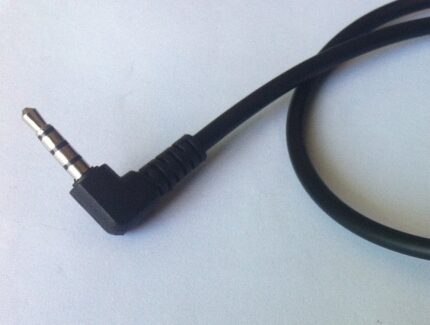
- It does not carry video. Some camcorders and media players put composite video on
the extra contact of a 3.5 mm four-pole jack. A three-pole TRS lead cannot reach it; that job needs a
dedicated four-pole breakout. - It does not convert mono to stereo. A mono source drives one channel. If only the
white RCA is live, the source is mono, not the cable. - It is not a phono input. A turntable needs a phono stage with equalization and a
ground bond; plug one into a line input and you get very quiet, very thin audio. For that job use a
proper tonearm lead into a
phono preamplifier. - It is not a balanced run. For more than a few meters, balance the link at both
ends with TRS to XLR leads and
balanced cable.
Cases, recesses and plugs that will not seat
The most common physical complaint about this lead has nothing to do with audio: it will not go all
the way into a phone that lives in a protective case. The opening in the case is narrower than the plug
barrel, so the plug sits partly out of the jack and one channel is lost. The fix is a plug with a
slimmer barrel rather than a different cable, and that is a build option worth asking for if your
devices live in cases. The same applies to recessed jacks on some powered speakers and wall panels.
Measure the depth and the opening, and the barrel is matched to it.
Typical applications for this trs 2x rca cable
- Phone, tablet or laptop into a home stereo amplifier or a powered monitor pair
- Portable player into a TV’s analog audio input
- Recording interface or mixer line input fed from a consumer device
- Car audio, into a
dashboard
mounted RCA outlet or a
flush
mount 2 RCA extension - Demo and retail displays where a source device is swapped several times a day
How to specify your build
- Length – keep it as short as the layout allows; unbalanced runs pick up noise as
they get longer. - Leg length at the RCA end, so both plugs reach jacks that may not be adjacent.
- Color code – red and white as standard, other colors on request.
- Jacket color and material, if the run is visible or has to be pulled.
- Quantity, and whether you need retail packing for resale.
3-5mm TRS builds are assembled and inspected to IPC/WHMA-A-620 Class 3 criteria, with ISO 9001 as the quality system over 32 to 12 AWG work. continuity and pinout are checked on every 3-5mm unit before packing, and seal checking is quoted whenever an ingress rating is on the drawing.
Custom builds and ordering
3-5mm TRS prototype builds start from 1 to 50 pcs and are out in 3 working days; production is quoted from 500 pcs at 14 working days after approval. Tooling not already held adds around 10 working days. Private-label 3-5mm runs ship under your part number and labeling, and material certificates and first-article reports come with them on request.
RoHS and REACH declarations are provided per project together with the agreed test reports; the documentation scope is listed under certifications and compliance. If your drawing specifies a UL style, we build to that drawing and supply the UL reference with the shipment instead of substituting an equivalent. The molded body is shot on our own presses; material choice and bond behavior follow the process described under overmold materials and injection parameters. More background: cable assemblies for broadcast and pro AV. Any tooling we cut for this part stays yours, maintained in our own tool room under your part reference.
Related audio assemblies
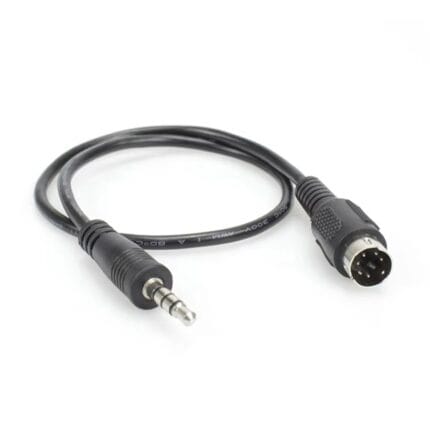
- Turntable Tonearm Cable with DIN and Dual RCA
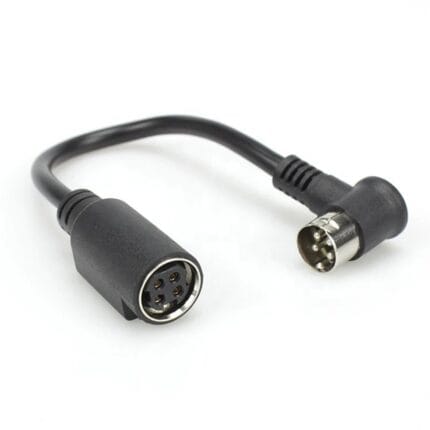
- 6 in Mini-DIN6 PS/2 Male to 2 Female Y Splitter
- 3.5 mm AUX Female to 2 RCA Male Car Dashboard
- Car Dashboard Flush Mount USB-A + 2 RCA Audio
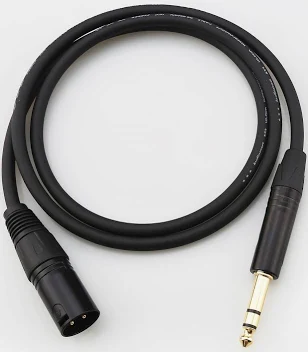
- 1/4 TRS to XLR Cable 6.35 mm Balanced Lead
- XLR Microphone Cable, Balanced Three Pin
Full range: audio and video cable assemblies.
Frequently Asked Questions
Why does it hum when my phone is charging?
Two mains references and an unbalanced connection. Run on battery, share one outlet strip, or fit a
ground-loop isolator.
Only one speaker works. Is the cable faulty?
Check for a mono source first, then reseat the 3.5 mm plug partially – a plug that is not fully
home leaves one channel open.
Can I use this to connect a turntable?
No. A turntable needs a phono stage with equalization and a ground bond.
Does it carry video from a camcorder?
Not this three-pole version. Composite video on a 3.5 mm jack needs a four-pole breakout built for
it.
| Connector A | 3.5 mm TRS male, straight, black housing |
|---|---|
| Connector B | RCA male x 2 (red + white, gold-plated) |
| Cable Length | Custom on request (typical 1-3 m) |
| Jacket | Black PVC |
| Application | Phone / tablet / laptop to stereo amplifier or TV analog input |
| Wiring | Tip to right, ring to left, sleeve common to both RCA shells |
| Conductor | Stranded copper |
| Shielding | Screen carried through to both RCA shells |
| Signal type | Unbalanced stereo, consumer line or headphone level |
| Build | Length, jacket color and leg length per your drawing |