Coiled 1/4 Inch Guitar Cable
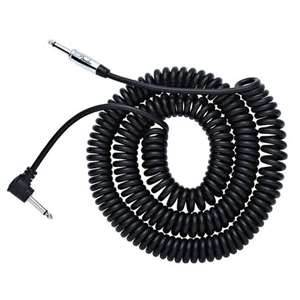
A coiled inch guitar cable with a straight TS plug at one end and a right-angle TS plug at the other, so slack never lies on the floor. Foil shield against handling noise, black PU / PVC coil, resting and stretched lengths to your stage.
Overview
A coiled inch guitar cable exists to solve one problem: a straight
lead long enough to let a player move is long enough to trip over, wrap around a pedal, and drag a
microphone stand with it. The coiled section stretches when the player walks out and contracts when
they come back, so the slack never lies on the floor. This build has a straight TS plug at one end and
a right-angle TS plug at the other, which is the combination most players want: the right-angle plug
goes into the guitar so the cable exits downward instead of sticking 40 mm out of the body, and the
straight plug goes to the board or the amp.
Key Specifications
| Connector A | 6.35 mm (1/4″) TS male, straight |
|---|---|
| Connector B | 6.35 mm (1/4″) TS male, right-angle |
| Coil Length | Custom on request (stretched length up to several meters) |
| Jacket | Black PU / PVC coil |
| Application | Electric guitar to pedalboard / amp |
| Conductor | Stranded copper |
| Shielding | Foil shield to reduce handling noise |
| Plug hardware | Molded plugs with strain-relief boots |
| Signal | Unbalanced mono instrument level |
| Build | Coil diameter, resting length and stretched length per your drawing |
How much stretch do you actually need?
The single most common ordering mistake is specifying the stretched length and forgetting the
resting length. A coil that rests at 1 m and stretches to 4 m feels completely different on stage from
one that rests at 2 m and stretches to 6 m, even though both cover the same working distance. Decide
from the furthest point the player walks to, then let the resting length be a little shorter than
that, so the coil is under slight tension rather than dragging.
| Working distance, player to amp or board | Resting coil length to order | Notes |
|---|---|---|
| Up to 2 m, seated or a small board | Short coil, or a straight patch lead | A coil is not worth it at this distance |
| 2 to 4 m, typical club stage | Resting around 1 m, stretched around 3 to 4 m | The default choice for most players |
| 4 to 7 m, wide stage or a long pedal run | Resting around 2 m, stretched to 6 m or more | Check the capacitance budget below |
| Beyond that | Wireless, or a buffer at the board | A very long coil is heavy and pulls on the jack |
The capacitance bill nobody mentions
A passive guitar pickup is a high-impedance source, and every meter of cable adds
capacitance
across it. That capacitance forms a resonant circuit with the pickup’s inductance, and the practical
result is a rolled-off top end: as the cable gets longer the guitar gets darker. A coiled cable is
physically long even when it looks short, so the effect is real, and it is the reason two players can
disagree about whether a coil “sounds different”.
- Put the first pedal on the board, or a dedicated buffer, before any long run. A buffered signal
drives cable capacitance without the tone change. - If the guitar must run straight to the amp on a long coil, expect to add a little treble at the
amp. - Cable capacitance for this build is stated per your drawing, and we will quote a measured figure
on request rather than a marketing number.
Why the right-angle end goes into the guitar
A straight plug in a guitar jack stands out from the body, where a strap, a hand or a passing cable
catches it, and the lever action damages both the jack and the plug. In a Strat-style recessed jack it
bends the plate. The right-angle end belongs at the instrument, exiting downward; the straight end goes
to the pedalboard or amp where nothing is moving. If your board is a
tight row of pancake patch
leads, say so when you order, because the plug barrel length has to clear the neighboring
jacks.
Coil memory, and how it dies
A coil fails by losing its memory, not by breaking. The three habits that kill it are leaving it
stretched over a long session, hanging it by the plugs so the coil carries its own weight, and
stretching it past its working length until the spiral takes a permanent set. Store it loosely coiled,
release the tension between sets where you can, and do not use the coil as a handle to drag the
cabinet. Handling noise, the crackle you hear when the cable moves, comes from a shield that has lost
contact with the plug shell; the foil shield on this build is there to keep that quiet under stage
movement, and the shield termination is what we test.
Where a coiled inch guitar cable earns its place
- Guitar or bass to a combo amp on a stage where the player moves
- Guitar to a pedalboard where a long straight lead would tangle with the pedals
- Studio live rooms, where a coiled lead keeps the floor clear for mic stands
- Keys and stage synths that sit off to the side and need a long reach
- Rental and backline stock, where the same lead has to suit different stage sizes
How to specify your build
- Resting length and stretched length — both, measured the way you will use it.
- Coil diameter, if you have a preference; tighter coils look neater and stretch
less. - Plug combination — straight to right-angle as standard, or straight both
ends. - Jacket — black PU / PVC as standard, other colors on request.
- Quantity, and whether you need retail packing for resale.
For Coiled 1/4 Inch Guitar builds the line runs to IPC/WHMA-A-620 Class 3 under ISO 9001, terminating 32 to 12 AWG. Every Coiled build gets a continuity and pinout check before it is boxed, and seal checking is quoted whenever an ingress rating is on the drawing.
Custom builds and ordering
Coiled 1/4 Inch Guitar prototype lots start from 1 to 50 pcs and ship in 3 working days; production requires 500 pcs and runs 14 working days after sample approval. Tooling not already held adds around 10 working days. Your part number and labeling go on OEM and ODM Coiled shipments, and we provide material certificates and first-article reports when asked.
Material declarations against RoHS and REACH are issued per project, alongside the dimensional and electrical reports agreed at quotation; see certifications, compliance and material declarations. Where your drawing names a UL style or another approval, the build follows your drawing and ships with the supporting document rather than a claim of our own. Where this build needs an overmold, the tool is designed, cut and maintained in our own shop under the overmold tooling we build in-house, and it is never used for another customer’s program. Related reading: cable assemblies for broadcast and pro AV.
Related audio and coiled assemblies
- Guitar Pedal Patch Cable with Low Profile Pancake Plugs
- Coiled Retractable Cable for Instruments and Test Gear
- Coiled Telephone Handset Cable 4P4C / 6P6C
- Barcode Scanner Cable with Coiled Cord
- 1/4 TRS to XLR Cable 6.35 mm Balanced Lead
- XLR Microphone Cable, Balanced Three Pin
- 6.35mm to MIDI 5-Pin DIN Female Cable
Full range: audio and video cable assemblies.
Frequently Asked Questions
Will a coiled cable make my guitar sound dull?
A long coiled cable has more capacitance than a short straight one, so the top end can roll off
slightly. A buffer or a buffered pedal early in the chain removes the effect entirely.
Can I use this as a speaker cable between a head and a cabinet?
No. This is an instrument-level cable with a signal shield. Speaker-level current needs a
two-conductor cable sized for it, and using a guitar lead there is a real failure mode.
Is it mono or stereo?
Mono. Both plugs are TS, two contacts, tip and sleeve. It is not a balanced TRS line and not a
headphone lead.
My coil has gone slack. Can it be fixed?
Not reliably. Once the spiral has taken a permanent set, replace it, and store the replacement
unstretched.
| Connector A | 6.35 mm (1/4″) TS male, straight |
|---|---|
| Connector B | 6.35 mm (1/4″) TS male, right-angle |
| Coil Length | Custom on request (stretched length up to several meters) |
| Jacket | Black PU / PVC coil |
| Application | Electric guitar to pedalboard / amp |
| Conductor | Stranded copper |
| Shielding | Foil shield to reduce handling noise |
| Plug hardware | Molded plugs with strain-relief boots |
| Signal | Unbalanced mono instrument level |
| Build | Coil diameter, resting length and stretched length per your drawing |
Related products
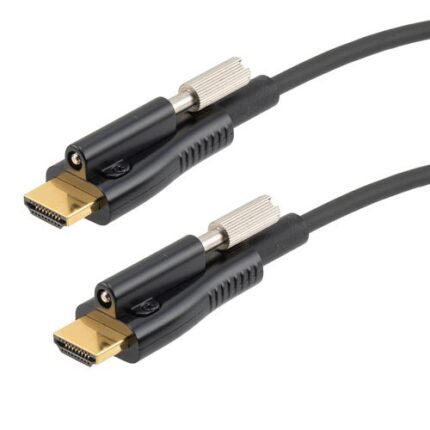
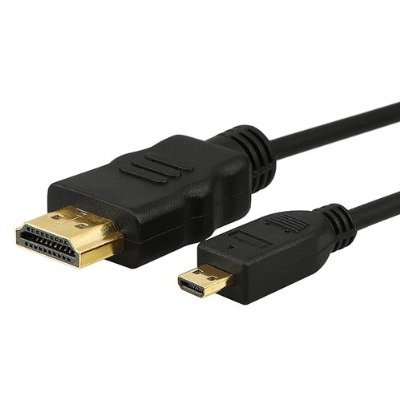
Active Optical HDMI Cable for Boardrooms and Ceiling Projectors
An active optical HDMI cable puts the high speed signal path onto fiber so a long boardroom or ceiling projector run stays slim enough to pull through conduit. Marked source and display ends, aramid strength member, hybrid copper for power and control. Tell us the route and we quote the length with a service loop.
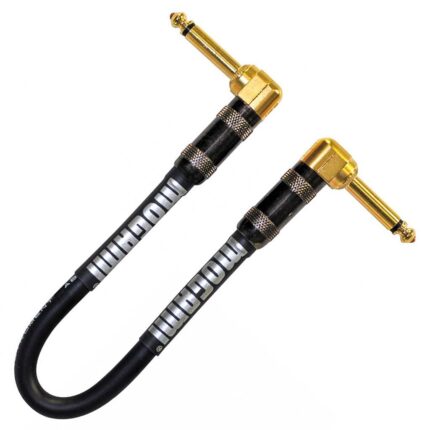
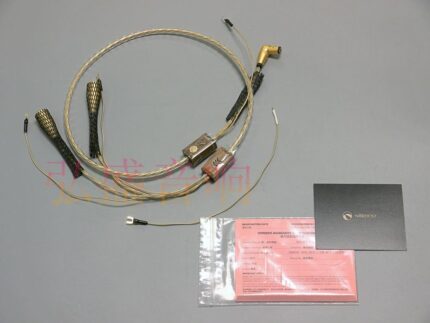
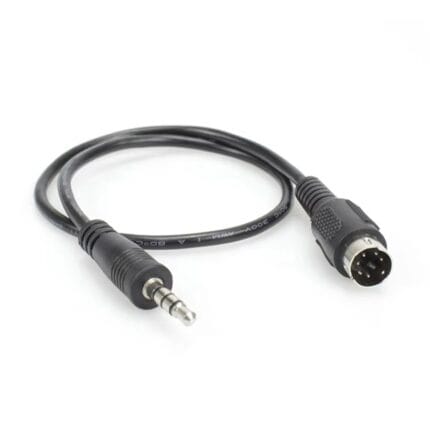
Turntable Tonearm Cable with DIN and Dual RCA Options
A turntable tonearm cable is the one link in a vinyl system where the wiring, the screening and the ground path are all audible. Built with DIN 5-pin or dual RCA ends, a separate ground spade and two shielding layers, to the pinout on your drawing. Send a photo of the back of the deck and we will match it.