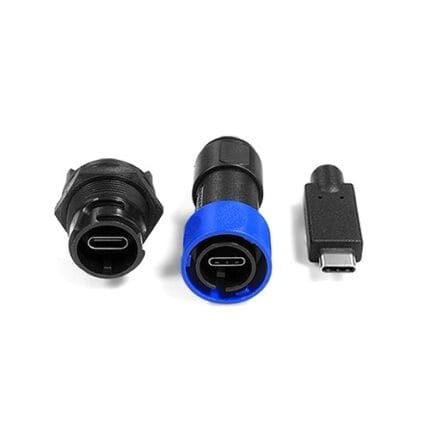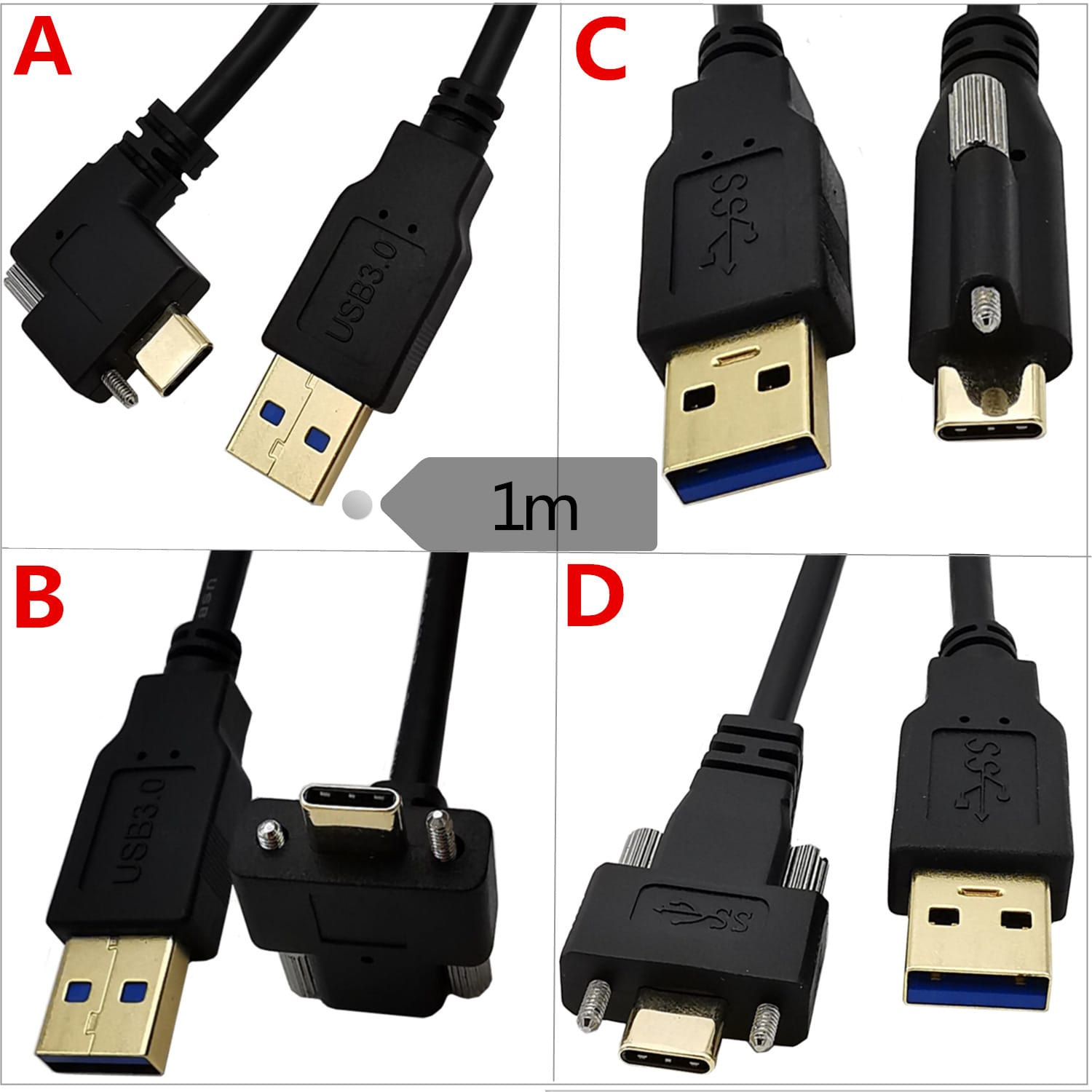
USB Type-C Latch-Lock Extension Cable (USB 3.1, 5 Gbps, Over-Molded Strain Relief, USB-IF Latch)
A type c latch lock cable is a USB 3.1 Gen1 extension whose latch is molded as one piece with the housing, so it cannot crack off. 5 Gbps, 360-degree shielding, over 50 N retention for vibrating machines.
Overview
A type c latch lock cable exists because the standard Type-C friction fit was designed for a phone on a desk, not for a camera on a moving gantry. A plain USB Type-C plug is held in by the spring force of the receptacle contacts alone, which is why it works fine in an office and works badly in a machine. This extension carries a positive latch on both ends, formed as part of the connector body during overmolding rather than glued or clipped on afterwards, so there is no separate piece to work loose. It seats with an audible click, holds against a pull well above what a friction fit manages, and still carries USB 3.1 Gen1 at 5 Gbps with 360-degree shielding and 100 percent shielded differential pairs.
Key Specifications
| Connector A | USB Type-C male with latch |
|---|---|
| Connector B | USB Type-C female with latch |
| Standard | USB 3.1 Gen1 (USB 3.2 Gen 1×1) |
| Data Rate | 5 Gbps |
| Lock | Positive latch formed in the overmold, one piece with the housing |
| Retention Force | >50 N (against 8-20 N for a standard friction fit) |
| Shielding | 360-degree EMI, 100 percent shielded differential pairs |
| Contact | Gold-plated |
| Strain Relief | Overmolded PVC |
| Jacket | Industrial PVC |
| Latch Geometry | Built to the USB-IF latch footprint |
How a friction fit comes out of a vibrating machine
Retention on a standard Type-C connection comes from contact spring force, and the retention window in the connector specification is deliberately low so that a user can unplug a phone with one hand. Put that joint on an end-of-arm tool, an inverter cabinet or a vehicle and three things happen.
- Fretting. Vibration produces micromotion at the contact interface. The plating wears, contact resistance climbs, and the link starts dropping frames before it drops out altogether.
- Ratchet walk-out. Oscillating load on a friction-held plug works it out of the receptacle a fraction of a millimeter at a time until the contacts part.
- Cable mass. The heavier the overmold and jacket, the more inertia hangs off the joint, and the faster the first two happen.
A latch converts the problem from one of friction to one of geometry: the plug is held by a mechanical feature, not by contact pressure, so vibration has nothing to ratchet against.
Latch, screw lock or friction fit?
These are three answers to the same question and they are not interchangeable. The right one depends on how often the joint is mated and how much room there is around it.
| Retention method | How it holds | Best for | Trade-off |
|---|---|---|---|
| Friction fit | Contact spring force only | Office and consumer gear, frequent mating by hand | Walks out under vibration; no positive indication of seating |
| Positive latch | A molded catch on the plug engages the receptacle | Vision cells, robotics, cabinets mated occasionally and never touched again | Needs a receptacle built to the same latch geometry |
| Screw lock | Thumbscrews clamp the plug to a panel or receptacle | Panel feedthroughs and permanent installs with room for hardware | Slower to mate; needs a cut-out and access for a driver |
| Sealed screw or bayonet | Threaded coupling with a gasket | Washdown, outdoor and food-processing equipment | Bulkiest option and the most expensive |
Where the port is on a panel wall rather than on a device, our USB-C Screw Locking Cable is usually the better fit. Where the environment is wet as well as vibrating, step up to IP67 Waterproof USB-C Screw Cable.
What the retention figure does and does not tell you
The pull-out figure quoted for this family is measured axially, straight back along the plug axis. That is the number in the datasheet and it is the number to compare between parts. It is not the number that describes a cable being snagged sideways, and it says nothing about how long the latch lasts after a thousand cycles. Two practical cautions follow from that.
- Specify retention and cycles together. A latch that holds hard but wears quickly is worse than one that holds adequately for the service life.
- Strain-relieve the cable regardless. No retention figure survives being used as a tie-down point. Anchor the harness within a short distance of the connector.
What is listed here for USB Type-C Latch-Lock builds is the industry-standard definition, not a measurement we took on a finished part. What your assembly is built and verified to is what your drawing states.
Shielding, and why the pigtail matters
At 5 Gbps the differential pairs are the least forgiving part of the assembly, and the usual cause of a marginal link is not the cable but the way the screen is terminated. A shield that stops at the overmold and is continued with a drain pigtail leaves an open window at exactly the frequency where it matters. This build terminates the braid 360 degrees into the connector shell, so the screen is continuous through the joint rather than routed around it. Keep the same rule in the installation: a shielded cable in an unshielded path is an unshielded cable.
Where a type c latch lock cable gets installed
- Machine vision camera links to a host PC in a cell that never stops shaking
- End-of-arm tooling and moving-axis harnesses on robots and gantries
- Inverter and combiner-box data links in renewable energy installations
- PLC cabinets, sensor lines and HMI panels in factory automation
- Commercial and industrial security, access control and surveillance enclosures
- Anywhere a USB 3.x link is currently held in with a cable tie or a dab of adhesive, where our Right-Angle USB Type-C Screw-Lock Cable may suit the clearance better
How to specify the build
- Ends required – male to female extension, or another combination.
- Data rate – USB 3.1 Gen1 at 5 Gbps, or USB 2.0 where that is enough.
- Length, measured along the route it will actually take.
- Whether the receptacle at the far end carries the matching latch geometry.
- Vibration and temperature the joint will see in service.
- Strain relief and jacket preference for the environment.
- Quantity, and whether this is a prototype or a production order.
Workmanship and testing
For USB Type-C Latch-Lock builds the line runs to IPC/WHMA-A-620 Class 3 under ISO 9001, terminating 32 to 12 AWG. Each USB unit passes a continuity and pinout check before it ships, and seal checking is quoted whenever an ingress rating is on the drawing.
RoHS and REACH declarations are provided per project together with the agreed test reports; the documentation scope is listed under certifications and compliance. If your drawing specifies a UL style, we build to that drawing and supply the UL reference with the shipment instead of substituting an equivalent. Overmold tooling for this part is designed and cut in our own tool room under the overmold tooling we build in-house, so the tool belongs to your program and a revision is a machining job rather than a new negotiation. More background: our build-to-print process.
Custom builds and ordering
USB Type-C Latch-Lock prototype lots start from 1 to 50 pcs and ship in 3 working days. Production requires 500 pcs and runs 14 working days after approval. Tooling not already held adds around 10 working days. Private-label USB runs ship under your part number and labeling, and material certificates and first-article reports can be supplied.
Related locking and screw-lock builds
- USB-C Screw Locking Cable, Side or Top 10Gbps
- USB4 Screw Lock Cable, 80Gbps Dual-Screw USB-C
- IP67 Waterproof USB-C Screw Cable, USB 3.2 Gen 2
- Circular USB-C Screw Cable with M12-Style Metal Shell
- Screw-Lock USB 3.0 Type-A Extension Cable
- IP69K Screw Lock Cable for RJ45 and M12
Full ranges: screw-lock molded cable and signal and data cables.
Frequently Asked Questions
Will the latch fit a normal Type-C receptacle?
The latch is built to the USB-IF latch footprint, so it engages a receptacle made to the same geometry. Against a plain friction receptacle it behaves like a normal plug. Check the receptacle on the device side before you rely on the retention.
Can the latch break off?
Not in the way a clipped-on part can. The latch is molded as one piece with the connector body, so there is no joint to fail and nothing to lose.
Does it still do USB 2.0 and charging?
Yes. The cable carries USB 3.1 Gen1 and is backward compatible with USB 2.0 and BC 1.2 charging.
How do I know it is seated?
The latch gives an audible and tactile click on full insertion. Train installers to listen for it rather than to push until it feels tight.
| Connector A | USB Type-C male with latch |
|---|---|
| Connector B | USB Type-C female with latch |
| Standard | USB 3.1 Gen1 (USB 3.2 Gen 1×1) |
| Data Rate | 5 Gbps |
| Lock | Positive latch formed in the overmold, one piece with the housing |
| Shielding | 360-degree EMI, 100 percent shielded differential pairs |
| Contact | Gold-plated |
| Strain Relief | Overmolded PVC |
| Jacket | Industrial PVC |
| Retention Force | >50 N (against 8-20 N for a standard friction fit) |
| Latch Geometry | Built to the USB-IF latch footprint |