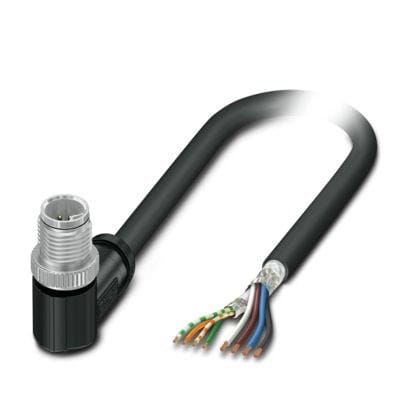
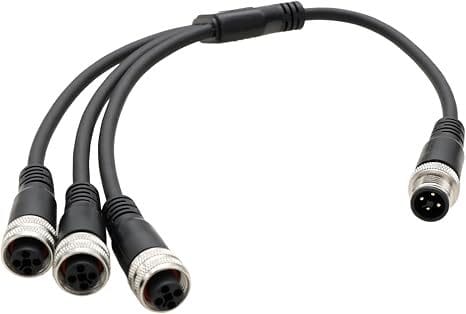
M12 T-Code Power Cable, 12 A / 60 V DC, 4-Pin, IP67
This m12 t-code power cable completes our M12 power family: the T-coded 4-pin layout carries 12 A at 60 V DC, the rating class that fieldbus power drops, DC drive feeds and PoDL powered devices specify.
Overview
This m12 t-code power cable completes our M12 power family: the T-coded 4-pin layout carries 12 A at 60 V DC, the rating class that fieldbus power drops, DC drive feeds and PoDL powered devices specify.
T-coding is the high-current member of the M12 power family: where L-coding carries 16 A class feeds, T-coding covers the 12 A / 60 V DC band used by fieldbus segment supplies, 24 V drive accessories and Single Pair Ethernet devices powered over the data line (PoDL). The distinctive keyway prevents accidental mating with signal or other power codings.
Key Specifications
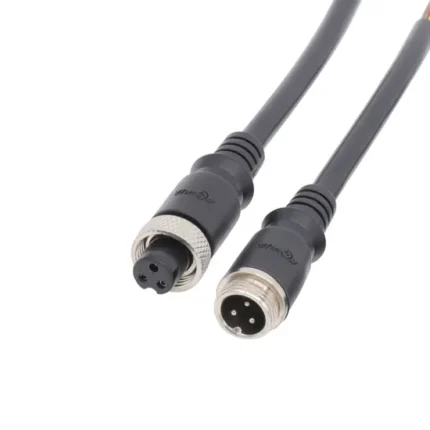
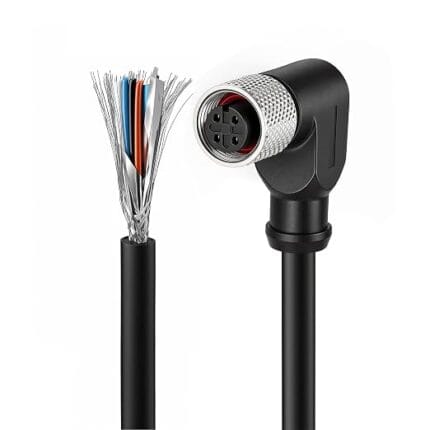
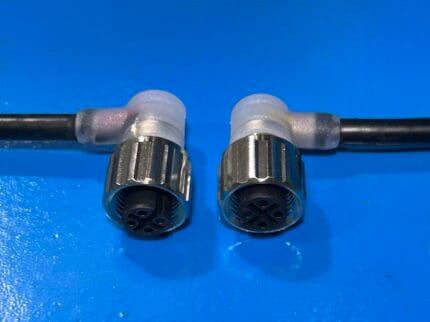
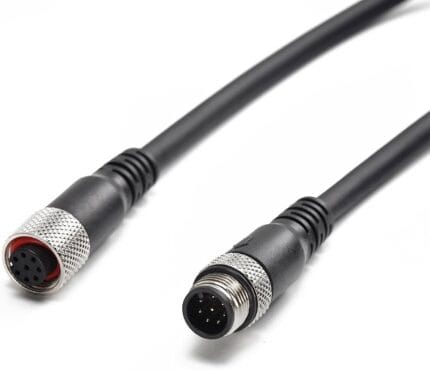
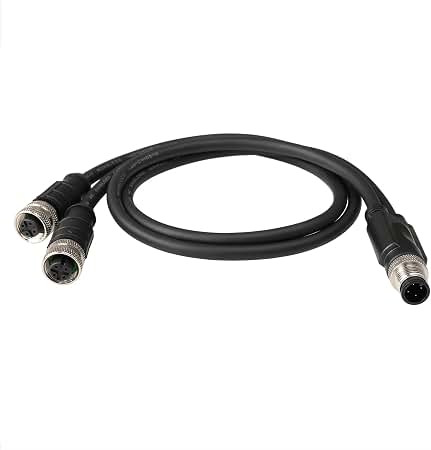
The table below lists the configuration shown in the product photo.
Where T-Code Sits Among the M12 Power Codings
The M12 family is not one connector, it is a keyed family, and the power side has grown several members. Published coding charts put L-coding at 63 V DC and 16 A on four-plus-FE contacts, T-coding at 60 to 63 V DC and 12 A on four contacts, K-coding and S-coding in the 630 V AC class at 12 to 16 A, and M-coding in the heavy-duty 630 V AC servo class. Which one belongs on your machine is decided by two things only: the voltage class of the supply and the current the load draws.
T-coding therefore occupies the compact DC power slot. It is the answer when a load is too hungry for a signal-coded connector but does not need the 16 A copper that L-coding implies, and it is physically smaller and cheaper than the 630 V AC codings because it does not have their creepage and clearance requirements.
Why DC Power Needs Its Own Keyway
The reason these codings exist at all is physical protection. A 24 V sensor port and a 60 V power port have identical threads and nearly identical shells; without separate keyways a technician working down a row of identical connectors can push a power plug into a signal socket. The result is usually instantaneous damage to the device and often a supply rail brought down for the whole segment.
Manufacturers solve it by rotating the insulator inside the shell and cutting the mating keyway to match, so each coding can only enter its own counterpart. The practical consequence for a buyer is simple: the coding letter is a safety feature, not a catalog option. Specifying T-code means specifying a port that cannot accept an A-coded plug, and that is usually worth more than any electrical difference.
Construction and Materials
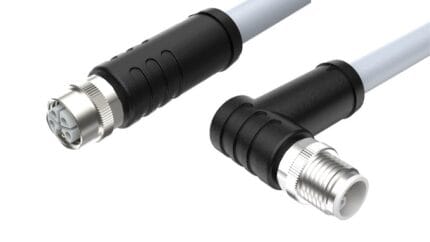
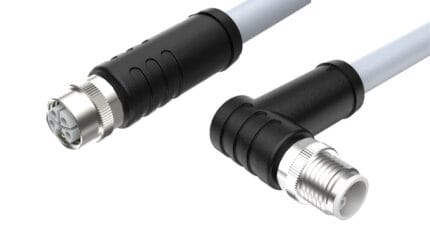
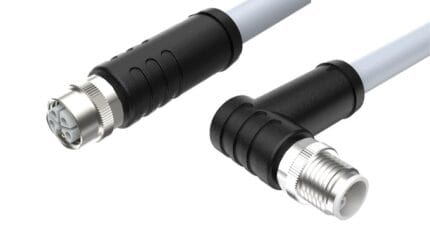
The connector is overmolded onto a round industrial jacket sized for power conductors, with the potting sealing the contact cavity and cable entry. The knurled metal coupling nut gives a vibration-resistant joint, and the T-coded insulator makes mis-mating with A, D or L-coded ports physically impossible.
Conductor cross-section is chosen for the 12 A class rather than the signal sizes used on A-coded cordsets, and the insulator is molded to the T-code keyway so the insert cannot be rotated into the wrong port. The potting closes the cable entry as well as the contact cavity.
Typical Applications
Deploy it on 24 V distribution drops from fieldbus power supplies, DC motor and actuator feeds inside machine cells, powered SPE endpoint connections, and any port specified as M12 T-coded where a sealed, screwed power joint is required.
Fieldbus segment supply is the classic use. Industrial networks that power several devices from one supply unit use exactly this class of connector on the feed, because the joint has to survive vibration and occasional washdown in a way a terminal block does not.
Small DC drives and motorised actuators form the second group. When a 24 V actuator sits out on the machine rather than in the cabinet, a sealed connector at the device removes a junction box, a gland and the labor that goes with both.
Single Pair Ethernet endpoints powered over the data pair round out the list: one connection delivering both the link and the supply, in a shell small enough to fit on a compact sensor head.
Conductor Size Decides the Real Current
The rating printed on a connector is measured at a defined conductor size and temperature, not for any cable you happen to attach. Put a thin signal-gauge jacket on a 12 A power feed and the connector will pass what is asked of it while the cable behind it heats.
That is why this build uses power-class conductors rather than the lighter cross-sections found on signal cordsets, and why the rating of a finished assembly deserves as much attention as the rating of its connector. Tell us the load current and the run length when you inquire and we will size the cores to suit.
Length, Derating and Voltage Drop
On a 24 V distribution drop the limiting factor is usually not current capacity but voltage drop. A modest current over a long run can put the receiving device below its minimum operating voltage, and the symptom — a device that resets under load and tests fine at the bench — is famously hard to trace.
Keep the drop short, size the cores generously, or both. If you tell us the run length and the load, we will check the drop before quoting rather than after commissioning.
Compatibility and Fitment
The keyway follows the T-coding used across standard M12 power ports, so the cordset mates with T-coded receptacles whatever the device brand. Confirm the supply voltage class on your segment before ordering; for 16 A class feeds see our L-code power range in the related categories below.
Send both ends of the circuit if the far side is not a T-coded port. Where one end is hard-wired into a terminal strip, a different connector family, or a device with its own captive lead, we build to that pair instead of inserting adapters into the run, because every adapter adds a failure point and rated contacts.
Installation and Handling Notes
Tighten the coupling nut by hand until it seats, then snug it. Overtightening with pliers deforms the seal rather than improving it, and a distorted seal is how IP67 becomes IP-nothing.
Support the cable within a short distance of the connector. Power conductors are heavier than signal ones, and their weight hanging off the joint puts sustained leverage on the point where the jacket enters the molding.
Custom Builds and Ordering
Lengths, gender combinations and conductor sizes are built to order. Send the power budget and device list and we will quote the matching cordset set. Prototype and sample lots run from 1 to 50 pieces and ship in 3 working days; production orders start at 500 pieces per part number and ship 14 working days after approval, with new overmold tooling adding about 10 working days.
Packaging and Shipping
Individually bagged with a dust cap over the mating face; bulk packaging with OEM labels is available.
Quality and Compliance
Every assembly is continuity tested across all contacts and inspected for full overmold fill before shipment. See the IEC M12 power connector standards for the governing interface specification.
RoHS and REACH declarations are provided per project together with the agreed test reports; the documentation scope is listed under certifications and compliance. If your drawing specifies a UL style, we build to that drawing and supply the UL reference with the shipment instead of substituting an equivalent. Sealing follows the insert, gasket and overmold-bond method described under waterproof sealing design and validation, so the rating comes from the joint design rather than from the connector datasheet alone. Related reading: our industrial automation work. Any tooling we cut for this part stays yours, maintained in our own tool room under your part reference.
Frequently Asked Questions
Can T-code be used in place of L-code? Only within the lower current band. If your segment calls for 16 A, use the L-coded build.
Will it mate with an A-coded port? No. The keyways differ, which is the point of coding.
Is it suitable for mains voltage? No. T-coding is a low-voltage DC class; AC mains lines belong on the K or S codings.
Do you check voltage drop? Yes. Give us load current and run length with the inquiry.
Related Cable Ranges
Browse the related ranges: Circular M-Series Cable Assemblies Signal and Data Cables Screw-Lock Molded Cable.
For the next step up in current see the M12 L-code right-angle power cable, and for signal-only drops the M12 A-code push-pull sensor cable.
| Coding | T-coded per IEC 61076-2-101 |
|---|---|
| Contacts | 4-pin |
| Rating | 12 A / 60 V DC |
| Ingress Rating | IP67 when mated |
| Application | Bus power, DC drives, PoDL devices |
| Coupling | M12 threaded, knurled nut |